
Online Database of Chemicals from Around the World
| Natural Micron Pharm Tech Co., Ltd. | China | |||
|---|---|---|---|---|
 | nmpharmtech.com | |||
 | +86 (0538) 535-2278 | |||
 | info@nmpharmtech.com | |||
| Chemical manufacturer since 2012 | ||||
| chemBlink Standard supplier since 2025 | ||||
| Classification | Organic raw materials >> Carboxylic compounds and derivatives >> Carboxylic esters and their derivatives |
|---|---|
| Name | Myristyl Nicotinate |
| Synonyms | tetradecyl pyridine-3-carboxylate |
| Molecular Structure | 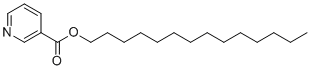 |
| Molecular Formula | C20H33NO2 |
| Molecular Weight | 319.48 |
| CAS Registry Number | 273203-62-6 |
| SMILES | CCCCCCCCCCCCCCOC(=O)C1=CN=CC=C1 |
| Density | 1.0±0.1 g/cm3 Calc.* |
|---|---|
| Boiling point | 411.7±18.0 °C 760 mmHg (Calc.)* |
| Flash point | 202.8±21.2 °C (Calc.)* |
| Index of refraction | 1.487 (Calc.)* |
| * | Calculated using Advanced Chemistry Development (ACD/Labs) Software. |
| Hazard Symbols |  GHS07 Warning Details GHS07 Warning Details |
|---|---|
| Risk Statements | H315-H319-H335 Details |
| Safety Statements | P261-P305+P351+P338 Details |
| SDS | Available |
 chemBlink Chemical Story
|
Myristyl nicotinate is an ester formed from nicotinic acid (vitamin B3) and myristyl alcohol, a 14-carbon saturated fatty alcohol. The compound is widely used in cosmetic and dermatological formulations for its skin-conditioning properties, enhanced penetration of active ingredients, and as a precursor to niacin in topical applications. By esterifying nicotinic acid with a long-chain alcohol, myristyl nicotinate exhibits increased lipophilicity, allowing better incorporation into oil-based or emulsion formulations and improved interaction with the lipid layers of the stratum corneum. The development of myristyl nicotinate is linked to research in vitamin delivery systems for the skin. Nicotinic acid itself is water-soluble and can cause vasodilation and flushing when applied topically or ingested in large amounts. By creating the myristyl ester, researchers produced a more lipophilic, less irritating form that can be metabolized enzymatically in the skin to release nicotinic acid gradually, providing the benefits of vitamin B3 without strong irritation. This strategy represents a broader approach in cosmetic chemistry, where esterification is used to enhance skin compatibility, stability, and delivery of active compounds. Chemically, myristyl nicotinate combines the pyridine ring of nicotinic acid with a linear C14 fatty chain. This structure confers amphiphilic properties: the nicotinate portion is polar and capable of hydrogen bonding, while the myristyl chain is hydrophobic and interacts with lipid membranes. In topical formulations, this dual character allows the molecule to penetrate the stratum corneum effectively and accumulate in skin lipids, where enzymatic hydrolysis releases nicotinic acid. The compound is typically stable under normal formulation and storage conditions and is compatible with a wide range of cosmetic ingredients, including emulsifiers, oils, and other vitamin derivatives. Applications of myristyl nicotinate in cosmetics are primarily focused on skin conditioning, anti-aging, and barrier support. Once hydrolyzed in the skin, nicotinic acid can stimulate microcirculation, enhance barrier repair, and modulate inflammatory pathways. The gradual release of nicotinic acid reduces the likelihood of irritation while providing the benefits of improved skin tone, hydration, and resilience. This has led to its incorporation into moisturizers, serums, creams, and anti-aging products targeted at sensitive or mature skin. In addition to cosmetic use, myristyl nicotinate has been studied in dermatological research for its potential to modulate keratinocyte and fibroblast activity, support skin barrier function, and enhance lipid metabolism in the epidermis. Its lipophilic nature allows it to serve as a delivery vehicle for other active compounds in topical formulations, improving overall bioavailability and efficacy of co-formulated ingredients. Safety studies indicate that myristyl nicotinate is well-tolerated in topical applications, with a low potential for irritation or sensitization. Its controlled enzymatic release of nicotinic acid makes it especially suitable for repeated use in cosmetic products intended for sensitive skin types. Overall, myristyl nicotinate represents a chemically modified vitamin derivative that exemplifies how esterification can enhance the performance, tolerability, and delivery of bioactive compounds in dermatological and cosmetic applications. Its combination of lipophilicity, stability, and gradual enzymatic conversion into nicotinic acid provides a practical approach to improving skin health and barrier function while minimizing irritation. References CAS# 273203-62-6|Myristyl Nicotinate|2022. Hydrolysis kinetics of the prodrug myristyl nicotinate. Pharmaceutical Development and Technology. DOI: 10.1080/10837450.2022.2152460 2016. Cosmetic Antiaging Ingredients. Textbook of Aging Skin. DOI: 10.1007/978-3-662-47398-6_99 2005. A pilot study evaluating the efficacy of topically applied niacin derivatives for treatment of female pattern alopecia. Journal of Cosmetic Dermatology. DOI: 10.1111/j.1473-2165.2005.00201.x |
| Market Analysis Reports |