
Online Database of Chemicals from Around the World
| Jiangsu Juming Chemical Technology Co., Ltd. | China | |||
|---|---|---|---|---|
 | en.jmchemchina.com | |||
 | +86 17798763151 | |||
 | admin@jumingchem.com | |||
| Chemical manufacturer since 2017 | ||||
| chemBlink Standard supplier since 2026 | ||||
| Classification | Organic raw materials >> Nitrile compound |
|---|---|
| Name | 4,6-Dibromo-2-fluoro-1,3-benzenediacetonitrile |
| Synonyms | 2-[4,6-dibromo-3-(cyanomethyl)-2-fluorophenyl]acetonitrile |
| Molecular Structure | 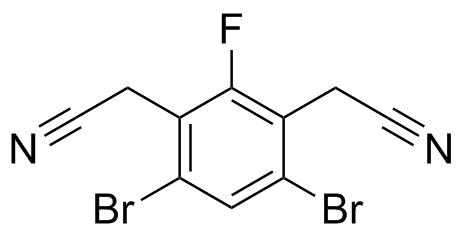 |
| Molecular Formula | C10H5Br2FN2 |
| Molecular Weight | 331.97 |
| CAS Registry Number | 2789616-13-1 |
| SMILES | C1=C(C(=C(C(=C1Br)CC#N)F)CC#N)Br |
| Hazard Symbols |  GHS07 Danger Details GHS07 Danger Details |
|---|---|
| Risk Statements | H301-H311-H331 Details |
| Safety Statements | P261-P264-P270-P271-P280-P302+P352-P304+P340-P310-P330-P361-P403+P233-P405-P501 Details |
| Transport Information | UN 3439 |
| SDS | Available |
 chemBlink Chemical Story
|
CAS 2789616-13-1 is 4,6-dibromo-2-fluoro-1,3-benzenediacetonitrile, also described as 2,2'-(4,6-dibromo-2-fluoro-1,3-phenylene)diacetonitrile. Its structure places two bromine atoms and one fluorine atom directly on an aromatic ring, while two -CH2-CN side chains occupy the remaining substituted positions. The result is a densely functionalized intermediate containing two different kinds of synthetic handles: aryl halides for cross-coupling and nitrile-bearing side chains for carbon-carbon and nitrogen chemistry. The brominated positions are natural candidates for palladium-catalyzed coupling. Aryl bromides can be transformed by Suzuki-Miyaura, Sonogashira, Buchwald-Hartwig and related reactions, allowing larger carbon or heteroatom substituents to be attached to the aromatic core. The aryl fluoride is generally less reactive in these coupling manifolds and can therefore remain as a persistent substituent. This difference in halogen reactivity is valuable when a chemist wants to elaborate a ring stepwise rather than change every position at once. The two acetonitrile groups provide a second dimension of reactivity. The methylene carbon next to a nitrile is more acidic than an ordinary alkane C-H bond because the nitrile helps stabilize the conjugate carbanion. After deprotonation under suitable conditions, such groups can participate in alkylation, condensation and other carbon-carbon bond-forming reactions. Nitriles can also be transformed into amides, carboxylic acids, amines and heterocycles. A molecule containing two of them can therefore serve as a precursor to more elaborate symmetric or unsymmetric architectures. Open literature for this exact CAS number is sparse. Commercial and database records confirm the identity, formula C10H5Br2FN2, molecular weight 331.97 and structural descriptors, but they do not establish one dominant final application. It would therefore be speculative to label the compound as a specific pharmaceutical or electronic-material intermediate without a documented synthetic route. Its chemistry is still worth telling because it illustrates how intermediates are designed. Rather than starting from an unreactive hydrocarbon skeleton, synthetic chemists often choose a molecule that already contains several differentiated points of entry. Here the C-Br bonds can extend the aromatic perimeter, the C-F bond can be retained as a property-modifying substituent, and the two -CH2-CN arms can be converted through an entirely different reaction family. CAS 2789616-13-1 is thus best viewed as a compact synthetic platform. Its value is not a famous end use but chemical optionality: several transformations are encoded in one small aromatic structure, allowing later chemists to choose which bonds to change and which to preserve. References: 1. ChemicalBook, CAS 2789616-13-1, identity and structure record. 2. Sigma-Aldrich / AA Blocks, 4,6-Dibromo-2-fluoro-1,3-benzenediacetonitrile product identity record. 3. Miyaura N, Suzuki A. Chem Rev. 1995;95:2457-2483. DOI: 10.1021/cr00039a007. |
| Market Analysis Reports |