
Online Database of Chemicals from Around the World
| Luminescence Technology Corp. | Taiwan | |||
|---|---|---|---|---|
 | www.lumtec.com.tw | |||
 | +886 (2) 2697-5600 | |||
 | +886 (2) 2697-5601 | |||
 | sales@lumtec.com.tw | |||
| Chemical manufacturer since 1999 | ||||
| chemBlink Standard supplier since 2024 | ||||
| Classification | Organic raw materials >> Organic phosphine compound |
|---|---|
| Name | (4-(3,6-Diphenyl-9H-carbazol-9-yl)butyl)phosphonic acid |
| Synonyms | Ph-4PACz |
| Molecular Structure | 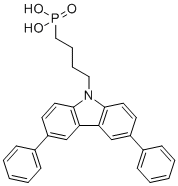 |
| Molecular Formula | C28H26NO3P |
| Molecular Weight | 455.48 |
| CAS Registry Number | 2814500-04-2 |
| SMILES | C1=CC=C(C=C1)C2=CC3=C(C=C2)N(C4=C3C=C(C=C4)C5=CC=CC=C5)CCCCP(=O)(O)O |
| Hazard Symbols |  GHS07 Warning Details GHS07 Warning Details | ||||||||||||
|---|---|---|---|---|---|---|---|---|---|---|---|---|---|
| Risk Statements | H315-H319 Details | ||||||||||||
| Safety Statements | P264-P280-P302+P352-P337+P313-P305+P351+P338-P362+P364-P332+P313 Details | ||||||||||||
| Hazard Classification | |||||||||||||
| |||||||||||||
| SDS | Available | ||||||||||||
 chemBlink Chemical Story
|
The compound (4-(3,6-diphenyl-9H-carbazol-9-yl)butyl)phosphonic acid is a synthetic molecule notable for its combination of a carbazole core and a phosphonic acid functional group. This design integrates the unique photophysical properties of carbazole derivatives with the binding versatility of phosphonic acid. Initially synthesized during investigations into organic light-emitting diode (OLED) materials, this compound demonstrates significant potential in optoelectronic applications, particularly as a hole-transporting material. The core carbazole structure, a tricyclic aromatic amine, is well-known for its electron-rich properties and stability under photoexcitation. Researchers focused on modifying the carbazole scaffold to enhance its photoluminescence and charge-transporting capabilities. Incorporating phenyl groups at the 3- and 6-positions of the carbazole increases its thermal stability and π-conjugation, making it suitable for use in high-performance electronic devices. The butyl linker terminating in a phosphonic acid group provides additional functionality, enabling strong adhesion to surfaces such as metal oxides. This structural versatility is ideal for integration into multi-layered optoelectronic devices. The compound's primary application lies in OLED technology, where it is used as a hole-transport layer (HTL) material. Its carbazole backbone facilitates efficient charge transfer, reducing recombination losses, while the phosphonic acid moiety improves interface adhesion between the HTL and adjacent layers. This enhances device efficiency and longevity, addressing key challenges in the development of durable and high-brightness OLED displays and lighting systems. Beyond OLEDs, (4-(3,6-diphenyl-9H-carbazol-9-yl)butyl)phosphonic acid has been investigated for use in photovoltaic systems, particularly dye-sensitized solar cells (DSSCs). In DSSCs, the compound can serve as a surface modifier for titanium dioxide electrodes, improving dye adsorption and electron transfer at the dye–electrode interface. These features contribute to increased energy conversion efficiency in solar cells. The compound also holds promise in photocatalysis, where its carbazole core can facilitate light absorption and electron transfer. The phosphonic acid group enhances its binding to catalytic surfaces, enabling its use in photocatalytic water splitting and pollutant degradation. In research contexts, (4-(3,6-diphenyl-9H-carbazol-9-yl)butyl)phosphonic acid is valued for its tunable optoelectronic properties. Studies have explored its potential in materials science, including its application in organic semiconductors and electrochemical sensors. This work highlights its versatility in advancing sustainable technologies and energy solutions. References 2024. Self-Assembled Monolayers as Hole-Selective Contacts in Inverted Perovskite Solar Cells: A Review. Korean Journal of Chemical Engineering. DOI: 10.1007/s11814-024-00335-7 2024. Regulating phase homogeneity by self-assembled molecules for enhanced efficiency and stability of inverted perovskite solar cells. Nature Photonics. DOI: 10.1038/s41566-024-01531-x |
| Market Analysis Reports |