
Online Database of Chemicals from Around the World
| Hubei Innerse Biotechnology Co., Ltd. | China | |||
|---|---|---|---|---|
 | www.innersebio.com | |||
 | +86 (027) 8818-9299 | |||
 | sales@innersebio.com | |||
 | QQ Chat | |||
| Chemical manufacturer since 2020 | ||||
| chemBlink Standard supplier since 2025 | ||||
| Shanghai Worldyang Chemical Co., Ltd. | China | |||
|---|---|---|---|---|
| www.worldyachem.com | |||
| +86 13651600618 +86 (21) 5679-5779 | |||
 | +86 (21) 5679-5266 | |||
| sales7777@worldyachem.com | |||
| QQ Chat | |||
 | WeChat: 13651600618 | |||
 | WhatsApp:+86 13651600618 | |||
| Chemical manufacturer since 2012 | ||||
| Name | 3,3'-Dioctadecyloxacarbocyanine perchlorate |
|---|---|
| Synonyms | 3-Octadecyl-2-[3-(3-octadecyl-2(3H)-benzoxazolylidene)-1-propen-1-yl]-benzoxazolium; diOC18(3)(1+) |
| Molecular Structure | 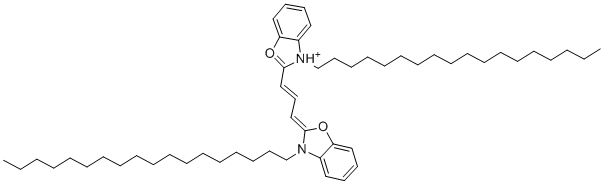 |
| Molecular Formula | C53H85N2O2 |
| Molecular Weight | 782.25 |
| CAS Registry Number | 28462-56-8 |
| SMILES | CCCCCCCCCCCCCCCCCC[n+]1c2ccccc2oc1/C=C/C=C3/N(c4ccccc4O3)CCCCCCCCCCCCCCCCCC |
 chemBlink Chemical Story
|
DiO belongs to the family of carbocyanine dyes, which were developed for their enhanced fluorescence and stability in biological environments. Chemically, DiO is a lipophilic dye characterized by its long alkyl chain (dioctadecyl) and carbocyanine structure, which enhances its affinity for lipid bilayers. The perchlorate form of DiO improves its solubility in organic solvents and facilitates its integration into lipid membranes. DiO exhibits strong fluorescence emission in the green spectral region (approximately 501 nm) when excited with light in the blue-green range (approximately 484 nm). This fluorescence property allows for sensitive and specific detection of labeled structures under fluorescence microscopy and flow cytometry. DiO is commonly used to label cell membranes in vitro and in vivo, providing researchers with clear visualization of cell boundaries and membrane dynamics. It helps track cell migration, adhesion, and interactions, aiding in the study of cell behavior and function. In neuroscience, DiO is used to trace neural pathways and visualize axonal projections in brain tissue. It helps researchers map neuronal connections and understand brain circuits. DiO is used to study vesicle trafficking and endocytic pathways within cells. It labels vesicles and organelles, enabling the study of cellular trafficking mechanisms. DiO is compatible with a variety of fluorescence microscopy techniques, including confocal microscopy, allowing for high-resolution imaging of labeled structures. It is also used in flow cytometry to analyze and sort cells based on membrane labeling intensity, facilitating quantitative cell analysis. DiO has several advantages for bioimaging: it is stable in aqueous solutions and biological media, remaining fluorescent during prolonged imaging; DiO can label a variety of cell types and tissues, making it suitable for a variety of biological applications; and it is compatible with other fluorescent dyes and biomolecular probes, allowing for multiplexed imaging studies. However, researchers should consider potential limitations, such as photobleaching and nonspecific binding, which can affect imaging quality and interpretation. Optimizing labeling conditions and controls can mitigate these issues. |
| Market Analysis Reports |