
Online Database of Chemicals from Around the World
| AAT Bioquest, Inc. | USA | |||
|---|---|---|---|---|
 | www.aatbio.com | |||
 | +1 (408) 733-1055 | |||
 | +1 (408) 733-1304 | |||
 | jack@aatbio.com | |||
| Chemical manufacturer since 2005 | ||||
| chemBlink Standard supplier since 2010 | ||||
| Chemodex Ltd. | Switzerland | |||
|---|---|---|---|---|
| www.chemodex.com | |||
| +41 (71) 244-4825 | |||
| +41 (71) 244-4826 | |||
| info@chemodex.com | |||
| Chemical manufacturer since 2001 | ||||
| chemBlink Standard supplier since 2018 | ||||
| Hubei Innerse Biotechnology Co., Ltd. | China | |||
|---|---|---|---|---|
| www.innersebio.com | |||
| +86 (027) 8818-9299 | |||
| sales@innersebio.com | |||
 | QQ Chat | |||
| Chemical manufacturer since 2020 | ||||
| chemBlink Standard supplier since 2025 | ||||
| Shanghai Worldyang Chemical Co., Ltd. | China | |||
|---|---|---|---|---|
| www.worldyachem.com | |||
| +86 13651600618 +86 (21) 5679-5779 | |||
| +86 (21) 5679-5266 | |||
| sales7777@worldyachem.com | |||
| QQ Chat | |||
 | WeChat: 13651600618 | |||
 | WhatsApp:+86 13651600618 | |||
| Chemical manufacturer since 2012 | ||||
| Classification | Organic raw materials >> Amino compound >> Amide compound |
|---|---|
| Name | 1,1'-Dioctadecyl-3,3,3',3'-tetramethylindocarbocyanine perchlorate |
| Synonyms | 2-[3-(3,3-dimethyl-1-octadecylindol-1-ium-2-yl)prop-2-enylidene]-3,3-dimethyl-1-octadecylindole;perchlorate |
| Molecular Structure | 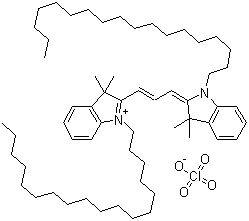 |
| Molecular Formula | C59H97N2.ClO4 |
| Molecular Weight | 933.87 |
| CAS Registry Number | 41085-99-8 |
| SMILES | CCCCCCCCCCCCCCCCCCN1C2=CC=CC=C2C(C1=CC=CC3=[N+](C4=CC=CC=C4C3(C)C)CCCCCCCCCCCCCCCCCC)(C)C.[O-]Cl(=O)(=O)=O |
| Solubility | Soluble (DMF, DMSO, methanol) |
|---|---|
| Melting point | 68 °C (dec.) |
| Hazard Symbols |  GHS07 Warning Details GHS07 Warning Details |
|---|---|
| Risk Statements | H315-H319-H335 Details |
| Safety Statements | P261-P280-P305+P351+P338-P304+P340-P405-P501 Details |
| SDS | Available |
 chemBlink Chemical Story
|
1,1'-Dioctadecyl-3,3,3',3'-tetramethylindocarbocyanine perchlorate, commonly known as DiI, is a highly fluorescent lipophilic dye that was developed in the 1970s during research into membrane probes and fluorescent dyes for cell studies. Its structure allows it to integrate into lipid bilayers and cell membranes, providing a powerful tool for observing and tracking cells and their components. DiI is a carbocyanine dye with a long octadecyl chain, which enhances its solubility in lipid environments. It appears as an orange-red crystalline powder. It emits strong fluorescence in the red spectrum when excited by green light (excitation/emission maxima: ~549/565 nm). DiI is widely used to label cell membranes, allowing researchers to track cell movement and interactions in real time. Its strong fluorescence and high affinity for lipid bilayers make it ideal for visualizing single cells in complex tissues. In neuroscience, DiI is used to trace neural pathways. It integrates into neuronal membranes and diffuses along axons and dendrites, allowing detailed mapping of neural circuits. DiI is used to label and track cells in developing embryos, providing insights into cell lineage, migration, and differentiation during organismal development. DiI is compatible with confocal and fluorescence microscopy, facilitating high-resolution imaging of cellular structures. Its bright fluorescence and photostability facilitate long-term imaging studies. DiI is used in super-resolution microscopy techniques such as STED and PALM, helping to visualize cellular components with nanoscale resolution, enhancing understanding of subcellular dynamics. DiI is used in flow cytometry to label and sort cells based on their fluorescence properties. It allows for the isolation of specific cell populations from heterogeneous mixtures. In apoptosis studies, DiI helps identify changes in cell membrane properties, providing information about the stages of cell death and the effects of various treatments. Used to study lipid interactions and membrane dynamics. Its ability to integrate into lipid bilayers provides insights into membrane structure, fluidity, and protein-lipid interactions. In drug delivery studies, DiI is used to study the behavior of lipid-based nanoparticles. Its fluorescence helps track the distribution and uptake of nanoparticles in biological systems. DiI is used in cancer research to visualize tumor cells and monitor their behavior in response to treatment. Its application in live cell imaging allows real-time observation of tumor cell dynamics. In stem cell research, DiI helps track stem cells during differentiation and transplantation studies. Its fluorescence provides a non-invasive method to monitor the fate of stem cells in vivo. |
| Market Analysis Reports |