
Online Database of Chemicals from Around the World
| Hangzhou StarShine Pharmaceutical Co., Ltd. | China | |||
|---|---|---|---|---|
 | www.starshinepharm.com | |||
 | +86 (571) 8512-3681 +86 13777804878 | |||
 | +86 (571) 8512-2157 | |||
 | sales@starshinepharm.com | |||
 | QQ Chat | |||
 | Skype Chat | |||
| Chemical manufacturer since 2007 | ||||
| chemBlink Standard supplier since 2008 | ||||
| ZHIYU Biotechnology Co., Ltd. | China | |||
|---|---|---|---|---|
| www.zhiyubiotech.com | |||
| +86 (512) 6279-1916 | |||
| +86 (512) 6279-1915 | |||
| sales@zhiyubiotech.com info@zhiyubiotech.com | |||
| QQ Chat | |||
| Chemical manufacturer since 2008 | ||||
| chemBlink Standard supplier since 2009 | ||||
| Hefei TNJ Chemical Industry Co., Ltd. | China | |||
|---|---|---|---|---|
| www.tnjchem.com | |||
| +86 (551) 6541-8684 | |||
| +86 (551) 6541-8697 | |||
| sales@tnjchem.com | |||
| Chemical manufacturer since 2001 | ||||
| chemBlink Standard supplier since 2010 | ||||
| BOC Sciences | USA | |||
|---|---|---|---|---|
| www.bocsci.com | |||
| +1 (631) 485-4226 | |||
| +1 (631) 614-7828 | |||
| info@bocsci.com | |||
| Chemical manufacturer | ||||
| chemBlink Standard supplier since 2010 | ||||
| Qingdao Kingway Pharmtech Co., Ltd. | China | |||
|---|---|---|---|---|
| www.kingwaypharm.com | |||
| +86 (532) 8711-8899 | |||
| +86 (532) 8411-7788 | |||
| sales@kingwaypharm.com kingwaypharm@hotmail.com | |||
| QQ Chat | |||
| Chemical manufacturer since 2012 | ||||
| chemBlink Standard supplier since 2013 | ||||
| Xuchang Chenhe Bio-pharmaceutical Tech. Co., Ltd. | China | |||
|---|---|---|---|---|
| www.the-chem.com | |||
| +86 (374) 579-3128 +86 15836530076 | |||
| +86 (374) 579-3128 | |||
| wxh5168@126.com wxh5168@163.com | |||
| QQ Chat | |||
| Chemical manufacturer since 2012 | ||||
| chemBlink Standard supplier since 2013 | ||||
| Shanghai Neosun Pharmaceutical Technology Co., Ltd. | China | |||
|---|---|---|---|---|
| www.neosunpharm.com | |||
| +86 (21) 2095-6531 +86 18116226605 +86 18939712385 | |||
| +86 (21) 2095-6532 | |||
| neosunpharm@163.com | |||
| QQ Chat | |||
| Chemical manufacturer since 2014 | ||||
| chemBlink Standard supplier since 2014 | ||||
| Hangzhou Leap Chem Co., Ltd. | China | |||
|---|---|---|---|---|
| www.leapchem.com | |||
| +86 (571) 8771-1850 | |||
| market19@leapchem.com | |||
| QQ Chat | |||
| Chemical manufacturer since 2006 | ||||
| chemBlink Standard supplier since 2015 | ||||
| Shanghai Rochi Pharmaceutical Co., Ltd. | China | |||
|---|---|---|---|---|
| www.rochipharma.com | |||
| +86 (21) 3875-1876 +86 15000076078 | |||
| +86 (21) 5027-5764 | |||
| info@rochipharma.com | |||
| QQ Chat | |||
| Chemical manufacturer since 2009 | ||||
| chemBlink Standard supplier since 2015 | ||||
| Hangzhou Cherry Pharmaceutical Technology Co., Ltd. | China | |||
|---|---|---|---|---|
| www.cherrypharmatech.com | |||
| +86 (571) 8163-6070 +86 18042403330 | |||
| +86 (571) 8163-6070 | |||
| info@cherrypharmatech.com | |||
| QQ Chat | |||
| Skype Chat | |||
| Chemical manufacturer since 2015 | ||||
| chemBlink Standard supplier since 2015 | ||||
| Amadis Chemical Co., Ltd. | China | |||
|---|---|---|---|---|
| www.amadischem.com | |||
| +86 (571) 8992-5085 | |||
| +86 (571) 8992-5065 | |||
| sales@amadischem.com | |||
| Chemical manufacturer since 2010 | ||||
| chemBlink Standard supplier since 2015 | ||||
| Coresyn Pharmatech Co., Ltd. | China | |||
|---|---|---|---|---|
| www.coresyn.com | |||
| +86 (571) 8662-6709 | |||
| sales@coresyn.com | |||
| Chemical manufacturer | ||||
| chemBlink Standard supplier since 2016 | ||||
| Lengshi Chemical (Qingzhou) Co., Ltd. | China | |||
|---|---|---|---|---|
| www.xinnuopharma.cn | |||
| +86 18615688656 | |||
| sales@xinnuopharma.com | |||
 | WeChat: 18615688656 | |||
| Chemical distributor since 2024 | ||||
| chemBlink Standard supplier since 2026 | ||||
| Classification | API >> Digestive system medication |
|---|---|
| Name | Netupitant |
| Synonyms | 2-[3,5-Bis(trifluoromethyl)phenyl]-N-[6-(4-methylpiperazin-1-yl)-4-(o-tolyl)pyridin-3-yl]-N-methylisobutyramide |
| Molecular Structure | 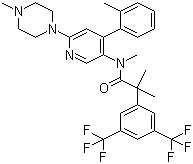 |
| Molecular Formula | C30H32F6N4O |
| Molecular Weight | 578.59 |
| CAS Registry Number | 290297-26-6 |
| SMILES | CC1=CC=CC=C1C2=CC(=NC=C2N(C)C(=O)C(C)(C)C3=CC(=CC(=C3)C(F)(F)F)C(F)(F)F)N4CCN(CC4)C |
| Density | 1.3±0.1 g/cm3 Calc.* |
|---|---|
| Boiling point | 597.4±50.0 °C 760 mmHg (Calc.)* |
| Flash point | 315.1±30.1 °C (Calc.)* |
| Solubility | 10 mM in DMSO (Expl.) |
| Index of refraction | 1.54 (Calc.)* |
| * | Calculated using Advanced Chemistry Development (ACD/Labs) Software. |
| Hazard Symbols |   GHS07;GHS08 Warning Details GHS07;GHS08 Warning Details |
|---|---|
| Risk Statements | H302-H315-H319-H361 Details |
| Safety Statements | P203-P264-P264+P265-P270-P280-P301+P317-P302+P352-P305+P351+P338-P318-P321-P330-P332+P317-P337+P317-P362+P364-P405-P501 Details |
| SDS | Available |
 chemBlink Chemical Story
|
Netupitant is a synthetic small-molecule drug belonging to the class of neurokinin-1 (NK1) receptor antagonists. It is used in combination with other antiemetic agents for the prevention of nausea and vomiting associated with chemotherapy. Its pharmacological activity is based on inhibition of substance P signaling in the central nervous system. The development of netupitant is part of a broader effort in medicinal chemistry to control chemotherapy-induced nausea and vomiting (CINV), a condition primarily mediated by multiple neurotransmitter systems, including serotonin (5-HT3) and substance P pathways. While earlier antiemetic drugs focused on serotonin receptor blockade, the identification of substance P as a key mediator of delayed emesis led to the development of NK1 receptor antagonists, including netupitant. Substance P is a neuropeptide belonging to the tachykinin family and acts primarily through the neurokinin-1 receptor, a G protein–coupled receptor widely distributed in the central and peripheral nervous systems. Activation of NK1 receptors in brain regions such as the area postrema and nucleus tractus solitarius is strongly associated with emetic signaling. By blocking these receptors, netupitant prevents substance P from initiating downstream signaling pathways involved in nausea and vomiting. Netupitant functions as a selective and high-affinity antagonist of the NK1 receptor. It binds to the receptor without activating it, thereby preventing endogenous substance P from exerting its biological effects. This competitive antagonism results in suppression of both acute and delayed phases of chemotherapy-induced emesis. Because substance P–mediated signaling is particularly important in delayed nausea and vomiting, NK1 antagonists provide a therapeutic advantage in this phase compared with older agents. In clinical use, netupitant is commonly administered in fixed-dose combinations with a serotonin 5-HT3 receptor antagonist and sometimes with a corticosteroid. This multi-target approach reflects the complex neurochemical pathways involved in emesis. By simultaneously inhibiting multiple signaling pathways, combination therapy provides more effective control of symptoms than single-agent regimens. From a chemical perspective, netupitant is a lipophilic, heteroaromatic compound designed to achieve high central nervous system penetration and prolonged receptor occupancy. Its structure includes multiple aromatic rings and heteroatoms that contribute to strong binding interactions within the NK1 receptor binding pocket. The molecular design emphasizes both affinity and long duration of action, which is important for covering the extended time course of delayed chemotherapy-induced nausea. Netupitant exhibits pharmacokinetic properties characterized by oral bioavailability and extensive tissue distribution. Its lipophilicity facilitates penetration across the blood–brain barrier, allowing it to reach central sites involved in emetic signaling. Metabolism occurs primarily in the liver, involving oxidative pathways mediated by cytochrome P450 enzymes, particularly CYP3A4. The long duration of action of netupitant is a key pharmacological feature, enabling single-dose administration in combination antiemetic regimens. This prolonged effect is associated with sustained occupancy of NK1 receptors, which helps maintain antiemetic protection over several days following chemotherapy administration. The discovery and optimization of NK1 receptor antagonists involved extensive structure–activity relationship studies aimed at improving receptor affinity, metabolic stability, and central nervous system availability. Netupitant represents a later-generation compound in this class, optimized for clinical efficacy and favorable pharmacokinetic properties. From a therapeutic standpoint, netupitant has contributed to significant improvements in supportive care for cancer patients undergoing emetogenic chemotherapy. By targeting a distinct neuropeptide pathway, it complements other antiemetic agents and reduces the incidence and severity of both acute and delayed nausea and vomiting. Overall, netupitant is a selective neurokinin-1 receptor antagonist that blocks substance P signaling in the central nervous system. Its significance lies in its role in modern antiemetic therapy, particularly in combination regimens for chemotherapy-induced nausea and vomiting, and in its contribution to improving quality of life in oncology care. References 2026. Bioequivalence of netupitant and palonosetron (NEPA) oral suspension and hard capsules in healthy individuals: results from an open-label, randomized, two-treatment, four-period, two-sequence replicative design trial. Supportive care in cancer : official journal of the Multinational Association of Supportive Care in Cancer. URL: https://www.ncbi.nlm.nih.gov/pmc/articles/PMC12864316 2026. Deciphering RNA and protein expression discordance identifies TOP2A as a prognostic biomarker and potential therapeutic target in lung adenocarcinoma. Discover Oncology. URL: https://www.ncbi.nlm.nih.gov/pmc/articles/PMC12852518 |
| Market Analysis Reports |