
Online Database of Chemicals from Around the World
| Hangzhou Verychem Science And Technology Co., Ltd. | China | |||
|---|---|---|---|---|
 | www.verychem.com | |||
 | +86 (571) 8816-2785 +86 13606544505 | |||
 | +86 (571) 8816-2787 | |||
 | lucy@verychem.com | |||
| Chemical manufacturer since 2004 | ||||
| chemBlink Massive supplier since 2021 | ||||
| HBCChem, Inc. | USA | |||
|---|---|---|---|---|
| www.hbcchem-inc.com | |||
| +1 (510) 219-6317 | |||
| +1 (510) 675-0318 | |||
| sales@hbcchem-inc.com | |||
| Chemical manufacturer | ||||
| chemBlink Standard supplier since 2008 | ||||
| Jilin Optical and Electronic Materials Co., Ltd. | China | |||
|---|---|---|---|---|
| www.jl-oled.com | |||
| +86 (431) 8583-4771 | |||
| +86 (431) 8583-4772 | |||
| sales1@jl-oled.com | |||
| Chemical manufacturer since 2005 | ||||
| chemBlink Standard supplier since 2010 | ||||
| BOC Sciences | USA | |||
|---|---|---|---|---|
| www.bocsci.com | |||
| +1 (631) 485-4226 | |||
| +1 (631) 614-7828 | |||
| info@bocsci.com | |||
| Chemical manufacturer | ||||
| chemBlink Standard supplier since 2010 | ||||
| Intatrade Chemicals GmbH | Germany | |||
|---|---|---|---|---|
| www.intatrade.de | |||
| +49 (3493) 605-465 | |||
| +49 (3493) 605-470 | |||
| sales@intatrade.de | |||
| Chemical distributor | ||||
| chemBlink Standard supplier since 2011 | ||||
| Beijing Guofang Dingsheng Technology Co., Ltd. | China | |||
|---|---|---|---|---|
| www.gfdschem.com | |||
| +86 (10) 8904-9254 5909-2859 +86 18610472091 +86 18031679351 | |||
| +86 (10) 5909-2859 | |||
| gfdskj@163.com | |||
 | QQ Chat | |||
| Chemical manufacturer since 2012 | ||||
| chemBlink Standard supplier since 2016 | ||||
| Anvia Chemicals, LLC | USA | |||
|---|---|---|---|---|
| www.anviachem.com | |||
| +1 (414) 534-7845 | |||
| +1 (414) 762-5539 | |||
| sales@anviachem.com | |||
| Chemical manufacturer | ||||
| Classification | Chemical reagent >> Organic reagent >> Cyanate ester / isocyanate |
|---|---|
| Name | 2,3,5,6-Tetrafluoro-7,7,8,8-tetracyanoquinodimethane |
| Synonyms | 7,7,8,8-Tetracyano-2,3,5,6-tetrafluoroquinodimethane; F4-TCNQ |
| Molecular Structure | 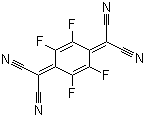 |
| Molecular Formula | C12F4N4 |
| Molecular Weight | 276.15 |
| CAS Registry Number | 29261-33-4 |
| EC Number | 624-300-1 |
| SMILES | C(#N)C(=C1C(=C(C(=C(C#N)C#N)C(=C1F)F)F)F)C#N |
| Density | 1.6±0.1 g/cm3, Calc.* |
|---|---|
| Melting point | 285-290 °C (Expl.) |
| Index of Refraction | 1.522, Calc.* |
| Boiling Point | -89.6±40.0 °C (760 mmHg), Calc.* |
| Flash Point | -100.4±27.3 °C, Calc.* |
| * | Calculated using Advanced Chemistry Development (ACD/Labs) Software. |
| Hazard Symbols |  GHS06 Danger Details GHS06 Danger Details | ||||||||||||||||||||||||||||||||
|---|---|---|---|---|---|---|---|---|---|---|---|---|---|---|---|---|---|---|---|---|---|---|---|---|---|---|---|---|---|---|---|---|---|
| Risk Statements | H301-H311-H331 Details | ||||||||||||||||||||||||||||||||
| Safety Statements | P261-P262-P264-P270-P271-P280-P301+P316-P302+P352-P304+P340-P316-P321-P330-P361+P364-P403+P233-P405-P501 Details | ||||||||||||||||||||||||||||||||
| Hazard Classification | |||||||||||||||||||||||||||||||||
| |||||||||||||||||||||||||||||||||
| SDS | Available | ||||||||||||||||||||||||||||||||
 chemBlink Chemical Story
|
2,3,5,6-Tetrafluoro-7,7,8,8-tetracyanoquinodimethane (TFQDM) is an organic compound with the chemical formula C10H2F4N4. It is a derivative of quinodimethane, a class of compounds characterized by a central quinone structure with additional substituents. In TFQDM, the quinodimethane core is substituted with four fluorine atoms and two cyano groups at specific positions on the aromatic ring. The discovery of TFQDM is rooted in the ongoing development of materials with unique electronic properties, particularly in the field of organic semiconductors and charge transfer materials. Quinodimethane derivatives have been studied extensively for their potential in electronic and optoelectronic applications. The addition of electron-withdrawing groups such as fluorine and cyano enhances the stability, electron affinity, and electronic properties of the molecule, making it an attractive candidate for various technological uses. TFQDM is primarily known for its use in the field of organic electronics. The presence of electron-withdrawing groups, particularly the cyano and fluorine substituents, makes the compound highly reactive and capable of engaging in charge transfer processes. As a result, TFQDM has found applications in the development of organic semiconductors, which are key components in devices such as organic light-emitting diodes (OLEDs), organic photovoltaics (OPVs), and organic field-effect transistors (OFETs). In organic photovoltaics, TFQDM is used as an electron acceptor material. The high electron affinity of TFQDM allows it to effectively accept electrons from donor materials, which is crucial in the formation of charge-separated states in photovoltaic cells. This property is beneficial for enhancing the efficiency of OPVs, as efficient electron transport is a key factor in optimizing the performance of these devices. Another important application of TFQDM is in the design of charge transfer complexes and materials for high-performance organic electronics. The compound's ability to interact with donor molecules and form charge transfer complexes has led to its use in the development of materials with improved electronic properties. These materials are particularly useful in the construction of organic semiconducting layers, which are essential for the function of various organic electronic devices. Additionally, TFQDM's unique structure has made it a subject of interest in research exploring new materials for energy storage and other electronic applications. The compound's ability to undergo reversible charge transfer processes makes it a potential candidate for use in batteries and supercapacitors, although its primary applications have remained focused on organic electronics. In conclusion, 2,3,5,6-Tetrafluoro-7,7,8,8-tetracyanoquinodimethane is a compound of significant interest in the fields of organic electronics and materials science. Its unique combination of electron-withdrawing groups, such as fluorine and cyano, provides it with useful properties for applications in organic semiconductors, charge transfer materials, and energy-related technologies. TFQDM's role in improving the performance of organic photovoltaics and other organic electronic devices highlights its value as a functional material in advanced technological applications. References 2022. Surface Passivation and Energetic Modification Suppress Nonradiative Recombination in Perovskite Solar Cells. Nano-Micro Letters, 14(1). DOI: 10.1007/s40820-022-00854-0 2022. Efficient p-doping of P3HT for hole transporting materials in perovskite solar cells. Rare Metals, 41(8). DOI: 10.1007/s12598-022-01982-7 2023. The role of molecular oxygen (O2) and UV light in the anion radical formation and stability of TCNQ and its fluorinated derivatives. Journal of Analytical Science and Technology, 14(1). DOI: 10.1186/s40543-022-00364-z |
| Market Analysis Reports |