
Online Database of Chemicals from Around the World
| Zhejiang Metallurgical Research Institute Co., Ltd. | China | |||
|---|---|---|---|---|
 | www.pgmcatalyst.com | |||
 | +86 (571) 8817-8133 +86 (578) 814-5985 | |||
 | +86 (578) 814-5986 | |||
 | xk@pgmcatalyst.com scm@pgmcatalyst.com ylq@pgmcatalyst.com | |||
| Chemical manufacturer since 1958 | ||||
| chemBlink Standard supplier since 2008 | ||||
| Sinocompound Catalysts Co., Ltd. | China | |||
|---|---|---|---|---|
| www.sinocompound.com | |||
| +86 (512) 6721-6630 | |||
| +86 (512) 5631-6689 | |||
| sales@sinocompound.com | |||
| Chemical manufacturer since 2008 | ||||
| chemBlink Standard supplier since 2010 | ||||
| Baoji Rock Pharmachem Co., Ltd. | China | |||
|---|---|---|---|---|
| www.bjrock.com | |||
| +86 (10) 8487-1070 8487-1071 8487-1072 | |||
| +86 (10) 8487-1078 | |||
| bjrock@163.com | |||
| Chemical manufacturer since 2003 | ||||
| chemBlink Standard supplier since 2010 | ||||
| BOC Sciences | USA | |||
|---|---|---|---|---|
| www.bocsci.com | |||
| +1 (631) 485-4226 | |||
| +1 (631) 614-7828 | |||
| info@bocsci.com | |||
| Chemical manufacturer | ||||
| chemBlink Standard supplier since 2010 | ||||
| Lanzhou Jinchuan Technology Park Co., Ltd. | China | |||
|---|---|---|---|---|
| www.jnmc.com | |||
| +86 (931) 524-6046 | |||
| +86 (931) 524-6048 | |||
| liangbin@jnmc.com jnmcpdpt@sina.com.cn | |||
| Chemical manufacturer | ||||
| chemBlink Standard supplier since 2011 | ||||
| Auspai Pty Lty | Australia | |||
|---|---|---|---|---|
| www.auspai.com.au | |||
| +61 (426) 886-972 | |||
| frankquy@gmail.com | |||
| Chemical distributor since 2013 | ||||
| chemBlink Standard supplier since 2013 | ||||
| HetCat - Heterocycles & Catalysts | Switzerland | |||
|---|---|---|---|---|
| www.hetcat.com | |||
| +41 (61) 363-9868 | |||
| +41 (61) 363-9869 | |||
| fallahpour@hetcat.com | |||
| Chemical manufacturer | ||||
| Anvia Chemicals, LLC | USA | |||
|---|---|---|---|---|
| www.anviachem.com | |||
| +1 (414) 534-7845 | |||
| +1 (414) 762-5539 | |||
| sales@anviachem.com | |||
| Chemical manufacturer | ||||
| MCAT GmbH | Germany | |||
|---|---|---|---|---|
| www.mcat.de | |||
| +49 (7531) 939-097 | |||
| +49 (7531) 939-098 | |||
| info@mcat.de | |||
| Chemical manufacturer | ||||
| Shanghai Worldyang Chemical Co., Ltd. | China | |||
|---|---|---|---|---|
| www.worldyachem.com | |||
| +86 13651600618 +86 (21) 5679-5779 | |||
| +86 (21) 5679-5266 | |||
| sales7777@worldyachem.com | |||
 | QQ Chat | |||
 | WeChat: 13651600618 | |||
 | WhatsApp:+86 13651600618 | |||
| Chemical manufacturer since 2012 | ||||
| Wako Pure Chemical Industries, Ltd. | Japan | |||
|---|---|---|---|---|
| www.wako-chem.co.jp | |||
| +81 (6) 6203-3741 | |||
| +81 (6) 6201-5964 | |||
| wkhk.info@fujifilm.com | |||
| Chemical manufacturer since 1922 | ||||
| Strem Chemicals, Inc. | USA | |||
|---|---|---|---|---|
| www.strem.com | |||
| +1 (978) 499-1600 | |||
| +1 (978) 465-3104 | |||
| info@strem.com | |||
| Chemical manufacturer | ||||
| Classification | Organic raw materials >> Organometallic compound >> Organic palladium |
|---|---|
| Name | Dichlorobis(tricyclohexylphosphine)palladium(II) |
| Synonyms | PdCl2[P(cy)3]2 |
| Molecular Structure | 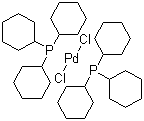 |
| Molecular Formula | C36H66Cl2P2Pd |
| Molecular Weight | 738.18 |
| CAS Registry Number | 29934-17-6 |
| EC Number | 681-696-9 |
| SMILES | C1CCC(CC1)P(C2CCCCC2)C3CCCCC3.C1CCC(CC1)P(C2CCCCC2)C3CCCCC3.Cl[Pd]Cl |
| Melting point | 270 °C (Decomposes) (Expl.) |
|---|---|
| Hazard Symbols |  GHS07 Warning Details GHS07 Warning Details | ||||||||
|---|---|---|---|---|---|---|---|---|---|
| Risk Statements | H302-H315-H319-H332-H335-H413 Details | ||||||||
| Safety Statements | P261-P264-P264+P265-P270-P271-P273-P280-P301+P317-P302+P352-P304+P340-P305+P351+P338-P317-P319-P321-P330-P332+P317-P337+P317-P362+P364-P403+P233-P405-P501 Details | ||||||||
| Hazard Classification | |||||||||
| |||||||||
| SDS | Available | ||||||||
 chemBlink Chemical Story
|
Dichlorobis(tricyclohexylphosphine)palladium(II), commonly abbreviated as PdCl2(PCy3)2, is a square planar palladium(II) complex widely used as a homogeneous catalyst in organometallic chemistry, particularly in cross-coupling reactions. It features a palladium center coordinated by two chloride ligands and two bulky tricyclohexylphosphine ligands. This compound belongs to the class of palladium(II) complexes with two monodentate phosphine ligands and is notable for its high activity and stability in various catalytic processes. The compound is typically synthesized by treating palladium(II) chloride (PdCl2) with tricyclohexylphosphine (PCy3) in a suitable solvent such as dichloromethane or tetrahydrofuran under inert atmosphere. The resulting yellow to orange solid is air-stable and soluble in organic solvents, which makes it practical for use in laboratory and industrial-scale syntheses. The steric bulk and strong electron-donating nature of tricyclohexylphosphine enhance the reactivity and stability of the palladium center, contributing to its catalytic performance. Dichlorobis(tricyclohexylphosphine)palladium(II) is best known for its application as a precatalyst in palladium-catalyzed cross-coupling reactions, including Suzuki–Miyaura, Stille, Heck, and Sonogashira couplings. In these reactions, the Pd(II) complex is typically reduced in situ to a Pd(0) species, which is the catalytically active form that enters the catalytic cycle. The bulky phosphine ligands help to stabilize the Pd(0) species and can influence both the rate and selectivity of the reaction by modulating the electronic and steric environment around the metal center. In Suzuki–Miyaura cross-coupling, for instance, the catalyst facilitates the formation of biaryl compounds through the coupling of aryl halides with arylboronic acids. The presence of bulky tricyclohexylphosphine ligands helps suppress side reactions such as β-hydride elimination and homocoupling, improving product yield and purity. In the Stille reaction, it is used to couple organotin reagents with aryl or vinyl halides, and in the Sonogashira reaction, it enables the coupling of terminal alkynes with aryl or vinyl halides under mild conditions. Beyond cross-coupling, PdCl2(PCy3)2 has also been investigated for applications in carbonylation reactions, reductive aminations, and allylic substitutions. Its robustness and versatility make it suitable for use in both academic research and fine chemical or pharmaceutical production. Structurally, the complex adopts a square planar geometry typical of d8 Pd(II) species. The steric hindrance provided by the tricyclohexylphosphine ligands contributes to high selectivity in catalytic processes by influencing substrate orientation and access to the palladium center. The complex is usually handled under an inert atmosphere to avoid ligand dissociation or oxidation of the phosphine groups, though it is relatively stable to air and moisture in the solid state. Safety considerations for handling PdCl2(PCy3)2 include the standard precautions for palladium compounds and phosphines. It should be handled in a well-ventilated fume hood with appropriate personal protective equipment. Disposal must follow local regulations for transition metal waste and organophosphine compounds. In summary, dichlorobis(tricyclohexylphosphine)palladium(II) is a well-defined palladium(II) complex widely employed as a precatalyst in organic synthesis. Its high efficiency, air-stability, and compatibility with a wide range of substrates make it a valuable tool in modern organometallic and synthetic chemistry. References 2024. Overcoming Difficulties in Total Synthesis of (+)-Cotylenin A. Modern Natural Product Synthesis. DOI: 10.1007/978-981-97-1619-7_11 2021. Identifying palladium culprits in amine catalysis. Nature Catalysis, 4(12). DOI: 10.1038/s41929-021-00710-1 2019. Synthesis of corannulene-based nanographenes. Communications Chemistry, 2(1). DOI: 10.1038/s42004-019-0160-1 |
| Market Analysis Reports |