
Online Database of Chemicals from Around the World
| Guangzhou Wanqian Pharmaceutical Technology Co., Ltd. | China | |||
|---|---|---|---|---|
 | www.wqpharma.cn | |||
 | +86 13928768873 | |||
 | sales@wqpharma.cn | |||
 | QQ Chat | |||
 | WeChat: 13928768873 | |||
| Chemical distributor since 2013 | ||||
| chemBlink Standard supplier since 2026 | ||||
| Classification | Biological >> Proteins and peptides >> Enzyme and activity assay |
|---|---|
| Name | Orforglipron impurity 22 |
| Synonyms | ert-butyl (6S)-5-cyano-4-hydroxy-6-methyl-3,6-dihydro-2H-pyridine-1-carboxylate |
| Molecular Structure | 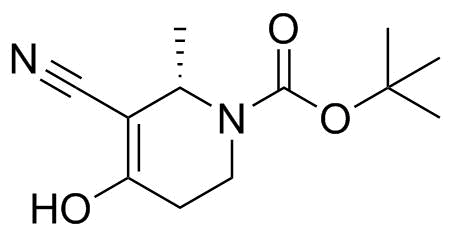 |
| Molecular Formula | C12H18N2O3 |
| Molecular Weight | 238.28 |
| CAS Registry Number | 3047293-07-9 |
| SMILES | C[C@H]1C(=C(CCN1C(=O)OC(C)(C)C)O)C#N |
 chemBlink Chemical Story
|
Orforglipron impurity 22 refers to a process-related or degradation-related impurity associated with the synthetic manufacture of orforglipron, a small-molecule glucagon-like peptide-1 receptor (GLP-1R) agonist. In pharmaceutical development, numbered impurities such as “impurity 22” are typically defined within a specific manufacturer’s impurity profiling system and correspond to a structurally characterized or partially characterized byproduct observed during synthesis, purification, or stability testing of the active pharmaceutical ingredient. In general, impurities in complex small-molecule drug substances like orforglipron arise from incomplete reactions, side reactions, reagent-derived byproducts, or structural rearrangements during multistep synthetic sequences. Because orforglipron contains a densely functionalized heteroaromatic scaffold with multiple ring-forming steps, fluorinated aromatic groups, and heterocyclic coupling motifs, its synthesis typically involves several intermediates where side reactions can produce structurally related analogs. Impurity 22 is not a universally standardized chemical entity in the public domain; rather, it is a designation used within a specific analytical or regulatory context, such as process development, quality control, or regulatory submission documentation. In such systems, impurities are assigned numerical identifiers after being detected and characterized using analytical techniques such as high-performance liquid chromatography, liquid chromatography–mass spectrometry, and nuclear magnetic resonance spectroscopy. The exact structural identity of impurity 22 is therefore defined by the controlling manufacturer’s impurity mapping for orforglipron. In pharmaceutical impurity profiling, related substances are commonly grouped based on their origin. Process-related impurities may include unreacted starting materials, partially constructed intermediates, or over-alkylated or under-oxidized analogs. Degradation-related impurities may form under stress conditions such as heat, oxidation, hydrolysis, or photolysis. Given the presence of multiple heteroaromatic rings and carbonyl-containing functional groups in orforglipron, potential degradation pathways may involve oxidation of heterocycles, cleavage of labile linkages, or rearrangements of substituted aromatic systems, depending on stability conditions. The identification and control of impurities like impurity 22 are critical in pharmaceutical development because regulatory standards require that drug substances meet strict purity criteria. Each impurity above a specified threshold must be identified, characterized, and controlled to ensure safety and consistency of the final product. Structural elucidation typically involves mass spectral fragmentation analysis combined with NMR interpretation and comparison to synthetic reference standards when available. From a chemical standpoint, impurities related to complex heterocyclic drugs often share similar core scaffolds with the parent compound but differ in substitution pattern, oxidation state, or ring connectivity. These small structural differences can arise from competing reaction pathways during key bond-forming steps. In fluorinated aromatic systems, for example, side reactions can involve alternative substitution patterns or incomplete coupling at activated positions. In heterocycle-forming steps, regioisomeric products may also form depending on reaction conditions and catalysts used. Because orforglipron is a highly engineered small molecule designed to interact with a G protein–coupled receptor, even minor structural modifications can significantly alter binding affinity or physicochemical properties. For this reason, impurity profiling is an essential component of its development and quality control strategy. Each impurity, including impurity 22, is evaluated for its presence, formation pathway, and potential removal through process optimization or purification. Without a publicly disclosed structural assignment, impurity 22 should be understood strictly as a labeled component within an analytical impurity profile rather than a universally defined chemical substance. Its identity is specific to the manufacturing and analytical context in which it is reported, and it is typically documented in internal development reports or regulatory submissions rather than general chemical literature. Overall, orforglipron impurity 22 is a process-designated impurity associated with the synthesis or stability profile of orforglipron, defined within a specific impurity numbering system. It represents a structurally related byproduct identified through analytical characterization during pharmaceutical development, and its significance lies in quality control, process optimization, and regulatory compliance rather than as a standalone widely defined chemical entity. References 2025. Process to make GLP1 RA and intermediates therefor. US-12365682-B2. URL: https://patents.google.com/patent/US12365682B2 2022. Process to make glp1 ra and intermediates therefor. WO-2024137426-A1. URL: https://patents.google.com/patent/WO2024137426A1 |
| Market Analysis Reports |