
Online Database of Chemicals from Around the World
| Guangzhou Wanqian Pharmaceutical Technology Co., Ltd. | China | |||
|---|---|---|---|---|
 | www.wqpharma.cn | |||
 | +86 13928768873 | |||
 | sales@wqpharma.cn | |||
 | QQ Chat | |||
 | WeChat: 13928768873 | |||
| Chemical distributor since 2013 | ||||
| chemBlink Standard supplier since 2026 | ||||
| Classification | Pharmaceutical intermediate >> Heterocyclic compound intermediate |
|---|---|
| Name | Orforglipron hemicalcium hydrate |
| Synonyms | 3-((1S,2S)-1-(5-((S)-2,2-Dimethyltetrahydro-2H-pyran-4-yl)-2-((S)-3-(3-(4-fluoro-1-methyl-1H-indazol-5-yl)-2-oxo-2,3-dihydro-1H-imidazol-1-yl)-2-(4-fluoro-3,5-dimethylphenyl)-4-methyl-4,5,6,7-tetrahydro-2H-pyrazolo[4,3-c]pyridine-5-carbonyl)-1H-indol-1-yl)-2-methylcyclopropyl)-1,2,4-oxadiazol-5(4H)-one calcium salt hydrate (2:1:2) |
| Molecular Structure | 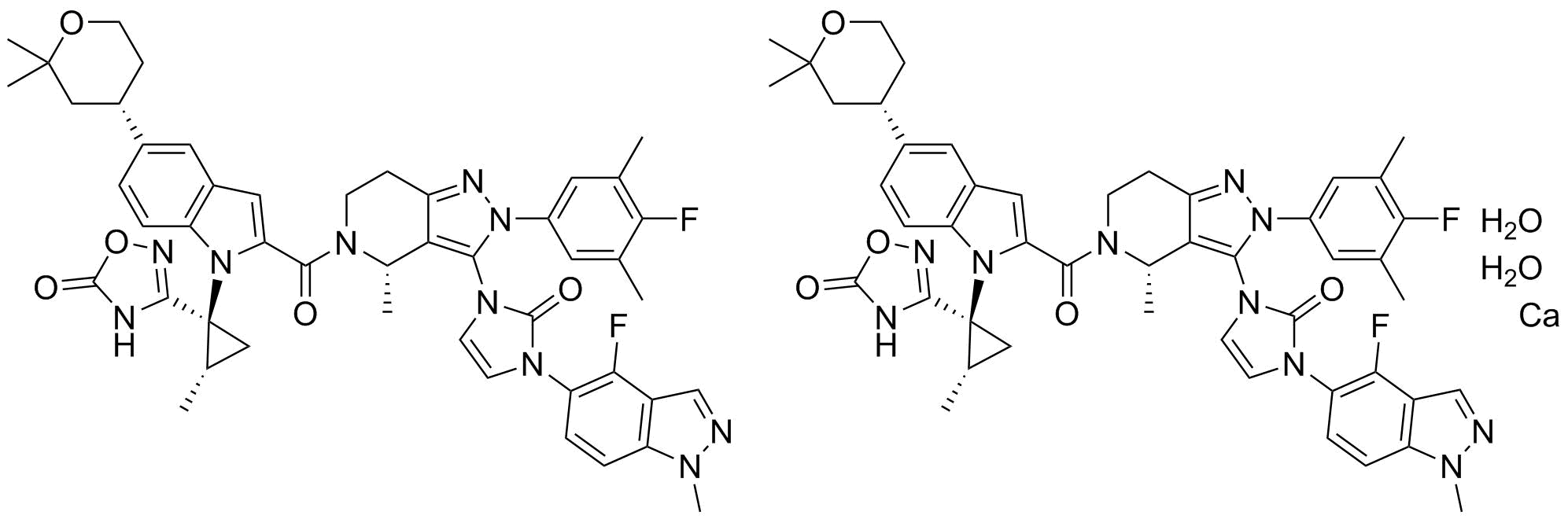 |
| Molecular Formula | C96H100CaF4N20O12 |
| Molecular Weight | 1842.02 |
| CAS Registry Number | 3008544-96-2 |
| SMILES | C[C@H]1C[C@]1(C2=NOC(=O)N2)N3C4=C(C=C(C=C4)[C@H]5CCOC(C5)(C)C)C=C3C(=O)N6CCC7=NN(C(=C7[C@@H]6C)N8C=CN(C8=O)C9=C(C1=C(C=C9)N(N=C1)C)F)C1=CC(=C(C(=C1)C)F)C.C[C@H]1C[C@]1(C2=NOC(=O)N2)N3C4=C(C=C(C=C4)[C@H]5CCOC(C5)(C)C)C=C3C(=O)N6CCC7=NN(C(=C7[C@@H]6C)N8C=CN(C8=O)C9=C(C1=C(C=C9)N(N=C1)C)F)C1=CC(=C(C(=C1)C)F)C.O.O.[Ca] |
| Hazard Symbols |  GHS07 Warning Details GHS07 Warning Details |
|---|---|
| Risk Statements | H302-H315-H319 Details |
| Safety Statements | P501-P270-P264-P280-P302+P352-P337+P313-P305+P351+P338-P362+P364-P332+P313-P301+P312+P330 Details |
 chemBlink Chemical Story
|
Orforglipron is a synthetic small-molecule compound developed as a non-peptide agonist of the glucagon-like peptide-1 receptor (GLP-1R). It was discovered through medicinal chemistry efforts aimed at identifying orally bioavailable alternatives to peptide-based GLP-1 receptor agonists, which traditionally require injection due to poor stability and absorption in the gastrointestinal tract. The compound was identified during research programs focused on metabolic disease therapeutics, particularly those targeting glucose regulation and energy balance. The discovery of orforglipron is part of a broader effort in pharmaceutical chemistry to develop small-molecule modulators of class B G protein–coupled receptors (GPCRs), a receptor family that includes GLP-1R. Historically, GLP-1 receptor agonists were primarily peptide analogs of the endogenous incretin hormone glucagon-like peptide-1. While effective, these peptide drugs generally exhibit limited oral bioavailability due to enzymatic degradation and poor membrane permeability. The development of non-peptide agonists such as orforglipron represents a major structural and pharmacological shift, enabling oral administration while maintaining receptor activity. Orforglipron contains a complex polycyclic heteroaromatic structure featuring multiple fused ring systems, including indole-like and pyrazole-containing motifs, as well as additional heterocycles and substituted aromatic rings. The molecule includes fluorinated aromatic substituents and several carbonyl-containing functional groups, which contribute to its electronic distribution and binding characteristics. The rigid three-dimensional arrangement created by its fused ring system is an important feature of its molecular recognition properties. The compound was developed using structure-based and high-throughput screening approaches to identify small molecules capable of interacting with the GLP-1 receptor binding site. Unlike endogenous GLP-1, which is a peptide that engages a large extracellular binding domain, small-molecule agonists must interact with alternative receptor regions or induce conformational changes that activate downstream signaling. Orforglipron represents one of the first orally active non-peptide molecules reported to function as a GLP-1 receptor agonist in clinical development. The hemicalcium hydrate form of orforglipron refers to a solid-state pharmaceutical form in which calcium ions and water molecules are incorporated into the crystalline structure. Such forms are commonly used in drug development to optimize properties such as crystallinity, stability, solubility, and manufacturability. The presence of calcium and water does not alter the identity of the active molecule but affects how the compound is organized in the solid phase. Hydrate formation can influence parameters such as melting behavior and hygroscopicity, which are relevant for formulation and storage. From a physicochemical perspective, orforglipron contains both hydrophobic and polar structural regions. Multiple aromatic rings and fluorinated substituents contribute to lipophilicity, while heteroatoms such as nitrogen and oxygen provide hydrogen-bonding capability and polarity. Carbonyl groups and heterocyclic nitrogen atoms can act as hydrogen bond acceptors, which are important for intermolecular interactions within the receptor binding environment. The fluorinated groups also influence electron distribution and metabolic stability due to the strong electronegativity and bond strength of carbon–fluorine bonds. The compound contains multiple stereochemical elements, and its three-dimensional configuration is important for biological activity. The spatial arrangement of its ring systems contributes to its ability to interact with the GLP-1 receptor and stabilize active receptor conformations associated with intracellular signaling pathways. In application, orforglipron has been investigated in clinical research programs for metabolic disorders, particularly type 2 diabetes mellitus and obesity. These conditions are associated with impaired glucose regulation and energy homeostasis. GLP-1 receptor activation is known to enhance glucose-dependent insulin secretion, suppress glucagon release, and influence appetite regulation through central and peripheral mechanisms. Orforglipron was designed to replicate these pharmacological effects through a non-peptide, orally administered small molecule format. The development of orforglipron represents a significant example of advancing small-molecule GPCR pharmacology, particularly in achieving oral activity for receptors traditionally targeted by peptide therapeutics. Its chemical design reflects modern medicinal chemistry strategies that integrate heterocyclic scaffolds, fluorination, and conformational rigidity to achieve receptor selectivity and pharmacokinetic suitability. Overall, orforglipron is a synthetic non-peptide GLP-1 receptor agonist discovered through medicinal chemistry optimization of small-molecule scaffolds for metabolic disease treatment. Its hemicalcium hydrate form is a pharmaceutical solid-state modification used to improve formulation properties, while the active molecule itself represents a structurally complex heteroaromatic system designed for oral receptor activation in glucose and energy regulation pathways. References 2025. Process to make GLP1 RA and intermediates therefor. US-12365682-B2 Grant Date: 2025-07-22. URL: https://patents.google.com/patent/US12365682B2 |
| Market Analysis Reports |