
Online Database of Chemicals from Around the World
| Hangzhou Verychem Science And Technology Co., Ltd. | China | |||
|---|---|---|---|---|
 | www.verychem.com | |||
 | +86 (571) 8816-2785 +86 13606544505 | |||
 | +86 (571) 8816-2787 | |||
 | lucy@verychem.com | |||
| Chemical manufacturer since 2004 | ||||
| chemBlink Massive supplier since 2021 | ||||
| BOC Sciences | USA | |||
|---|---|---|---|---|
| www.bocsci.com | |||
| +1 (631) 485-4226 | |||
| +1 (631) 614-7828 | |||
| info@bocsci.com | |||
| Chemical manufacturer | ||||
| chemBlink Standard supplier since 2010 | ||||
| Jinan Rouse Industry Co., Ltd. | China | |||
|---|---|---|---|---|
| www.rousechem.com | |||
| +86 (531) 8313-0512 | |||
| +86 (531) 8313-0512 | |||
| candice@rousechem.com | |||
 | QQ Chat | |||
| Chemical manufacturer since 2014 | ||||
| chemBlink Standard supplier since 2014 | ||||
| Hangzhou Leap Chem Co., Ltd. | China | |||
|---|---|---|---|---|
| www.leapchem.com | |||
| +86 (571) 8771-1850 | |||
| market19@leapchem.com | |||
| QQ Chat | |||
| Chemical manufacturer since 2006 | ||||
| chemBlink Standard supplier since 2015 | ||||
| Pure Synmr Ingredients Limited | China | |||
|---|---|---|---|---|
| www.synmr.com | |||
| +86 (21) 6045-7587 ex 806 | |||
| sven@puresynmr.com | |||
| Chemical manufacturer since 2014 | ||||
| chemBlink Standard supplier since 2017 | ||||
| Shanghai Cosroma Biotech Co., LTD | China | |||
|---|---|---|---|---|
| www.cosroma.com | |||
| +86-21-31125890 | |||
| +86-21-31125890 | |||
| info@cosroma.com | |||
| Chemical manufacturer since 2017 | ||||
| chemBlink Standard supplier since 2021 | ||||
| Beri Pharma Co., Ltd. | China | |||
|---|---|---|---|---|
| www.zhberi.com | |||
| +86 19500796935 | |||
| elena@zhberi.com | |||
 | Skype Chat | |||
 | WeChat: 19500796925 | |||
 | WhatsApp:+8619500796925 | |||
| Chemical manufacturer since 2015 | ||||
| chemBlink Standard supplier since 2024 | ||||
| Classification | Biochemical >> Peptide |
|---|---|
| Name | S-Acetylglutathione |
| Synonyms | 5-[[3-acetylsulfanyl-1-(carboxymethylamino)-1-oxopropan-2-yl]amino]-2-amino-5-oxopentanoic acid |
| Molecular Structure | 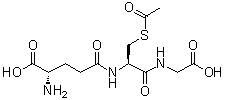 |
| Molecular Formula | C12H19N3O7S |
| Molecular Weight | 349.36 |
| Protein Sequence | XXG |
| CAS Registry Number | 3054-47-5 |
| EC Number | 221-275-5 |
| SMILES | CC(=O)SCC(C(=O)NCC(=O)O)NC(=O)CCC(C(=O)O)N |
| Solubility | Freely soluble (130 g/L) (25 °C), Calc.* |
|---|---|
| Density | 1.436±0.06 g/cm3 (20 °C 760 Torr), Calc.* |
| Index of Refraction | 1.567, Calc.* |
| Boiling Point | 770.2±60.0 °C (760 mmHg), Calc.* |
| Flash Point | 419.6±32.9 °C, Calc.* |
| * | Calculated using Advanced Chemistry Development (ACD/Labs) Software. |
| Hazard Symbols |  GHS07 Warning Details GHS07 Warning Details |
|---|---|
| Risk Statements | H302 Details |
| Safety Statements | 3054-47-5 Details |
| SDS | Available |
 chemBlink Chemical Story
|
S-Acetyl Glutathione (SAG) is a derivative of glutathione, a key antioxidant found in all living cells. This modification involves attaching an acetyl group to the sulfur atom of a cysteine residue in glutathione, which enhances its stability and bioavailability. The discovery of S-Acetyl Glutathione has led to a wide range of applications in medicine, nutrition, and health supplements. The discovery of S-Acetyl Glutathione stemmed from the need to develop a more stable and effective form of glutathione. Glutathione itself is made up of three amino acids (glutamine, cysteine, and glycine) and is a very effective antioxidant, but it breaks down rapidly in the digestive system after oral administration. Researchers sought a derivative that could withstand this breakdown and be more effectively absorbed by the body, leading to the development of S-Acetyl Glutathione. The chemical formula of S-Acetyl Glutathione is C12H19N3O7S and its molecular weight is 349.36 g/mol. Acetylation of glutathione increases its lipophilicity, allowing it to more easily cross cell membranes. This modification protects the sulfhydryl group of cysteine from oxidation, ensuring that the compound remains intact until it reaches the target cell. The primary application of S-acetyl glutathione is as a premium form of glutathione supplement. Its increased stability and bioavailability make it more effective at replenishing intracellular glutathione levels compared to regular glutathione supplements. This is particularly beneficial in situations where oxidative stress is a significant factor, such as chronic inflammation, autoimmune disease, and aging. Glutathione is essential for the liver's detoxification processes, binding to toxins to make them more soluble in water and easier to excrete. S-acetyl glutathione supplementation supports these detoxification pathways and promotes overall liver health and function. Glutathione plays a key role in regulating immune responses. It helps maintain a balance between pro-inflammatory and anti-inflammatory cytokines, supporting a strong and controlled immune response. S-acetyl glutathione can enhance immune function, making it valuable in managing conditions such as chronic infections, autoimmune diseases, and general immune support. Studies have shown that glutathione can inhibit the replication of certain viruses, including influenza and herpes simplex. S-Acetyl Glutathione may have antiviral effects and help control viral infections by increasing intracellular glutathione levels. Glutathione is known for its skin-lightening properties by inhibiting melanin synthesis. S-Acetyl Glutathione has a high absorption rate, making it more effective in achieving and maintaining an even skin tone. It is often included in cosmetics and skincare regimens to reduce pigmentation and make the skin brighter. Oxidative stress is a major factor in the aging process. By increasing glutathione levels, S-Acetyl Glutathione helps protect cells from oxidative damage, reducing signs of aging such as wrinkles, fine lines, and loss of skin elasticity. It also supports cellular health and longevity, promoting overall vitality and youthfulness. Glutathione is essential for brain health, protecting neurons from oxidative damage and supporting mitochondrial function. S-Acetyl Glutathione crosses the blood-brain barrier more effectively than regular glutathione, providing neuroprotective effects. It is being studied for its potential in treating neurodegenerative diseases such as Parkinson's and Alzheimer's. Maintaining optimal glutathione levels is essential for cognitive function. S-Acetyl Glutathione supplementation can enhance mental clarity, memory, and overall cognition, making it a valuable addition to nootropics and brain health supplements. The future of S-Acetyl Glutathione research lies in further elucidating its mechanism of action, optimizing its delivery methods, and exploring its potential in various therapeutic settings. Ongoing studies are aimed at better understanding its benefits in chronic disease, aging, and overall health maintenance. References 2004. S-Acetylglutathione normalizes intracellular glutathione content in cultured fibroblasts from patients with glutathione synthetase deficiency. Journal of Inherited Metabolic Disease, 27(6). DOI: 10.1023/b:boli.0000045838.65498.ff 2003. Effects of S-acetylglutathione in cell and animal model of herpes simplex virus type 1 infection. Medical Microbiology and Immunology, 192(3). DOI: 10.1007/s00430-003-0212-z 2002. S-acetyl-glutathione selectively induces apoptosis in human lymphoma cells through a GSH-independent mechanism. International Journal of Oncology, 20(1). DOI: 10.3892/ijo.20.1.69 |
| Market Analysis Reports |