
Online Database of Chemicals from Around the World
| Nanjing Search Biotech Co., Ltd. | China | |||
|---|---|---|---|---|
 | www.searchbio.com.cn | |||
 | +86 (25) 8168-2922 8586-0978 +86 18913919581 | |||
 | +86 (25) 8586-0962 | |||
 | trade@searchbio.com.cn sales@searchbio.com.cn Linda@searchbio.com.cn | |||
 | QQ Chat | |||
| Chemical manufacturer since 2007 | ||||
| chemBlink Standard supplier since 2007 | ||||
| Discovery Fine Chemicals Ltd. | UK | |||
|---|---|---|---|---|
| www.discofinechem.com | |||
| +44 (1202) 874-517 | |||
| +44 (845) 094-4385 | |||
| pjc@discofinechem.com | |||
| Chemical manufacturer | ||||
| chemBlink Standard supplier since 2009 | ||||
| Hefei TNJ Chemical Industry Co., Ltd. | China | |||
|---|---|---|---|---|
| www.tnjchem.com | |||
| +86 (551) 6541-8684 | |||
| +86 (551) 6541-8697 | |||
| sales@tnjchem.com | |||
| Chemical manufacturer since 2001 | ||||
| chemBlink Standard supplier since 2010 | ||||
| BOC Sciences | USA | |||
|---|---|---|---|---|
| www.bocsci.com | |||
| +1 (631) 485-4226 | |||
| +1 (631) 614-7828 | |||
| info@bocsci.com | |||
| Chemical manufacturer | ||||
| chemBlink Standard supplier since 2010 | ||||
| Hangzhou Leap Chem Co., Ltd. | China | |||
|---|---|---|---|---|
| www.leapchem.com | |||
| +86 (571) 8771-1850 | |||
| market19@leapchem.com | |||
| QQ Chat | |||
| Chemical manufacturer since 2006 | ||||
| chemBlink Standard supplier since 2015 | ||||
| Hunan Yunbang Biomedical Co., Ltd. | China | |||
|---|---|---|---|---|
| www.hunanyunbang.com | |||
| +86 (731) 8552-5705 +86 13319518603 | |||
| +86 (731) 8552-5705 | |||
| ivy@hnhbsj.com | |||
| QQ Chat | |||
 | Skype Chat | |||
| Chemical manufacturer since 2014 | ||||
| chemBlink Standard supplier since 2019 | ||||
| HuNan Huibaiyi New Materials Co; Ltd. | China | |||
|---|---|---|---|---|
| www.hbsjxcl.com | |||
| +86 13319523173 | |||
| ivy@hnhbsj.com | |||
| QQ Chat | |||
 | WeChat: 13319523173 | |||
| Chemical manufacturer since 2014 | ||||
| chemBlink Standard supplier since 2026 | ||||
| Chemos GmbH & Co. KG | Germany | |||
|---|---|---|---|---|
| www.chemos.de | |||
| +49 871-966346-0 | |||
| +49 871-966346-13 | |||
| chemos@chemos.de | |||
| Chemical distributor | ||||
| Indofine Chemical Company, Inc. | USA | |||
|---|---|---|---|---|
| www.indofinechemical.com | |||
| +1 (888) 463-6346 | |||
| +1 (908) 359-1179 | |||
| info@indofinechemical.com | |||
| Chemical manufacturer since 1981 | ||||
| Ivy Fine Chemicals | USA | |||
|---|---|---|---|---|
| www.ivychem.com | |||
| +1 (856) 465-8550 | |||
| +1 (856) 616-1161 | |||
| sales@ivychem.com | |||
| Chemical manufacturer | ||||
| BioVectra, Inc. | Canada | |||
|---|---|---|---|---|
| www.biovectra.com | |||
| +1 (902) 566-9116 (866) 883-2872 | |||
| +1 (902) 628-2045 | |||
| info@biovectra.com | |||
| Chemical manufacturer since 1970 | ||||
| Apollo Scientific Ltd. | UK | |||
|---|---|---|---|---|
| www.apolloscientific.co.uk | |||
| +44 (161) 406-0505 | |||
| +44 (161) 406-0506 | |||
| sales@apolloscientific.co.uk | |||
| Chemical manufacturer | ||||
| AK Scientific, Inc | USA | |||
|---|---|---|---|---|
| www.aksci.com | |||
| +1 (510) 429-8835 | |||
| +1 (510) 429-8836 | |||
| sales@aksci.com | |||
| Chemical manufacturer | ||||
| Classification | Organic raw materials >> Carboxylic compounds and derivatives >> Halogenation, sulfonation, nitration or nitrosation of carboxylic acids |
|---|---|
| Name | Diammonium 2,2'-azino-bis(3-ethylbenzothiazoline-6-sulfonate) |
| Synonyms | ABTS diammonium salt; 2,2'-Azino-bis(3-ethylbenzothiazoline-6-sulfonic acid) diammonium salt |
| Molecular Structure | 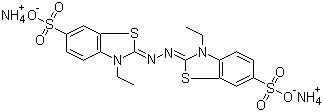 |
| Molecular Formula | C18H16N4O6S4.2(NH4) |
| Molecular Weight | 548.68 |
| CAS Registry Number | 30931-67-0 |
| EC Number | 250-396-6 |
| SMILES | CCN1/C(=N/N=C/2SC3=C(N2CC)C=CC(=C3)S(=O)(=O)O)/SC4=C1C=CC(=C4)S(=O)(=O)O.N.N |
| Melting point | 250 (Decomposes) °C (Expl.) |
|---|---|
| Solubility | H2O: 50 mg/mL (Expl.) |
| Hazard Symbols |  GHS07 Warning Details GHS07 Warning Details | ||||||||||||||||||||
|---|---|---|---|---|---|---|---|---|---|---|---|---|---|---|---|---|---|---|---|---|---|
| Risk Statements | H315-H319-H335 Details | ||||||||||||||||||||
| Safety Statements | P261-P305+P351+P338 Details | ||||||||||||||||||||
| Hazard Classification | |||||||||||||||||||||
| |||||||||||||||||||||
| SDS | Available | ||||||||||||||||||||
 chemBlink Chemical Story
|
Diammonium 2,2′-azino-bis(3-ethylbenzothiazoline-6-sulfonate), commonly known as ABTS diammonium salt, is a synthetic aromatic heterocyclic compound widely used as a chromogenic and redox indicator in biochemical and analytical applications. The molecule consists of two benzothiazoline-derived units linked through an azo-type nitrogen bridge and contains sulfonate groups balanced by ammonium counterions. Its structure combines extended conjugation, ionic functionality, and redox-active properties. The central feature of the molecule is the azino linkage connecting two identical aromatic heterocyclic units. This linkage joins two benzothiazoline-derived systems through nitrogen atoms and forms part of an extended conjugated electronic network. The conjugated system allows electron delocalization over a large portion of the molecule, which strongly influences its optical and redox behavior. Each half of the molecule contains a benzothiazoline framework. Benzothiazole-related structures consist of a benzene ring fused to a five-membered heterocyclic ring containing both sulfur and nitrogen atoms. Fusion of these rings creates a rigid aromatic system with extensive electron delocalization. The heteroatoms modify electron distribution and contribute to the molecule's redox properties. The aromatic units each contain an ethyl substituent at the 3-position. Ethyl groups are relatively nonpolar hydrocarbon substituents that contribute minor hydrophobic character and influence steric properties without substantially changing the electronic structure of the conjugated core. A particularly important feature is the presence of sulfonate groups (–SO3−) at the 6-position of each aromatic unit. Sulfonate groups are strongly acidic functionalities that typically remain ionized under most conditions. These groups contribute substantial hydrophilicity and provide the molecule with negative charge. Because two sulfonate groups are present, the molecule exists as a dianionic species. The diammonium form contains two ammonium cations (NH4+) serving as counterions to balance the negative charges of the sulfonate groups. These ammonium ions participate mainly through ionic interactions and usually dissociate in aqueous solution. Their presence improves handling and contributes to the water-soluble character of the compound. From a structural perspective, ABTS contains both highly polar and aromatic regions. The aromatic benzothiazoline-derived systems contribute rigidity and extended π-electron delocalization, while the sulfonate groups introduce strong ionic character. The result is a molecule that is highly compatible with aqueous environments despite possessing a substantial aromatic framework. The most significant chemical characteristic of ABTS is its redox behavior. The molecule can undergo oxidation to form a relatively stable radical cation species known as ABTS•+. Formation of this radical results in substantial changes in electronic structure and absorption characteristics. Because the unpaired electron is delocalized across the conjugated framework, the radical species exhibits considerable stability compared with many other radicals. This redox behavior forms the basis for the compound's widespread use in analytical chemistry and biochemistry. The oxidized radical form displays a strong visible color, and changes in its concentration can be monitored spectrophotometrically. The compound is therefore frequently used in enzyme assays and measurements involving oxidation-reduction processes. Hydrogen bonding and electrostatic interactions also contribute significantly to the compound's intermolecular behavior. The sulfonate groups strongly interact with water molecules and ionic species, enhancing aqueous solubility. Overall, diammonium 2,2′-azino-bis(3-ethylbenzothiazoline-6-sulfonate) is a highly conjugated aromatic heterocyclic compound featuring benzothiazoline units, sulfonate functionalities, and ammonium counterions. Its combination of extensive electron delocalization, water solubility, and stable redox behavior makes it a widely used chromogenic and analytical reagent. References 2016. A sacrificial millipede altruistically protects its swarm using a drone blood enzyme, mandelonitrile oxidase. Scientific Reports. DOI: 10.1038/srep26998 1976. Lesion of striatal neurones with kainic acid provides a model for Huntington's chorea. Nature. DOI: 10.1038/263244a0 |
| Market Analysis Reports |