
Online Database of Chemicals from Around the World
| Hefei TNJ Chemical Industry Co., Ltd. | China | |||
|---|---|---|---|---|
 | www.tnjchem.com | |||
 | +86 (551) 6541-8684 | |||
 | +86 (551) 6541-8697 | |||
 | sales@tnjchem.com | |||
| Chemical manufacturer since 2001 | ||||
| chemBlink Standard supplier since 2010 | ||||
| BOC Sciences | USA | |||
|---|---|---|---|---|
| www.bocsci.com | |||
| +1 (631) 485-4226 | |||
| +1 (631) 614-7828 | |||
| info@bocsci.com | |||
| Chemical manufacturer | ||||
| chemBlink Standard supplier since 2010 | ||||
| Suzhou Ryan Pharmachem Technology Co., Ltd. | China | |||
|---|---|---|---|---|
| www.ryanchem.com | |||
| +86 (512) 6878-0025 6878-0026 +86 18013195319 | |||
| +86 (512) 6878-0025 ex 8004 | |||
| sales@ryanchem.com | |||
 | QQ Chat | |||
| Chemical manufacturer since 2010 | ||||
| chemBlink Standard supplier since 2012 | ||||
| Wuhan Hengheda Pharm Co., Ltd. | China | |||
|---|---|---|---|---|
| www.hhdpharm.com | |||
| +86 18086046872 | |||
| hhdpharm@hotmail.com | |||
| Chemical manufacturer since 2013 | ||||
| chemBlink Standard supplier since 2013 | ||||
| Hangzhou Leap Chem Co., Ltd. | China | |||
|---|---|---|---|---|
| www.leapchem.com | |||
| +86 (571) 8771-1850 | |||
| market19@leapchem.com | |||
| QQ Chat | |||
| Chemical manufacturer since 2006 | ||||
| chemBlink Standard supplier since 2015 | ||||
| Shanghai Send Pharmaceutical Technology Co., Ltd. | China | |||
|---|---|---|---|---|
| www.shsendpharma.com | |||
| +86 (0)21) 5808-8081 | |||
| sale@shsendpharm.com | |||
| QQ Chat | |||
| Chemical manufacturer since 2012 | ||||
| chemBlink Standard supplier since 2024 | ||||
| Classification | API >> Circulatory system medication |
|---|---|
| Name | Alagebrium chloride |
| Synonyms | 4,5-Dimethyl-3-(2-oxo-2-phenylethyl)thiazolium chloride; 2-(4,5-Dimethyl-1,3-thiazol-3-yl)-1-phenyl-ethanone chloride |
| Molecular Structure | 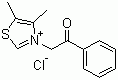 |
| Molecular Formula | C13H14ClNOS |
| Molecular Weight | 267.77 |
| CAS Registry Number | 341028-37-3 |
| EC Number | 636-473-0 |
| SMILES | CC1=C(SC=[N+]1CC(=O)C2=CC=CC=C2)C.[Cl-] |
| Hazard Symbols |   GHS06;GHS07 Danger Details GHS06;GHS07 Danger Details | ||||||||||||||||||||||||
|---|---|---|---|---|---|---|---|---|---|---|---|---|---|---|---|---|---|---|---|---|---|---|---|---|---|
| Risk Statements | H302-H315-H318-H335 Details | ||||||||||||||||||||||||
| Safety Statements | P261-P264-P264+P265-P270-P271-P280-P301+P317-P302+P352-P304+P340-P305+P354+P338-P317-P319-P321-P330-P332+P317-P362+P364-P403+P233-P405-P501 Details | ||||||||||||||||||||||||
| Hazard Classification | |||||||||||||||||||||||||
| |||||||||||||||||||||||||
| SDS | Available | ||||||||||||||||||||||||
 chemBlink Chemical Story
|
Alagebrium chloride, also known as ALT-711, is a small molecule drug that has garnered attention for its potential therapeutic applications in treating age-related diseases, particularly those associated with the accumulation of advanced glycation end-products (AGEs). AGEs are complex compounds formed when proteins or lipids become glycated as a result of exposure to sugars, leading to various pathological conditions, including diabetes, cardiovascular diseases, and neurodegenerative disorders. Alagebrium chloride acts as a cross-link breaker, targeting these AGEs to improve tissue elasticity and function. The discovery of Alagebrium chloride can be traced back to the early 1990s, when researchers began exploring the implications of AGEs in the aging process and related diseases. The compound was identified as a potential therapeutic agent aimed at disrupting the cross-links formed by AGEs in connective tissues, which can lead to reduced elasticity and increased stiffness. This discovery paved the way for a series of preclinical and clinical studies evaluating its safety and efficacy. Alagebrium chloride is synthesized through a multi-step process involving the reaction of specific precursors to yield the desired chemical structure. The synthesis typically includes the formation of the chlorinated derivative, followed by purification steps to ensure the compound meets pharmaceutical standards. The precise chemical structure of Alagebrium chloride contributes to its ability to interact with AGE cross-links, making it a promising candidate for therapeutic applications. One of the primary applications of Alagebrium chloride is in the field of cardiovascular medicine. Clinical studies have demonstrated its potential to improve arterial compliance and reduce systolic blood pressure in patients with conditions associated with increased vascular stiffness, such as diabetes and hypertension. By breaking down the AGE cross-links that contribute to vascular stiffness, Alagebrium chloride may enhance blood flow and reduce the risk of cardiovascular events. Additionally, research is ongoing into the compound's effects on other age-related conditions, including neurodegenerative diseases like Alzheimer's disease. Some studies suggest that AGEs may play a role in neuroinflammation and the progression of cognitive decline. By mitigating the impact of AGEs in neural tissues, Alagebrium chloride holds promise for improving cognitive function and overall brain health. Beyond its direct therapeutic applications, Alagebrium chloride also serves as a valuable tool in scientific research. Its mechanism of action provides insights into the role of AGEs in various diseases, facilitating a deeper understanding of their biological impact and potential strategies for intervention. Researchers continue to investigate the compound's pharmacological properties, exploring modifications to enhance its efficacy and minimize side effects. In summary, Alagebrium chloride is a significant chemical entity with potential applications in treating age-related diseases linked to advanced glycation end-products. Its discovery marked an important advancement in the quest for therapies that address the effects of aging on the human body. Ongoing research aims to further elucidate its mechanisms and broaden its applications, solidifying its role in modern medicine. References 2007. Alagebrium chloride. Pharmaceutical Substances. URL: https://pharmaceutical-substances.thieme.com/ps/search-results?docUri=KD-01-0103 |
| Market Analysis Reports |