
Online Database of Chemicals from Around the World
| Luminescence Technology Corp. | Taiwan | |||
|---|---|---|---|---|
 | www.lumtec.com.tw | |||
 | +886 (2) 2697-5600 | |||
 | +886 (2) 2697-5601 | |||
 | sales@lumtec.com.tw | |||
| Chemical manufacturer since 1999 | ||||
| chemBlink Standard supplier since 2024 | ||||
| Classification | Pharmaceutical intermediate >> OLED material intermediate |
|---|---|
| Name | 3,3'-Bis(N-carbazolyl)-1,1'-biphenyl |
| Synonyms | 9,9'-Biphenyl-3,3'-diylbis-9H-carbazole |
| Molecular Structure | 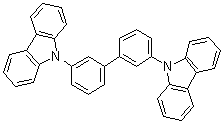 |
| Molecular Formula | C36H24N2 |
| Molecular Weight | 484.59 |
| CAS Registry Number | 342638-54-4 |
| EC Number | 803-683-0 |
| SMILES | C1=CC=C2C(=C1)C3=CC=CC=C3N2C4=CC=CC(=C4)C5=CC(=CC=C5)N6C7=CC=CC=C7C8=CC=CC=C86 |
| Solubility | Insoluble (7.3E-8 g/L) (25 °C), Calc.* |
|---|---|
| Density | 1.19±0.1 g/cm3 (20 °C 760 Torr), Calc.* |
| Melting point | 270 °C (chloroform ligroine )** |
| Index of Refraction | 1.697, Calc.* |
| Boiling Point | 732.3±60.0 °C (760 mmHg), Calc.* |
| Flash Point | 396.7±32.9 °C, Calc.* |
| * | Calculated using Advanced Chemistry Development (ACD/Labs) Software V11.02 (©1994-2014 ACD/Labs) |
| ** | Gong, Shaolong |
| Hazard Symbols |  GHS05 Danger Details GHS05 Danger Details | ||||||||||||||||
|---|---|---|---|---|---|---|---|---|---|---|---|---|---|---|---|---|---|
| Risk Statements | H318 Details | ||||||||||||||||
| Safety Statements | P264+P265-P280-P305+P354+P338-P317 Details | ||||||||||||||||
| Hazard Classification | |||||||||||||||||
| |||||||||||||||||
| SDS | Available | ||||||||||||||||
 chemBlink Chemical Story
|
3,3'-Bis(N-carbazolyl)-1,1'-biphenyl, also known as bis-carbazolyl biphenyl, is a compound that belongs to a class of materials known for their electronic and optical properties. It is characterized by a structure that consists of a biphenyl backbone, with two carbazole groups attached at the 3,3' positions of the aromatic rings. This compound is primarily used in organic electronics and optoelectronic devices due to its excellent charge transport capabilities and strong light-emitting properties. The discovery of 3,3'-bis(N-carbazolyl)-1,1'-biphenyl is part of the broader exploration of organic semiconductors in the late 20th century, as research into organic materials for electronic applications gained momentum. The development of this compound can be traced to the work of chemists and material scientists studying organic molecules for use in light-emitting diodes (LEDs), organic solar cells (OPVs), and organic thin-film transistors (OTFTs). The carbazole group, known for its electron-donating properties, is central to the compound's function as a hole-transport material. The biphenyl backbone provides stability and allows for efficient electron delocalization, which is critical for enhancing the overall charge transport properties of the material. This material is considered a key component in the design of high-performance organic semiconductors for optoelectronic devices. 3,3'-Bis(N-carbazolyl)-1,1'-biphenyl has been widely used in the development of organic light-emitting diodes (OLEDs). OLEDs are a promising technology for displays and lighting due to their low power consumption, flexibility, and ability to emit bright and vivid colors. The use of 3,3'-bis(N-carbazolyl)-1,1'-biphenyl in OLEDs helps to improve the device efficiency by acting as a hole transport layer, enabling efficient charge injection and reducing energy loss. Its ability to enhance the performance of OLEDs makes it an essential material for next-generation display technologies, including televisions, smartphones, and wearable electronics. In addition to OLEDs, this compound also finds application in organic solar cells (OPVs). OPVs are an emerging technology for solar energy conversion, and 3,3'-bis(N-carbazolyl)-1,1'-biphenyl has been studied for its potential to improve the efficiency of these devices. The compound’s excellent electronic properties make it a promising candidate for enhancing charge transport and stability in OPVs. The use of organic materials like 3,3'-bis(N-carbazolyl)-1,1'-biphenyl in solar cells could lead to more efficient and cost-effective alternatives to traditional silicon-based solar technologies. The compound also holds potential for use in organic thin-film transistors (OTFTs), which are important components in flexible and lightweight electronic devices. OTFTs are used in a range of applications, including sensors, flexible displays, and radio-frequency identification (RFID) tags. The use of 3,3'-bis(N-carbazolyl)-1,1'-biphenyl as a semiconductor material in OTFTs offers advantages such as high mobility and stability, which are crucial for the reliable operation of these devices. Research into the applications of 3,3'-bis(N-carbazolyl)-1,1'-biphenyl continues to explore its potential in the development of high-performance organic semiconductors. As the demand for flexible, lightweight, and energy-efficient electronic devices grows, the compound’s versatility and strong electronic properties make it an attractive material for various cutting-edge technologies in the field of organic electronics. References 2019. Recent Advances in carbazole-based conjugated materials. Journal of Materials Chemistry C, 7(25). DOI: 10.1039/C9TC0134A |
| Market Analysis Reports |