
Online Database of Chemicals from Around the World
| Watec Laboratories, Inc. | China | |||
|---|---|---|---|---|
 | www.wateclaboratories.com | |||
 | +86 (519) 8692-1516 +86 18602586511 | |||
 | +86 (519) 8526-7382 | |||
 | info@wateclaboratories.com | |||
 | QQ Chat | |||
| Chemical manufacturer since 2014 | ||||
| chemBlink Standard supplier since 2012 | ||||
| Classification | Organic raw materials >> Alcohols, phenols, phenolic compounds and derivatives |
|---|---|
| Name | 5,7,7-Trimethyl-2-(1,3,3-trimethylbutyl)-1-octanol |
| Synonyms | 2-(4,4-dimethylpentan-2-yl)-5,7,7-trimethyloctan-1-ol |
| Molecular Structure | 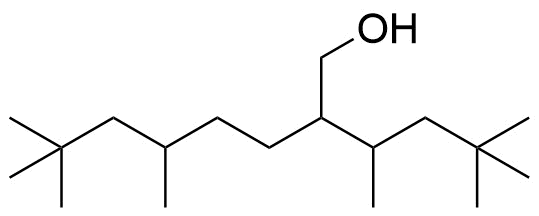 |
| Molecular Formula | C18H38O |
| Molecular Weight | 270.49 |
| CAS Registry Number | 36400-98-3 |
| EC Number | 826-392-0 |
| SMILES | C1=CC=C2C(=C1)NC(=N2)C3=CSC=N3 |
 chemBlink Chemical Story
|
5,7,7-Trimethyl-2-(1,3,3-trimethylbutyl)-1-octanol is a highly branched aliphatic alcohol belonging to the class of synthetic long-chain fatty alcohol derivatives. Its structure consists of a C8 primary alcohol backbone (1-octanol framework) substituted with multiple methyl groups and a bulky branched alkyl side chain, specifically a 1,3,3-trimethylbutyl group at the 2-position and additional methyl substituents at the 5- and 7-positions. The molecule contains a terminal primary hydroxyl group (–CH2OH), which defines it as an alcohol and provides its principal site of chemical reactivity. This hydroxyl group can undergo typical alcohol reactions such as esterification, etherification, oxidation to aldehydes or carboxylic acids, and substitution under appropriate conditions. The carbon skeleton is extensively branched, which significantly affects its physical and chemical properties. Branching reduces crystallinity, lowers melting point, and increases fluidity compared with linear analogues of similar molecular weight. The presence of multiple methyl groups and a bulky side chain also increases steric hindrance around the molecular framework. The 1,3,3-trimethylbutyl substituent is a highly branched alkyl group that introduces a tertiary carbon center and multiple methyl branches. This contributes strong hydrophobic character and enhances lipophilicity. The overall structure is therefore dominated by nonpolar hydrocarbon content, with only a single polar functional group. From a physicochemical perspective, 5,7,7-trimethyl-2-(1,3,3-trimethylbutyl)-1-octanol is expected to be poorly soluble in water due to its large hydrophobic surface area. However, it is likely soluble in nonpolar or weakly polar organic solvents. The compound would exhibit low volatility relative to smaller alcohols due to its high molecular weight and extensive branching. The steric bulk around the alcohol group can influence its reactivity. Primary alcohols typically undergo oxidation more readily than secondary or tertiary alcohols, but in this case, steric hindrance from nearby substituents may reduce accessibility to reagents or enzymes. This can affect reaction rates in both chemical and biological systems. Compounds with similar highly branched alcohol structures are often used in industrial applications such as plasticizers, surfactant intermediates, lubricant additives, or specialty chemical building blocks. The branching improves thermal stability, oxidative resistance, and low-temperature fluidity in formulated products. Although specific biological or pharmaceutical activity is not a characteristic feature of such heavily substituted aliphatic alcohols, their structural motifs are relevant in materials chemistry and formulation science, where hydrophobicity and steric effects are important design parameters. Synthesis of highly branched alcohols of this type typically involves multi-step organic processes such as aldol condensations, oligomerization of smaller aldehydes or olefins, followed by hydrogenation or reduction steps to generate the final alcohol functionality. Control of branching patterns is achieved through selective carbon–carbon bond-forming reactions. Historically, branched-chain alcohols have been developed to improve performance characteristics compared with linear fatty alcohols, particularly in applications requiring low freezing points, low viscosity at reduced temperatures, and improved oxidative stability. Overall, 5,7,7-trimethyl-2-(1,3,3-trimethylbutyl)-1-octanol is a highly branched C8 primary alcohol derivative with substantial hydrophobic character and a single reactive hydroxyl group. Its structure reflects typical design principles of synthetic branched alcohols used in industrial chemistry to achieve modified physical properties such as reduced crystallinity and enhanced stability. |
| Market Analysis Reports |