
Online Database of Chemicals from Around the World
| Wuhan Kemi-works Chemical Co., Ltd. | China | |||
|---|---|---|---|---|
 | www.kemiworks.net | |||
 | +86 (27) 8573-6489 | |||
 | +86 (27) 8573-6485 | |||
 | info@kemiworks.net sales@kemiworks.com | |||
| Chemical manufacturer | ||||
| chemBlink Premium supplier since 2011 | ||||
| Classification | API >> Antibiotics >> Beta-lactamase inhibitor |
|---|---|
| Name | Doripenem hydrate |
| Synonyms | (+)-(4R,5S,6S)-6-[(1R)-1-Hydroxyethyl]-4-methyl-7-oxo-3-[[(3S,5S)-5-[(sulfamoylamino)-methyl]-3-pyrrolidinyl]thio]-1-azabicyclo[3.2.0]hept-2-ene-2-carboxylic acid hydrate |
| Molecular Structure | 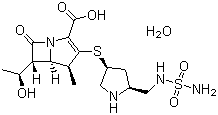 |
| Molecular Formula | C15H24N4O6S2.H2O |
| Molecular Weight | 438.52 |
| CAS Registry Number | 364622-82-2 |
| EC Number | 680-392-3 |
| SMILES | C[C@@H]1[C@@H]2[C@H](C(=O)N2C(=C1S[C@H]3C[C@H](NC3)CNS(=O)(=O)N)C(=O)O)[C@@H](C)O.O |
| Solubility | 36 mg/mL (DMSO), 26 mg/mL (water) |
|---|---|
| Hazard Symbols |  GHS08 Warning Details GHS08 Warning Details | ||||||||
|---|---|---|---|---|---|---|---|---|---|
| Risk Statements | H341 Details | ||||||||
| Safety Statements | P203-P280-P318-P405-P501 Details | ||||||||
| Hazard Classification | |||||||||
| |||||||||
| SDS | Available | ||||||||
 chemBlink Chemical Story
|
Doripenem hydrate is a broad-spectrum carbapenem antibiotic used primarily to treat severe bacterial infections. As a member of the β-lactam class of antibiotics, doripenem is structurally similar to other carbapenems, offering a potent mechanism to inhibit bacterial cell wall synthesis. Its discovery was part of the ongoing efforts to develop more effective antibiotics to combat resistant bacterial strains, particularly those resistant to other antibiotic classes. The development of doripenem began in the early 2000s, spearheaded by pharmaceutical companies looking for alternatives to older antibiotics that were becoming less effective due to rising bacterial resistance. The compound was designed to overcome some of the limitations of earlier carbapenems like imipenem and meropenem, especially in terms of stability and effectiveness against a wider range of pathogens. Doripenem’s unique structure and functional groups were optimized to maximize its antibacterial activity while also increasing its resistance to hydrolysis by bacterial enzymes that inactivate other β-lactam antibiotics. Synthetically, doripenem is prepared through a series of chemical reactions that build its β-lactam ring and essential structural components. The synthesis involves the introduction of various protective groups to stabilize the intermediate compounds, followed by specific reactions to form the carbapenem structure. The final hydrate form, Doripenem hydrate, is produced by crystallizing the compound in the presence of water, ensuring that it retains its potency and stability for medical use. One of the key applications of doripenem hydrate is in the treatment of multi-drug-resistant infections. It has proven effective against a broad spectrum of both Gram-positive and Gram-negative bacteria, including difficult-to-treat pathogens such as Pseudomonas aeruginosa and Enterobacteriaceae. This makes doripenem an important option for treating infections that occur in hospital settings, particularly in immunocompromised patients or those with complex, life-threatening conditions like pneumonia, intra-abdominal infections, and urinary tract infections. Additionally, doripenem hydrate is used in the treatment of infections caused by bacteria resistant to other commonly used antibiotics. Its ability to resist β-lactamase enzymes, which are responsible for rendering many antibiotics ineffective, makes it a valuable tool in combating resistant infections. This capability is particularly important in the context of rising antibiotic resistance, where bacteria evolve mechanisms to evade the action of standard antibiotics. The compound is typically administered intravenously, as this route ensures high bioavailability and effective concentrations in the bloodstream. The dosage and duration of treatment depend on the type and severity of the infection, as well as patient-specific factors such as renal function. The use of doripenem hydrate has become increasingly common in hospital settings, particularly in intensive care units (ICUs), where resistant infections are more prevalent. Beyond its antimicrobial activity, doripenem hydrate has been studied for its safety profile. It is generally well tolerated, though some side effects, such as gastrointestinal disturbances, rash, or mild renal effects, may occur. As with all antibiotics, it is important to monitor patients for signs of adverse reactions, especially during extended use. In conclusion, doripenem hydrate is an important antimicrobial agent in the fight against resistant bacterial infections. Its discovery and development represent a significant step forward in antibiotic therapy, offering an effective treatment option for severe infections that may not respond to other antibiotics. The ongoing research into its use and potential side effects continues to solidify its role as a critical tool in modern medicine. References 2013. Doripenem. Pharmaceutical Substances. URL: https://pharmaceutical-substances.thieme.com/ps/search-results?docUri=KD-04-0123 |
| Market Analysis Reports |