
Online Database of Chemicals from Around the World
| Chengdu Herbpurify Co., Ltd. | China | |||
|---|---|---|---|---|
 | www.scstandards.com | |||
 | +86 028 8265-1368 | |||
 | 2851037747@qq.com | |||
 | QQ Chat | |||
 | WeChat: 18981950076 | |||
| Chemical manufacturer since 2019 | ||||
| chemBlink Standard supplier since 2026 | ||||
| Classification | Organic raw materials >> Ketone compound |
|---|---|
| Name | Melliferone |
| Synonyms | (1S,4S,5R,8R,13S,14R,17S,18R)-4,5,9,9,13,20,20-heptamethyl-24-oxahexacyclo[15.5.2.01,18.04,17.05,14.08,13]tetracos-15-ene-10,23-dione |
| Molecular Structure | 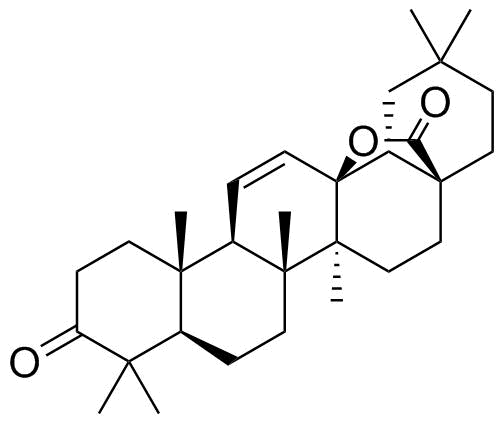 |
| Molecular Formula | C30H44O3 |
| Molecular Weight | 452.67 |
| CAS Registry Number | 377724-68-0 |
| SMILES | C[C@]12CCC(=O)C([C@@H]1CC[C@@]3([C@@H]2C=C[C@@]45[C@]3(CC[C@@]6([C@H]4CC(CC6)(C)C)C(=O)O5)C)C)(C)C |
| Density | 1.1±0.1 g/cm3 Calc.* |
|---|---|
| Boiling point | 557.9±50.0 °C 760 mmHg (Calc.)* |
| Flash point | 235.5±30.2 °C (Calc.)* |
| Index of refraction | 1.559 (Calc.)* |
| * | Calculated using Advanced Chemistry Development (ACD/Labs) Software. |
 chemBlink Chemical Story
|
Melliferone is a naturally occurring phenolic coumarin compound belonging to the benzopyrone family of secondary metabolites. Structurally, it is identified as 7-hydroxy-4-methylcoumarin, a substituted coumarin characterized by a fused benzene and α-pyrone ring system bearing a hydroxyl group at the 7-position and a methyl group at the 4-position. Coumarins are widely distributed in higher plants and are known for their diverse ecological roles and broad range of biological activities. The discovery of coumarin derivatives, including melliferone, is closely linked to early phytochemical investigations of plant secondary metabolites in the nineteenth and early twentieth centuries. Coumarin itself was first isolated from natural sources such as tonka beans and sweet clover, and subsequent chemical studies revealed a large family of structurally related compounds present in various plant species. Melliferone was identified as part of this expanding class of hydroxylated coumarins during systematic investigations of plant phenolics. Naturally occurring coumarins such as melliferone are typically biosynthesized through the phenylpropanoid pathway. In this pathway, the amino acid phenylalanine is converted into cinnamic acid derivatives, which are further modified through hydroxylation, methylation, and lactonization reactions to form the characteristic coumarin scaffold. The substitution pattern in melliferone reflects enzymatic hydroxylation and cyclization processes that occur in plant metabolic systems. Melliferone has been reported in various plant species and is often associated with members of the Apiaceae and other families rich in phenolic secondary metabolites. As a plant-derived compound, it is considered part of the chemical defense and signaling repertoire of plants, where phenolic compounds can contribute to protection against microbial infection, herbivory, and environmental stress. Chemically, melliferone contains a conjugated aromatic system that contributes to its stability and characteristic reactivity. The phenolic hydroxyl group at the 7-position is capable of participating in hydrogen bonding and can undergo typical phenolic reactions such as etherification or esterification. The lactone moiety within the coumarin ring system is relatively stable under neutral conditions but can undergo hydrolysis under strongly basic conditions, leading to ring opening. Coumarin derivatives, including melliferone, have been extensively studied for their photophysical properties. The extended conjugation within the benzopyrone system allows absorption of ultraviolet light, and some substituted coumarins exhibit fluorescence. While melliferone itself is not among the most widely used fluorescent coumarins, its structural framework is closely related to compounds used in optical brighteners, fluorescent probes, and laser dyes. In biological research, coumarin derivatives have attracted interest due to their diverse range of reported bioactivities, which include antioxidant, anti-inflammatory, and antimicrobial effects in various experimental systems. These activities are influenced by substitution patterns on the coumarin core, particularly the presence and position of hydroxyl groups. Melliferone, as a hydroxylated methylcoumarin, represents one of the simpler naturally occurring members of this family used in phytochemical and pharmacological studies. From an analytical perspective, melliferone can be characterized using standard spectroscopic techniques. Nuclear magnetic resonance spectroscopy provides information on aromatic substitution and functional group environments, while infrared spectroscopy reveals characteristic lactone carbonyl stretching vibrations. Mass spectrometry is commonly used for molecular weight confirmation and structural analysis in plant extract studies. Overall, melliferone is a naturally derived hydroxylated coumarin that exemplifies the structural diversity of plant phenolic metabolites. Its significance lies in its role as a representative coumarin derivative within plant biosynthetic systems and as a model compound in studies of natural product chemistry, photophysical behavior, and structure–activity relationships in phenolic lactones. References 2026. The LOTUS Initiative for Open Natural Products Research: frozen dataset union wikidata (with metadata). . DOI: 10.5281/zenodo.5794106 2008. Antiplasmodial Triterpenoids from Ekebergia capensis. Journal of Natural Products. DOI: 10.1021/np0780093 2001. Anti-AIDS agents. 48.(1) Anti-HIV activity of moronic acid derivatives and the new melliferone-related triterpenoid isolated from Brazilian propolis. Journal of Natural Products. DOI: 10.1021/np010211x |
| Market Analysis Reports |