
Online Database of Chemicals from Around the World
| SINOJIE (HK) Limited | China | |||
|---|---|---|---|---|
 | www.sinojie.com | |||
 | +86 (21) 5230-3877 | |||
 | +86 (21) 5230-3799 | |||
 | sissizhou@sinojie.com | |||
| Chemical manufacturer | ||||
| chemBlink Standard supplier since 2007 | ||||
| Bazhou Lude Fine Chemical Co., Ltd. | China | |||
|---|---|---|---|---|
| www.bzlude.com | |||
| +86 (316) 735-5016 | |||
| +86 (316) 735-5017 | |||
| xuzhongxi@163.com | |||
| Chemical manufacturer | ||||
| chemBlink Standard supplier since 2008 | ||||
| Simagchem Corporation | China | |||
|---|---|---|---|---|
| www.simagchem.com | |||
| +86 13806087780 | |||
| +86 (592) 268-0237 | |||
| sale@simagchem.com | |||
| Chemical manufacturer since 2002 | ||||
| chemBlink Standard supplier since 2008 | ||||
| BOC Sciences | USA | |||
|---|---|---|---|---|
| www.bocsci.com | |||
| +1 (631) 485-4226 | |||
| +1 (631) 614-7828 | |||
| info@bocsci.com | |||
| Chemical manufacturer | ||||
| chemBlink Standard supplier since 2010 | ||||
| Langfang GreatAp Chemicals Co., Ltd. | China | |||
|---|---|---|---|---|
| www.grechembld.com | |||
| +86 (316) 209-8955 +86 18630626679 | |||
| +86 (316) 209-8956 | |||
| sales@grechembld.com | |||
 | QQ Chat | |||
| Chemical manufacturer since 2001 | ||||
| chemBlink Standard supplier since 2012 | ||||
| Shanghai Scientia Pharmaceutical Technology Co., Ltd. | China | |||
|---|---|---|---|---|
| www.scientiapharm.net | |||
| +86 (21) 5430-1573 6172-1573 400-036-1573 | |||
| +86 (21) 5186-1981 | |||
| sales@scientiapharm.com scientiapharm@gmail.com | |||
| QQ Chat | |||
| Chemical manufacturer since 2009 | ||||
| chemBlink Standard supplier since 2012 | ||||
| Forxine Pharmaceutical Co., Ltd. | China | |||
|---|---|---|---|---|
| www.forxine.com | |||
| +86 (21) 6496-1699 | |||
| +86 (21) 6496-1388 ex 8320 | |||
| reagent@forxine.com sales@forxine.com | |||
| QQ Chat | |||
| Chemical manufacturer since 2013 | ||||
| chemBlink Standard supplier since 2014 | ||||
| Infinity Scientific | China | |||
|---|---|---|---|---|
| www.infsci.com | |||
| +86 400-106-2016 +86 18500163824 | |||
| biz2@infsci.com | |||
| QQ Chat | |||
| Chemical manufacturer since 2014 | ||||
| chemBlink Standard supplier since 2015 | ||||
| Gansu Junmao New Materials Technology Co., Ltd. | China | |||
|---|---|---|---|---|
| www.gsjmhydrid.com | |||
| +86 18522062012 | |||
| +86 (22) 2743-5750 | |||
| sales@gsjunmao.com | |||
| Chemical distributor since 2019 | ||||
| chemBlink Standard supplier since 2019 | ||||
| Saian Chemical (shanghai) Co., Ltd. | China | |||
|---|---|---|---|---|
| www.saianchem.com | |||
| +86 18633110822 | |||
| teresa.liu@saianchem.com | |||
| QQ Chat | |||
 | WeChat: 18633110822 | |||
| Chemical distributor since 2018 | ||||
| chemBlink Standard supplier since 2025 | ||||
| Classification | Organic raw materials >> Organometallic compound >> Organic lithium |
|---|---|
| Name | Lithium triisobutylhydroborate |
| Synonyms | Lithium tri-sec-butylborohydride |
| Molecular Structure | 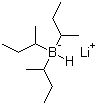 |
| Molecular Formula | C12H28BLi |
| Molecular Weight | 190.10 |
| CAS Registry Number | 38721-52-7 |
| EC Number | 254-101-1 |
| SMILES | [Li+].[B-](C(C)CC)(C(C)CC)C(C)CC |
| Concentration | 1.0 M in tetrahydrofuran |
|---|---|
| Density | 0.89 g/mL |
| Flash point | -17 °C |
| Water solubility | reacts |
| Hazard Symbols |    GHS02;GHS05;GHS07 Danger Details GHS02;GHS05;GHS07 Danger Details | ||||||||||||||||||||||||||||||||
|---|---|---|---|---|---|---|---|---|---|---|---|---|---|---|---|---|---|---|---|---|---|---|---|---|---|---|---|---|---|---|---|---|---|
| Risk Statements | H225-H250-H260-H314-H318-H335 Details | ||||||||||||||||||||||||||||||||
| Safety Statements | P210-P222-P223-P231-P231+P232-P233-P240-P241-P242-P243-P260-P261-P264-P264+P265-P271-P280-P301+P330+P331-P302+P335+P334-P302+P361+P354-P303+P361+P353-P304+P340-P305+P354+P338-P316-P317-P319-P321-P363-P370+P378-P402+P404-P403+P233-P403+P235-P405-P501 Details | ||||||||||||||||||||||||||||||||
| Hazard Classification | |||||||||||||||||||||||||||||||||
| |||||||||||||||||||||||||||||||||
| Transport Information | UN 3394 | ||||||||||||||||||||||||||||||||
| SDS | Available | ||||||||||||||||||||||||||||||||
 chemBlink Chemical Story
|
Lithium triisobutylhydroborate is an organoboron compound commonly used as a selective reducing agent in organic synthesis. It consists of a lithium cation paired with the triisobutylhydroborate anion, which contains a boron atom bonded to three isobutyl groups and one hydride ion. The chemical formula is often written as Li[BH(i-Bu)3], where i-Bu stands for the isobutyl group (–CH2CH(CH3)2). This reagent was developed as a milder and more selective alternative to conventional hydride reducing agents such as lithium aluminum hydride or sodium borohydride. Lithium triisobutylhydroborate provides chemists with the ability to reduce certain functional groups without affecting others, making it valuable in complex molecule synthesis where selective reduction is critical. The discovery of lithium triisobutylhydroborate dates back to research focused on tailoring borohydride derivatives to achieve specific reactivity and selectivity profiles. By replacing alkyl groups on boron with bulky isobutyl substituents, the reagent’s steric environment is modified, which influences its reducing power and selectivity. Its synthesis typically involves reaction of triisobutylborane with lithium hydride or lithium aluminum hydride under controlled conditions to generate the lithium salt of triisobutylhydroborate. In organic synthesis, lithium triisobutylhydroborate is widely used for the reduction of esters, lactones, and nitriles to their corresponding alcohols under relatively mild conditions. Unlike lithium aluminum hydride, it generally does not reduce ketones or aldehydes efficiently, allowing selective transformations in multifunctional molecules. This property is particularly valuable in the pharmaceutical and fine chemical industries, where protecting sensitive groups during reduction is essential. Additionally, lithium triisobutylhydroborate is used in the reduction of acid chlorides and anhydrides to aldehydes, which are useful intermediates in organic synthesis. Its mildness prevents over-reduction to alcohols, a common problem with stronger hydride reagents. This selective reduction capability enables the synthesis of aldehydes in high yield and purity. The reagent is typically handled as a solution in ether solvents such as tetrahydrofuran (THF) or diethyl ether, where it remains stable under inert atmosphere conditions. It is sensitive to moisture and air and must be stored and used under dry, oxygen-free environments to prevent decomposition and loss of reactivity. Due to its reactive hydride character, lithium triisobutylhydroborate can react violently with water and protic solvents, releasing hydrogen gas. In terms of safety, proper precautions such as using gloves, goggles, and working in a fume hood are necessary to avoid exposure to vapors and accidental contact. Its controlled reactivity also requires careful temperature management during reactions to prevent exothermic events. Lithium triisobutylhydroborate continues to be an important reagent in modern synthetic organic chemistry due to its unique combination of selectivity and mild reducing power. Its applications extend from laboratory-scale synthesis to industrial processes where fine control over functional group transformations is required. Research into modified borohydride reagents like lithium triisobutylhydroborate has expanded the toolbox of chemists working on complex molecular architectures. Overall, lithium triisobutylhydroborate represents a significant advancement in hydride chemistry, offering precise and selective reduction capabilities that support the synthesis of pharmaceuticals, agrochemicals, and specialty chemicals with improved efficiency and reduced side reactions. References 2005. Boron Hydrides. Science of Synthesis. URL: https://science-of-synthesis.thieme.com/app/text/?id=SD-026-00131 2009. Diastereoselective Reduction: Synthesis of (+)-Polyoxamic Acid. Science of Synthesis. URL: https://science-of-synthesis.thieme.com/app/text/?id=SD-040-00336 2013. Enantioselective Synthesis of Amaryllidaceae Alkaloids (+)‐Vittatine, (+)‐epi‐Vittatine, and (+)‐Buphanisine. Chemistry - An Asian Journal, 8(10). DOI: 10.1002/asia.201300595 |
| Market Analysis Reports |