
Online Database of Chemicals from Around the World
| Simagchem Corporation | China | |||
|---|---|---|---|---|
 | www.simagchem.com | |||
 | +86 13806087780 | |||
 | +86 (592) 268-0237 | |||
 | sale@simagchem.com | |||
| Chemical manufacturer since 2002 | ||||
| chemBlink Standard supplier since 2008 | ||||
| Langfang GreatAp Chemicals Co., Ltd. | China | |||
|---|---|---|---|---|
| www.grechembld.com | |||
| +86 (316) 209-8955 +86 18630626679 | |||
| +86 (316) 209-8956 | |||
| sales@grechembld.com | |||
 | QQ Chat | |||
| Chemical manufacturer since 2001 | ||||
| chemBlink Standard supplier since 2012 | ||||
| Sigma-Aldrich, Inc. | China | |||
|---|---|---|---|---|
| www.sigmaaldrich.com | |||
| +86 (21) 6141-5566 800-819-3336 | |||
| orderCN@sial.com | |||
| Chemical manufacturer since 1992 | ||||
| chemBlink Standard supplier since 2013 | ||||
| Saian Chemical (shanghai) Co., Ltd. | China | |||
|---|---|---|---|---|
| www.saianchem.com | |||
| +86 18633110822 | |||
| teresa.liu@saianchem.com | |||
| QQ Chat | |||
 | WeChat: 18633110822 | |||
| Chemical distributor since 2018 | ||||
| chemBlink Standard supplier since 2025 | ||||
| Classification | Organic raw materials >> Organometallic compound >> Organic lithium |
|---|---|
| Name | Lithium triamylborohydride |
| Synonyms | LS-Selectride |
| Molecular Structure | 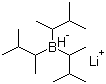 |
| Molecular Formula | C15H34B.Li |
| Molecular Weight | 232.18 |
| CAS Registry Number | 60217-34-7 |
| EC Number | 804-124-3 |
| SMILES | [Li+].[B-](C(C)C(C)C)(C(C)C(C)C)C(C)C(C)C |
| Density | 0.903 g/mL (25 °C) (Expl.) |
|---|---|
| Hazard Symbols |     GHS02;GHS08;GHS05;GHS07 Danger Details GHS02;GHS08;GHS05;GHS07 Danger Details | ||||||||||||
|---|---|---|---|---|---|---|---|---|---|---|---|---|---|
| Risk Statements | H225-H260-H314-H335-H336-H351 Details | ||||||||||||
| Safety Statements | P210-P231+P232-P280-P303+P361+P353-P304+P340+P310-P305+P351+P338 Details | ||||||||||||
| Hazard Classification | |||||||||||||
| |||||||||||||
 chemBlink Chemical Story
|
Lithium triamylborohydride is an organoboron reagent used primarily as a selective reducing agent in organic synthesis. It is composed of a lithium cation paired with the triamylborohydride anion, where the boron atom is bonded to three amyl groups (pentyl groups) and one hydride ion. The bulky amyl substituents create significant steric hindrance around the boron center, which influences the reagent's reactivity and selectivity. Its chemical formula is often represented as Li[BH(Amy)3], where Amy stands for the amyl group (–CH2CH2CH2CH2CH3). This reagent was developed to offer milder and more selective hydride reductions compared to traditional agents such as lithium aluminum hydride or sodium borohydride. Lithium triamylborohydride reduces functional groups like esters, lactones, and nitriles efficiently, often under milder conditions and with improved selectivity, making it valuable for complex organic synthesis where control over reduction is critical. The introduction of bulky amyl groups was aimed at modulating the reagent’s steric and electronic properties, thus tuning its reducing power. This modification results in lower reactivity toward certain functional groups such as ketones and aldehydes, allowing selective reduction in multifunctional molecules. In synthetic applications, lithium triamylborohydride is used to reduce esters to the corresponding alcohols without over-reduction, a common challenge with stronger hydride reagents. It can also selectively reduce acid chlorides to aldehydes, a useful transformation in organic synthesis for obtaining aldehydes that are sensitive to harsher conditions. The reagent is typically handled as a solution in ethers such as tetrahydrofuran (THF) or diethyl ether, which stabilize the reactive hydride species. It is sensitive to moisture and air and must be stored and manipulated under inert atmosphere conditions to prevent decomposition and loss of activity. Contact with water or protic solvents results in rapid hydrogen gas evolution. Safety precautions are necessary when working with lithium triamylborohydride due to its reactivity. Proper protective equipment such as gloves, goggles, and use of a fume hood are standard to avoid exposure and mitigate risks associated with its flammability and vigorous reaction with moisture. Overall, lithium triamylborohydride is a valuable reagent for chemists seeking selective reduction pathways in complex molecule synthesis. Its unique steric profile allows precise control over hydride transfer reactions, contributing to advancements in pharmaceutical, agrochemical, and fine chemical manufacturing. References 1978. Selective Reductions Using Metal Hydrides. Aspects of Mechanism and Organometallic Chemistry. DOI: 10.1007/978-1-4684-3393-7_7 2005. Trialkylborohydrides. Science of Synthesis. URL: https://science-of-synthesis.thieme.com/app/text/?id=SD-006-00975 2024. Synthetic techniques for thermodynamically disfavoured substituted six-membered rings. Nature Reviews Chemistry, 8(7). DOI: 10.1038/s41570-024-00612-3 |
| Market Analysis Reports |