
Online Database of Chemicals from Around the World
| Hangzhou Verychem Science And Technology Co., Ltd. | China | |||
|---|---|---|---|---|
 | www.verychem.com | |||
 | +86 (571) 8816-2785 +86 13606544505 | |||
 | +86 (571) 8816-2787 | |||
 | lucy@verychem.com | |||
| Chemical manufacturer since 2004 | ||||
| chemBlink Massive supplier since 2021 | ||||
| Simagchem Corporation | China | |||
|---|---|---|---|---|
| www.simagchem.com | |||
| +86 13806087780 | |||
| +86 (592) 268-0237 | |||
| sale@simagchem.com | |||
| Chemical manufacturer since 2002 | ||||
| chemBlink Standard supplier since 2008 | ||||
| Chongqing Xingcan Pharmaceutical Technology Co., Ltd. | China | |||
|---|---|---|---|---|
| www.starrymed.com | |||
| +86 (23) 6120-3303 +86 13650506873 | |||
| +86 (23) 6120-3303 | |||
| xingcanyaoye@sina.com | |||
 | QQ Chat | |||
| Chemical manufacturer since 2012 | ||||
| chemBlink Standard supplier since 2016 | ||||
| Frinton Laboratories, Inc. | USA | |||
|---|---|---|---|---|
| www.frinton.com | |||
| +1 (856) 722-7037 | |||
| +1 (856) 439-1977 | |||
| sales@frinton.com frinton@frinton.com | |||
| Chemical manufacturer since 1963 | ||||
| Classification | Organic raw materials >> Aryl compounds >> Biphenyl compounds |
|---|---|
| Name | 4-Hydroxy-4'-nitrobiphenyl |
| Synonyms | 4-(4-nitrophenyl)phenol |
| Molecular Structure | 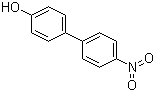 |
| Molecular Formula | C12H9NO3 |
| Molecular Weight | 215.21 |
| CAS Registry Number | 3916-44-7 |
| EC Number | 679-959-8 |
| SMILES | C1=CC(=CC=C1C2=CC=C(C=C2)O)[N+](=O)[O-] |
| Density | 1.3±0.1 g/cm3 Calc.* |
|---|---|
| Melting point | 207 °C (Expl.) |
| Boiling point | 387.3±17.0 °C 760 mmHg (Calc.)* |
| Flash point | 168.6±9.4 °C (Calc.)* |
| Index of refraction | 1.638 (Calc.)* |
| * | Calculated using Advanced Chemistry Development (ACD/Labs) Software. |
| Hazard Symbols |  GHS07 Warning Details GHS07 Warning Details | ||||||||||||
|---|---|---|---|---|---|---|---|---|---|---|---|---|---|
| Risk Statements | H315-H319-H335 Details | ||||||||||||
| Safety Statements | P261-P264-P264+P265-P271-P280-P302+P352-P304+P340-P305+P351+P338-P319-P321-P332+P317-P337+P317-P362+P364-P403+P233-P405-P501 Details | ||||||||||||
| Hazard Classification | |||||||||||||
| |||||||||||||
| SDS | Available | ||||||||||||
 chemBlink Chemical Story
|
4-Hydroxy-4'-nitrobiphenyl is a substituted biphenyl compound that illustrates how relatively simple aromatic molecules can become indispensable intermediates in the development of advanced functional materials. Although it is not widely recognized outside chemical manufacturing, compounds of this type have contributed significantly to high-performance polymers, liquid crystals, dyes, optical materials, and numerous specialty organic molecules. Its importance lies not in a single commercial application, but in the versatility of the biphenyl framework itself—a molecular architecture that has become one of the most influential structural motifs in modern materials chemistry. The biphenyl skeleton has attracted chemists for more than a century because it combines structural rigidity with synthetic flexibility. Unlike a single benzene ring, two directly connected aromatic rings provide an extended, nearly planar conjugated system while still allowing controlled modification through substitution. As researchers learned to introduce functional groups at specific positions, biphenyl compounds evolved from laboratory curiosities into essential building blocks for increasingly sophisticated molecular design. Among the many possible substituents, the combination of a hydroxyl group and a nitro group is particularly valuable. The hydroxyl group serves as an important synthetic handle, readily participating in etherification, esterification, polymer-forming reactions, and numerous carbon-oxygen bond constructions. The nitro group fulfills a complementary role, as it can be selectively reduced to an amino group, opening pathways to amides, azo compounds, heterocycles, and a wide variety of aromatic derivatives. Together, these two functional groups transform a simple biphenyl into a versatile platform for molecular construction. The para-substituted arrangement found in 4-hydroxy-4'-nitrobiphenyl is equally significant. Para substitution creates a highly symmetrical molecular geometry that is often desirable in advanced materials. Molecular symmetry can influence crystal packing, thermal behavior, optical properties, and liquid-crystalline organization. As a result, para-substituted biphenyls have become important intermediates in the synthesis of liquid crystal compounds, engineering polymers, and organic electronic materials. During the rapid growth of polymer science in the second half of the twentieth century, rigid aromatic building blocks became increasingly important for improving thermal stability and mechanical performance. Biphenyl derivatives were incorporated into high-performance polyesters, polyethers, polyamides, and other engineering polymers to increase chain rigidity and dimensional stability. At the same time, aromatic intermediates containing both hydroxyl and amino functionalities became valuable precursors for specialty dyes, pigments, ultraviolet absorbers, and functional coatings. The influence of substituted biphenyls extends into modern electronic and optical materials. Their rigid conjugated structures provide useful electronic characteristics, while carefully selected substituents allow researchers to fine-tune molecular polarity, intermolecular interactions, and self-assembly. Consequently, biphenyl chemistry continues to support research in organic semiconductors, molecular recognition, supramolecular chemistry, and advanced functional materials. From a broader perspective, 4-hydroxy-4'-nitrobiphenyl reflects one of the defining strategies of modern synthetic chemistry: designing multifunctional molecular building blocks rather than isolated target molecules. By incorporating several complementary functional groups into a single aromatic framework, chemists create intermediates capable of participating in numerous synthetic pathways while minimizing unnecessary reaction steps. This modular philosophy has become fundamental to both academic research and industrial manufacturing. The scientific significance of 4-hydroxy-4'-nitrobiphenyl therefore lies far beyond its identity as a substituted aromatic compound. It demonstrates how thoughtful molecular design transforms a simple biphenyl into a versatile platform for constructing advanced materials. Its continued importance illustrates that progress in chemistry often depends not on increasingly complicated molecules, but on carefully engineered intermediates that enable efficient access to entirely new classes of functional compounds. References 1. Hird, M. (2007). "Fluorinated Liquid Crystals – Properties and Applications." Chemical Society Reviews, 36, 2070–2095. 2. Cassidy, P. E. Thermally Stable Polymers. Marcel Dekker, 1980. 3. Carey, F. A.; Sundberg, R. J. Advanced Organic Chemistry, Part B: Reactions and Synthesis. 5th ed. Springer, 2007. |
| Market Analysis Reports |