
Online Database of Chemicals from Around the World
| Shijiazhuang C-element Biotech Co., Ltd. | China | |||
|---|---|---|---|---|
 | www.c-elementbiotech.com | |||
 | +86 18033710157 | |||
 | Lisa@C-elementBiotech.com | |||
 | QQ Chat | |||
 | WeChat: 18033710157 | |||
| Chemical manufacturer since 2025 | ||||
| chemBlink Standard supplier since 2025 | ||||
| AOBChem USA | USA | |||
|---|---|---|---|---|
| www.aobchem.com | |||
| +1 (323) 382-7678 | |||
 | +1 (213) 687-8698 | |||
| sales@aobchem.com | |||
| Chemical manufacturer | ||||
| Atlantic Research Chemicals Ltd. | UK | |||
|---|---|---|---|---|
| www.atlantic-chemicals.com | |||
| +44 (8707) 746-454 | |||
| +44 (8707) 746-455 | |||
| info@atlantic-chemicals.com | |||
| Chemical manufacturer | ||||
| Aaron Chemistry GmbH | Germany | |||
|---|---|---|---|---|
| www.aaron-chemistry.de | |||
| +49 (8823) 917-521 | |||
| +49 (8823) 917-523 | |||
| sales@aaron-chemistry.de | |||
| Chemical manufacturer | ||||
| Classification | Pharmaceutical intermediate >> Heterocyclic compound intermediate >> Pyridine compound >> Bromopyridine |
|---|---|
| Name | 5-Bromonicotinoyl chloride |
| Molecular Structure | 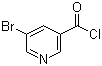 |
| Molecular Formula | C6H3BrClNO |
| Molecular Weight | 220.45 |
| CAS Registry Number | 39620-02-5 |
| EC Number | 679-310-9 |
| SMILES | C1=C(C=NC=C1Br)C(=O)Cl |
| Density | 1.8±0.1 g/cm3 Calc.* |
|---|---|
| Melting point | 72 - 74 °C (Expl.) |
| Boiling point | 265.4±25.0 °C 760 mmHg (Calc.)* |
| Flash point | 114.3±23.2 °C (Calc.)* |
| Index of refraction | 1.59 (Calc.)* |
| * | Calculated using Advanced Chemistry Development (ACD/Labs) Software. |
| Hazard Symbols |  GHS05 Danger Details GHS05 Danger Details | ||||||||
|---|---|---|---|---|---|---|---|---|---|
| Risk Statements | H314 Details | ||||||||
| Safety Statements | P260-P264-P280-P301+P330+P331-P302+P361+P354-P304+P340-P305+P354+P338-P316-P321-P363-P405-P501 Details | ||||||||
| Hazard Classification | |||||||||
| |||||||||
| SDS | Available | ||||||||
 chemBlink Chemical Story
|
5-Bromonicotinoyl chloride is an organic compound derived from nicotinic acid, a pyridine carboxylic acid, by functionalization at the 5-position with a bromine atom and conversion of the carboxylic acid group to an acyl chloride. It belongs to the class of halogenated pyridine derivatives, which are widely studied in medicinal and synthetic chemistry due to their ability to participate in diverse chemical transformations. The synthesis of 5-bromonicotinoyl chloride generally involves a two-step process starting from 5-bromonicotinic acid. First, bromination of nicotinic acid selectively introduces a bromine atom at the 5-position of the pyridine ring, typically under controlled electrophilic halogenation conditions. The resulting 5-bromonicotinic acid is then treated with reagents such as thionyl chloride (SOCl2) or oxalyl chloride (COCl)2 to convert the carboxylic acid group into the corresponding acyl chloride. This chlorination step is usually carried out under anhydrous conditions with a catalytic amount of dimethylformamide (DMF) to facilitate the reaction. 5-Bromonicotinoyl chloride is an important intermediate in organic synthesis, particularly in the preparation of amides, esters, and ketones via nucleophilic acyl substitution reactions. The acyl chloride moiety is highly reactive toward nucleophiles, allowing for straightforward derivatization with amines, alcohols, and other nucleophilic reagents. These reactions are used to build more complex heterocyclic structures and functionalized pyridine-containing molecules. One of the key applications of 5-bromonicotinoyl chloride is in medicinal chemistry. The bromine atom on the pyridine ring offers a handle for further functionalization through cross-coupling reactions such as Suzuki-Miyaura, Stille, or Sonogashira couplings. These reactions enable the introduction of aryl, vinyl, or alkynyl groups at the 5-position, thereby expanding the molecular diversity accessible from this intermediate. Additionally, the pyridine nucleus is a privileged scaffold in drug discovery, known for its presence in a wide range of bioactive compounds, including kinase inhibitors, antiviral agents, and central nervous system drugs. The reactivity and functionalization potential of 5-bromonicotinoyl chloride make it useful in the design and synthesis of novel ligands, agrochemical candidates, and heterocyclic frameworks used in material science. For example, amide products derived from this compound can act as chelating ligands in coordination chemistry or be further elaborated into fluorophores or molecular sensors. In synthetic methodology development, the compound is used to explore regioselective transformations on pyridine rings, particularly when studying electronic effects of substituents on reaction outcomes. Due to the presence of both an acyl chloride and a bromine substituent on an aromatic nitrogen-containing ring, 5-bromonicotinoyl chloride must be handled with care. It is sensitive to moisture, which can hydrolyze the acyl chloride group, and should be stored under inert atmosphere. Reactions involving this compound are typically carried out under dry and controlled conditions to avoid decomposition and ensure high yields. In summary, 5-bromonicotinoyl chloride serves as a versatile intermediate in the synthesis of functionalized pyridine derivatives. Its utility arises from the reactivity of the acyl chloride group combined with the synthetic flexibility offered by the bromine atom. These features make it a valuable tool in the fields of pharmaceutical development, material science, and modern organic synthesis. References 2018. Synthesis and Cerebrovascular Anti-Ischemic Activity of New 5-Hydroxyadamantan-2-One Derivatives. Pharmaceutical Chemistry Journal, 52(2). DOI: 10.1007/s11094-018-1772-y 2022. Design, Synthesis, and Insecticidal Activity of Novel Diacylhydrazine Derivatives Containing an Isoxazole Carboxamide or a Pyridine Carboxamide Moiety. Russian Journal of General Chemistry, 92(1). DOI: 10.1134/s1070363222010182 |
| Market Analysis Reports |