
Online Database of Chemicals from Around the World
| Kelien Water Purification Technology Co., Ltd. | China | |||
|---|---|---|---|---|
 | www.kelien.com | |||
 | +86 (519) 8366-1998 | |||
 | +86 (519) 8366-1152 | |||
 | info@kelien.com | |||
| Chemical manufacturer | ||||
| chemBlink Standard supplier since 2005 | ||||
| Shandong Taihe Water Treatment Co., Ltd. | China | |||
|---|---|---|---|---|
| www.thwater.net | |||
| +86 (632) 511-3066 | |||
| +86 (632) 346-0156 | |||
| th@thwater.com | |||
| Chemical manufacturer | ||||
| chemBlink Standard supplier since 2008 | ||||
| Simagchem Corporation | China | |||
|---|---|---|---|---|
| www.simagchem.com | |||
| +86 13806087780 | |||
| +86 (592) 268-0237 | |||
| sale@simagchem.com | |||
| Chemical manufacturer since 2002 | ||||
| chemBlink Standard supplier since 2008 | ||||
| Tianjin Zhongxin Chem-tech Co., Ltd. | China | |||
|---|---|---|---|---|
| www.tjzxchem.com | |||
| +86 (22) 6688-0623 | |||
| +86 (22) 8988-0739 ex 8030 | |||
| sales@tjzxchem.com | |||
| Chemical manufacturer since 2007 | ||||
| chemBlink Standard supplier since 2009 | ||||
| Wealson Enterprises Co., Ltd. | China | |||
|---|---|---|---|---|
| www.wealson.com | |||
| +86 (632) 388-0000 | |||
| chemical@wealson.com | |||
| Chemical distributor | ||||
| chemBlink Standard supplier since 2010 | ||||
| Classification | Organic raw materials >> Carboxylic compounds and derivatives |
|---|---|
| Name | 2-Phosphonobutane-1,2,4-tricarboxylic acid sodium salt |
| Synonyms | PBTC sodium salt; PBTC-4Na |
| Molecular Structure | 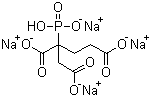 |
| Molecular Formula | C7H7Na4O9P |
| Molecular Weight | 358.06 |
| CAS Registry Number | 40372-66-5 |
| EC Number | 254-894-4 |
| SMILES | C(CC(CC(=O)[O-])(C(=O)[O-])P(=O)(O)[O-])C(=O)[O-].[Na+].[Na+].[Na+].[Na+] |
| Hazard Symbols |  GHS07 Warning Details GHS07 Warning Details | ||||||||||||||||||||
|---|---|---|---|---|---|---|---|---|---|---|---|---|---|---|---|---|---|---|---|---|---|
| Risk Statements | H302-H319-H332 Details | ||||||||||||||||||||
| Safety Statements | P261-P264-P264+P265-P270-P271-P280-P301+P317-P304+P340-P305+P351+P338-P317-P330-P337+P317-P501 Details | ||||||||||||||||||||
| Hazard Classification | |||||||||||||||||||||
| |||||||||||||||||||||
 chemBlink Chemical Story
|
2-Phosphonobutane-1,2,4-tricarboxylic acid sodium salt, commonly referred to as PBTC, is an important chemical compound used in various industrial applications, particularly in the fields of water treatment, agriculture, and as a chelating agent. The discovery of PBTC can be traced back to ongoing research in the 1960s aimed at developing effective phosphonic acids that could serve as water treatment agents. Researchers sought to create compounds that would not only reduce scale formation but also enhance the stability of metal ions in aqueous solutions. The molecular structure of PBTC features three carboxylic acid groups and one phosphonic acid group, which provides it with unique properties that facilitate its role as a chelating agent. This multifunctional nature allows PBTC to bind with metal ions, preventing precipitation and maintaining them in a soluble form. As a result, PBTC has become a preferred choice in applications where scale inhibition and metal ion stabilization are essential. One of the primary applications of PBTC is in water treatment, where it is used as a scale inhibitor in cooling water systems and industrial boilers. Scale formation can lead to reduced efficiency and increased energy consumption in these systems. By incorporating PBTC, operators can effectively minimize scale build-up, prolong equipment life, and enhance operational efficiency. Its ability to inhibit scale is attributed to its unique chemical structure, which allows for effective adsorption onto the surfaces of potential scale-forming minerals. In addition to water treatment, PBTC is employed in various agricultural applications. As a chelating agent, it is used to improve the availability of essential micronutrients, such as iron, manganese, and zinc, in soils and fertilizers. The presence of PBTC helps to solubilize these nutrients, making them more accessible to plants and promoting healthier growth. This application is particularly significant in regions with calcareous or alkaline soils, where nutrient availability is often limited. PBTC also finds use in the formulation of detergents and cleaning products. Its ability to complex with metal ions enhances the effectiveness of surfactants, leading to improved cleaning performance. Additionally, its low toxicity profile makes it a safer alternative to traditional phosphates, which have been subject to environmental regulations due to their contribution to eutrophication in water bodies. The versatility of PBTC extends to its role in the oil and gas industry, where it is used as a scale inhibitor and corrosion inhibitor in various processes. The compound's ability to mitigate scale formation and stabilize metal ions is crucial for maintaining the integrity and efficiency of equipment in harsh operational environments. From a safety and regulatory perspective, PBTC is generally considered safe for use in various applications, but adherence to proper handling guidelines is essential to minimize any potential risks. Manufacturers and end-users are encouraged to follow relevant regulations and safety data sheets to ensure safe usage. In summary, 2-Phosphonobutane-1,2,4-tricarboxylic acid sodium salt is a multifunctional chemical compound with significant applications in water treatment, agriculture, and industrial processes. Its unique structure and properties make it an effective chelating agent and scale inhibitor, contributing to improved operational efficiency and nutrient availability. As industries continue to seek sustainable and effective solutions for their challenges, the importance of PBTC in promoting efficiency and environmental stewardship is expected to grow. References 2019. 2-Phosphonobutane-1,2,4-tricarboxylic acid (PBTCA) degradation by ozonation: Kinetics, phosphorus transformation, anti-precipitation property changes and phosphorus removal. Water Research, 148. DOI: 10.1016/j.watres.2018.10.038 2017. Enhancing the soil heavy metals removal efficiency by adding HPMA and PBTCA along with plant washing agents. Journal of Hazardous Materials, 339. DOI: 10.1016/j.jhazmat.2017.06.007 1994. Utilization of 2-phosphonobutane-1,2,4-tricarboxylic acid as source of phosphorus by environmental bacterial isolates. Chemosphere, 29(1). DOI: 10.1016/0045-6535(94)90092-2 |
| Market Analysis Reports |