
Online Database of Chemicals from Around the World
| Hangzhou Read Chemical Co., Ltd. | China | |||
|---|---|---|---|---|
 | www.hzread.com | |||
 | +86 (571) 8723-4293 8991-2636 | |||
 | +86 (571) 8723-4255 | |||
 | sales@hzread.com info@hzread.com | |||
 | QQ Chat | |||
| Chemical manufacturer since 2007 | ||||
| chemBlink Standard supplier since 2007 | ||||
| Shandong E.Fine Pharmacy Co., Ltd. | China | |||
|---|---|---|---|---|
| www.yifeiguoji.com | |||
| +86 (531) 8181-4810 +86 15053131565 | |||
| +86 (531) 8796-0218 | |||
| 116336356@qq.com | |||
| QQ Chat | |||
| Chemical manufacturer since 2010 | ||||
| chemBlink Standard supplier since 2008 | ||||
| Hefei TNJ Chemical Industry Co., Ltd. | China | |||
|---|---|---|---|---|
| www.tnjchem.com | |||
| +86 (551) 6541-8684 | |||
| +86 (551) 6541-8697 | |||
| sales@tnjchem.com | |||
| Chemical manufacturer since 2001 | ||||
| chemBlink Standard supplier since 2010 | ||||
| Shenzhen Feiming Science&Technology Co., Ltd. | China | |||
|---|---|---|---|---|
| www.fmect.com | |||
| +86 (755) 8523-2577 | |||
| +86 (755) 8523-2577 | |||
| sale@fmect.com | |||
| Chemical distributor since 2010 | ||||
| chemBlink Standard supplier since 2011 | ||||
| Finetech Industry Limited | China | |||
|---|---|---|---|---|
| www.finetechchem.com | |||
| +86 (27) 8746-5837 +86 18971612321 | |||
| +86 (27) 8777-2287 | |||
| sales@finetechnology-ind.com | |||
| QQ Chat | |||
| Chemical manufacturer since 2009 | ||||
| chemBlink Standard supplier since 2019 | ||||
| Carbone Scientific Co., Ltd. | UK | |||
|---|---|---|---|---|
| www.carbonesci.com | |||
| +44 (870) 486-8629 | |||
| +44 (870) 288-7399 | |||
| sales@carbonesci.com | |||
| Chemical distributor | ||||
| Classification | Organic raw materials >> Organic sulfur compound |
|---|---|
| Name | (2-Carboxyethyl)dimethylsulfonium chloride |
| Molecular Structure | 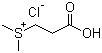 |
| Molecular Formula | C5H11ClO2S |
| Molecular Weight | 170.66 |
| CAS Registry Number | 4337-33-1 |
| EC Number | 679-627-2 |
| SMILES | C[S+](C)CCC(=O)O.[Cl-] |
| Melting point | 1293 °C |
|---|---|
| Hazard Symbols |   GHS08;GHS09 Warning Details GHS08;GHS09 Warning Details | ||||||||||||
|---|---|---|---|---|---|---|---|---|---|---|---|---|---|
| Risk Statements | H315-H319 Details | ||||||||||||
| Safety Statements | P264-P264+P265-P280-P302+P352-P305+P351+P338-P321-P332+P317-P337+P317-P362+P364 Details | ||||||||||||
| Hazard Classification | |||||||||||||
| |||||||||||||
| SDS | Available | ||||||||||||
 chemBlink Chemical Story
|
(2-Carboxyethyl)dimethylsulfonium chloride, commonly known as CEDS chloride, is a sulfonium compound with great potential in various chemical and biological applications. Its unique structure combines the sulfonium ion with a carboxylic acid functional group, providing versatile applications in different fields such as organic synthesis and biochemical research. The discovery of (2-carboxyethyl)dimethylsulfonium chloride can be traced back to the investigation of the synthesis and reactivity of sulfonium compounds in the mid-20th century. Sulfonium salts are of interest because of their potential as intermediates in organic synthesis and their presence in certain biological systems. CEDS chloride with its unique structure was synthesized to explore its chemical properties and potential applications. The chemical formula of CEDS chloride is C5H11ClO2S and its molecular weight is 170.66 g/mol. The molecule consists of a dimethylsulfonium ion attached to a 2-carboxyethyl group, forming a zwitterionic structure in aqueous solution. This dual functionality makes CEDS chloride an interesting compound for various chemical reactions and interactions. In organic synthesis, CEDS chloride can be used as an effective methylating agent. The sulfonium ion can transfer a methyl group to a nucleophile, promoting the formation of carbon-carbon and carbon-heteroatom bonds. This reactivity is particularly useful in the synthesis of complex organic molecules, including pharmaceuticals and natural products. CEDS chloride is used as an intermediate in the synthesis of other sulfonium and oxysulfonium compounds. Its carboxylic acid group allows for further derivatization, enabling the construction of more complex molecular structures. CEDS chloride is relevant to the study of sulfur-containing metabolites. Sulfonium compounds are found in various biochemical pathways, and CEDS chloride can serve as a model compound for understanding these processes. Its structure allows researchers to study the behavior of sulfonium ions in biological systems. The compound is also used in enzyme inhibition studies. Sulfonium salts can interact with enzyme active sites, providing insights into enzyme mechanisms and potential drug targets. CEDS chloride has a carboxylic acid functionality that allows for unique interactions with enzymes, aiding in the design of enzyme inhibitors. The pharmaceutical industry explores the potential of CEDS chloride as a precursor for drug synthesis. The reactivity of the sulfonium group and the versatility of the carboxylic acid make it an attractive starting material for the manufacture of biologically active compounds. Its derivatives may exhibit pharmacological properties, leading to new therapeutic agents. In materials science, CEDS chlorides are used to modify polymers. Their functional groups enable the introduction of sulfonium ions into the polymer matrix, thereby enhancing the material's properties. These modifications can improve the thermal stability, electrical conductivity, and other properties of the resulting polymers, making them suitable for advanced applications. CEDS chlorides are studied for their role in environmental chemistry, particularly in the degradation of pollutants. Sulfonium compounds can participate in redox reactions that break down harmful substances in the environment. Understanding the reactivity of CEDS chlorides can aid in the development of strategies for pollutant remediation. Current research continues to explore the full potential of (2-carboxyethyl) dimethylsulfonium chloride. Future developments focus on enhancing its applications in synthetic organic chemistry, understanding its biochemical interactions, and discovering new uses for it in materials science and environmental chemistry. Innovations in these areas may lead to more efficient synthetic methods, new pharmaceuticals, and advanced materials with tailored properties. References 1948. Dimethyl-beta-propiothetin, a new methyl donor. The Journal of Biological Chemistry, 174(1). DOI: 10.1016/s0021-9258(18)57408-1 2024. Dimethylsulfoniopropionate (DMSP): From Biochemistry to Global Ecological Significance. Annual Review of Microbiology, 78. DOI: 10.1146/annurev-micro-041222-024055 |
| Market Analysis Reports |