
Online Database of Chemicals from Around the World
| Hangzhou Verychem Science And Technology Co., Ltd. | China | |||
|---|---|---|---|---|
 | www.verychem.com | |||
 | +86 (571) 8816-2785 +86 13606544505 | |||
 | +86 (571) 8816-2787 | |||
 | lucy@verychem.com | |||
| Chemical manufacturer since 2004 | ||||
| chemBlink Massive supplier since 2021 | ||||
| Simagchem Corporation | China | |||
|---|---|---|---|---|
| www.simagchem.com | |||
| +86 13806087780 | |||
| +86 (592) 268-0237 | |||
| sale@simagchem.com | |||
| Chemical manufacturer since 2002 | ||||
| chemBlink Standard supplier since 2008 | ||||
| Hefei TNJ Chemical Industry Co., Ltd. | China | |||
|---|---|---|---|---|
| www.tnjchem.com | |||
| +86 (551) 6541-8684 | |||
| +86 (551) 6541-8697 | |||
| sales@tnjchem.com | |||
| Chemical manufacturer since 2001 | ||||
| chemBlink Standard supplier since 2010 | ||||
| BOC Sciences | USA | |||
|---|---|---|---|---|
| www.bocsci.com | |||
| +1 (631) 485-4226 | |||
| +1 (631) 614-7828 | |||
| info@bocsci.com | |||
| Chemical manufacturer | ||||
| chemBlink Standard supplier since 2010 | ||||
| Intatrade Chemicals GmbH | Germany | |||
|---|---|---|---|---|
| www.intatrade.de | |||
| +49 (3493) 605-465 | |||
| +49 (3493) 605-470 | |||
| sales@intatrade.de | |||
| Chemical distributor | ||||
| chemBlink Standard supplier since 2011 | ||||
| Epsilon Chimie Chemical Manufacturer | France | |||
|---|---|---|---|---|
| www.epsilon-chimie.com | |||
| +33 (2) 9842-4650 | |||
| +33 (2) 9842-4402 | |||
| pierre.cornec@epsilon-chimie.com | |||
| Chemical manufacturer | ||||
| PCI Synthesis, Inc. | USA | |||
|---|---|---|---|---|
| www.pcisynthesis.com | |||
| +1 (978) 462-5555 463-4853 | |||
| +1 (978) 465-2057 | |||
| sales@pcisynthesis.com | |||
| Chemical manufacturer | ||||
| Classification | Organic raw materials >> Organic phosphine compound |
|---|---|
| Name | n-Hexylphosphonic acid |
| Synonyms | Hexanephosphonic acid; Hexylphosphonic acid; NSC 222656 |
| Molecular Structure | 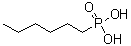 |
| Molecular Formula | C6H15O3P |
| Molecular Weight | 166.16 |
| CAS Registry Number | 4721-24-8 |
| EC Number | 811-094-5 |
| SMILES | CCCCCCP(=O)(O)O |
| Solubility | Slightly soluble (7.1 g/L) (25 °C), Calc.* |
|---|---|
| Density | 1.132±0.06 g/cm3 (20 °C 760 Torr), Calc.* |
| Melting point | 105-106 °C (ligroine)(Expl.)** |
| Index of Refraction | 1.455, Calc.* |
| Boiling Point | 299.7±23.0 °C (760 mmHg), Calc.* |
| Flash Point | 135.0±22.6 °C, Calc.* |
| * | Calculated using Advanced Chemistry Development (ACD/Labs) Software V11.02 (©1994-2014 ACD/Labs) |
| ** | Griffin, Claibourne E. |
| Hazard Symbols |   GHS05;GHS07 Danger Details GHS05;GHS07 Danger Details | ||||||||||||||||
|---|---|---|---|---|---|---|---|---|---|---|---|---|---|---|---|---|---|
| Risk Statements | H290-H314-H315-H318-H319 Details | ||||||||||||||||
| Safety Statements | P234-P260-P261-P264-P264+P265-P271-P280-P301+P330+P331-P302+P352-P302+P361+P354-P304+P340-P305+P351+P338-P305+P354+P338-P316-P317-P319-P321-P332+P317-P337+P317-P362+P364-P363-P390-P403+P233-P405-P406-P501 Details | ||||||||||||||||
| Hazard Classification | |||||||||||||||||
| |||||||||||||||||
| SDS | Available | ||||||||||||||||
 chemBlink Chemical Story
|
n-Hexylphosphonic acid is an organic compound with the chemical formula C6H13PO3. It is a phosphonic acid derivative, consisting of a phosphonic acid group (-PO3H2) attached to a hexyl (C6H13) chain. This compound belongs to the class of organophosphonic acids, which are known for their wide variety of applications in industrial and chemical processes. n-Hexylphosphonic acid was first synthesized as part of ongoing efforts to explore the chemistry of organophosphonic acids and their potential uses. The compound has been recognized for its ability to form stable metal complexes and its role in modifying surfaces for various applications. Its discovery and subsequent studies have provided insights into the chemical reactivity of phosphonic acids, as well as their use in industrial applications. The primary application of n-hexylphosphonic acid is in surface modification, particularly in the formation of self-assembled monolayers (SAMs) on metal surfaces, glass, and other materials. The phosphonic acid group can strongly bind to metal oxides, making it an ideal compound for modifying the surface properties of materials in fields such as catalysis, sensors, and corrosion protection. n-Hexylphosphonic acid has been used to improve the adhesion of coatings and to modify the wettability and hydrophobicity of surfaces. n-Hexylphosphonic acid has also found applications in the field of chromatography, where it is used as a stationary phase material in certain types of column chromatography. Its ability to interact with various organic and inorganic compounds through its phosphonic acid group allows it to separate compounds based on their affinity for the surface. This property makes it useful in analytical chemistry for purifying or isolating certain chemical species. Furthermore, n-hexylphosphonic acid has been investigated for its potential use in corrosion inhibition. The compound's ability to form stable complexes with metal ions makes it a candidate for preventing metal degradation in industrial systems, such as pipelines, tanks, and other metal infrastructure. It can be used to form protective coatings on metal surfaces, thereby enhancing their resistance to corrosion and wear. In addition, n-hexylphosphonic acid has been studied in the context of its interactions with other chemical compounds, particularly in the preparation of organophosphorus materials. These materials can be used in a variety of chemical processes, including catalysis, the production of flame retardants, and other specialized applications. Overall, n-hexylphosphonic acid plays an important role in various fields of chemistry and industry. Its ability to modify surfaces, form stable metal complexes, and be used in chromatography makes it a versatile compound in both research and industrial settings. Its applications continue to expand, particularly in areas related to materials science, catalysis, and surface chemistry. References 2016. Phosphonic acids aid composition adjustment in the synthesis of Cu2+xZn1−xSnSe4−y nanoparticles. Journal of Nanoparticle Research, 18(8). DOI: 10.1007/s11051-016-3545-4 2016. Phosphonic acids as stabilizing ligands for cadmium chalcogenide colloidal quantum dots. Russian Chemical Bulletin, 65(8). DOI: 10.1007/s11172-016-1531-8 2023. Shape control of CdSe/CdS nanocrystals during shell formation and growth: Dominating effects of surface ligands over core crystal structure. Science China Materials, 66(7). DOI: 10.1007/s40843-023-2481-1 |
| Market Analysis Reports |