
Online Database of Chemicals from Around the World
| Hangzhou Verychem Science And Technology Co., Ltd. | China | |||
|---|---|---|---|---|
 | www.verychem.com | |||
 | +86 (571) 8816-2785 +86 13606544505 | |||
 | +86 (571) 8816-2787 | |||
 | lucy@verychem.com | |||
| Chemical manufacturer since 2004 | ||||
| chemBlink Massive supplier since 2021 | ||||
| Yancheng Langde Chemical & Pharmaceutical Co., Ltd. | China | |||
|---|---|---|---|---|
| www.langdechem.com | |||
| +86 (515) 8835-9955 +86 13705103058 | |||
| +86 (515) 8835-7955 | |||
| langdechem@163.com | |||
 | QQ Chat | |||
| Chemical manufacturer since 2006 | ||||
| chemBlink Standard supplier since 2006 | ||||
| Simagchem Corporation | China | |||
|---|---|---|---|---|
| www.simagchem.com | |||
| +86 13806087780 | |||
| +86 (592) 268-0237 | |||
| sale@simagchem.com | |||
| Chemical manufacturer since 2002 | ||||
| chemBlink Standard supplier since 2008 | ||||
| Zhejiang Qiming Pharmaceutical Co., Ltd. | China | |||
|---|---|---|---|---|
| www.qimingpharm.com | |||
| +86 (571) 8716-3895 8716-3893 | |||
| +86 (571) 8716-3816 | |||
| sales@qimingpharm.com | |||
| QQ Chat | |||
| Chemical manufacturer | ||||
| chemBlink Standard supplier since 2009 | ||||
| Hefei TNJ Chemical Industry Co., Ltd. | China | |||
|---|---|---|---|---|
| www.tnjchem.com | |||
| +86 (551) 6541-8684 | |||
| +86 (551) 6541-8697 | |||
| sales@tnjchem.com | |||
| Chemical manufacturer since 2001 | ||||
| chemBlink Standard supplier since 2010 | ||||
| BOC Sciences | USA | |||
|---|---|---|---|---|
| www.bocsci.com | |||
| +1 (631) 485-4226 | |||
| +1 (631) 614-7828 | |||
| info@bocsci.com | |||
| Chemical manufacturer | ||||
| chemBlink Standard supplier since 2010 | ||||
| Eastar Chemical Corporation | USA | |||
|---|---|---|---|---|
| www.eastarchem.com | |||
| +1 800-898-2436 | |||
| +1 (877) 898-2436 | |||
| info@eastarchem.com | |||
| Chemical manufacturer since 1989 | ||||
| chemBlink Standard supplier since 2014 | ||||
| Hangzhou Leap Chem Co., Ltd. | China | |||
|---|---|---|---|---|
| www.leapchem.com | |||
| +86 (571) 8771-1850 | |||
| market19@leapchem.com | |||
| QQ Chat | |||
| Chemical manufacturer since 2006 | ||||
| chemBlink Standard supplier since 2015 | ||||
| LKT Laboratories, Inc. | USA | |||
|---|---|---|---|---|
| www.lktlabs.com | |||
| +1 (888) 558-5227 | |||
| +1 (651) 644-8357 | |||
| peacerli@mbolin-lktlabs.com | |||
| Chemical manufacturer | ||||
| AK Scientific, Inc | USA | |||
|---|---|---|---|---|
| www.aksci.com | |||
| +1 (510) 429-8835 | |||
| +1 (510) 429-8836 | |||
| sales@aksci.com | |||
| Chemical manufacturer | ||||
| Axiom Chemicals Private Limited. | India | |||
|---|---|---|---|---|
| axiomchemicals.com | |||
| +91 7433900100 | |||
| sales@axiomchemicals.com | |||
| Chemical manufacturer since 2011 | ||||
| Classification | API >> Special medicine >> Dermatology medication |
|---|---|
| Name | Crotamiton |
| Synonyms | N-Ethyl-N-(2-methylphenyl)-butenamide |
| Molecular Structure | 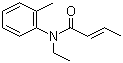 |
| Molecular Formula | C13H17NO |
| Molecular Weight | 203.28 |
| CAS Registry Number | 483-63-6 |
| EC Number | 207-596-3 |
| SMILES | CCN(C1=CC=CC=C1C)C(=O)/C=C/C |
| Density | 1.0±0.1 g/cm3, Calc.* |
|---|---|
| Index of Refraction | 1.552, Calc.* |
| Boiling Point | 282.7±19.0 °C (760 mmHg), Calc.* |
| Flash Point | 115.5±12.7 °C, Calc.* |
| * | Calculated using Advanced Chemistry Development (ACD/Labs) Software. |
| Hazard Symbols |  GHS07 Warning Details GHS07 Warning Details | ||||||||||||||||||||
|---|---|---|---|---|---|---|---|---|---|---|---|---|---|---|---|---|---|---|---|---|---|
| Risk Statements | H302-H315-H317-H319 Details | ||||||||||||||||||||
| Safety Statements | P280-P305+P351+P338 Details | ||||||||||||||||||||
| Hazard Classification | |||||||||||||||||||||
| |||||||||||||||||||||
| SDS | Available | ||||||||||||||||||||
 chemBlink Chemical Story
|
Crotamiton, with the chemical formula C11H15NO2S, is an organic compound that has gained prominence in the medical and pharmaceutical fields due to its antipruritic and scabicidal properties. It was first introduced in the 1950s as a topical agent for the treatment of scabies and pruritus (itching). Crotamiton is a synthetic compound that belongs to the class of drugs known as scabicides, which are used to treat scabies infestations caused by the Sarcoptes scabiei mite. The discovery of crotamiton was part of the ongoing search for effective treatments for scabies, a highly contagious skin condition characterized by intense itching and the appearance of a rash due to mite infestation. Prior to the development of crotamiton, treatments for scabies were limited and often had significant side effects. The introduction of crotamiton marked a significant advancement in the treatment of scabies due to its effectiveness and relatively mild side effect profile compared to other scabicides available at the time. One of the primary applications of crotamiton is in the treatment of scabies. Crotamiton is available as a cream or lotion, which is applied directly to the skin to treat the scabies mites. It works by killing the mites and alleviating the associated itching. Unlike some other scabicides, crotamiton is considered to be less irritating to the skin, making it a suitable option for individuals with sensitive skin. Its effectiveness and mildness have made it a popular choice for treating scabies, particularly in cases where other treatments have failed or caused adverse reactions. In addition to its use as a scabicide, crotamiton has been used to treat pruritus, which refers to generalized itching that is not caused by scabies. Pruritus can be a symptom of various conditions, including eczema, dermatitis, and allergic reactions. Crotamiton’s ability to relieve itching and irritation makes it a useful agent in the management of these conditions. When applied topically, it works by soothing the skin and reducing the inflammatory response, thus providing relief from discomfort. Crotamiton has also found use in the treatment of other skin conditions, such as insect bites and stings, where its antipruritic effects help reduce itching and promote healing. It is often included in formulations for conditions that require a mild and non-irritating topical treatment. Furthermore, it has been considered in the development of combination products that target multiple skin conditions at once, making it an integral part of dermatological care. Despite its many benefits, crotamiton is not without its limitations. While it is effective in the treatment of scabies and pruritus, it may not be as potent as other treatments available for these conditions, such as permethrin or benzyl benzoate. In cases of severe scabies infestations, crotamiton may need to be used in conjunction with other medications to achieve optimal results. Furthermore, while it is generally well-tolerated, some individuals may experience mild side effects such as skin irritation, redness, or allergic reactions. Over the years, the application of crotamiton has expanded to various dermatological formulations, such as lotions and creams, which are widely available for over-the-counter use. This ease of availability has made it a common choice for self-treatment of mild skin conditions, especially in regions where access to more potent scabicides may be limited. In conclusion, crotamiton is an important chemical substance that has had a significant impact on the treatment of scabies and pruritus. Its development as a topical agent provided a much-needed alternative to other treatments that were often more irritating and less effective. Although crotamiton may not be as powerful as some other agents for certain conditions, its mildness and effectiveness have ensured its continued use in dermatology. As research progresses, new formulations and applications for crotamiton may continue to emerge, broadening its therapeutic potential. References 2024. Skin Infestations in the Diabetic Patients: Scabies. Cutaneous Manifestations in Diabetes. DOI: 10.1007/978-3-031-65300-1_10 2023. Scabies Itch. Scabies. DOI: 10.1007/978-3-031-26070-4_16 1949. The Use of N-Ethyl-O-Crotono-Toluidide in the Treatment of Scabies and Various Pruritic Dermatoses. The Journal of investigative dermatology, 12. DOI: 10.1038/jid.1949.63 |
| Market Analysis Reports |