
Online Database of Chemicals from Around the World
| BOC Sciences | USA | |||
|---|---|---|---|---|
 | www.bocsci.com | |||
 | +1 (631) 485-4226 | |||
 | +1 (631) 614-7828 | |||
 | info@bocsci.com | |||
| Chemical manufacturer | ||||
| chemBlink Standard supplier since 2010 | ||||
| Omicron Biochemicals, Inc. | USA | |||
|---|---|---|---|---|
| www.omicronbio.com | |||
| +1 (574) 287-6910 | |||
| +1 (574) 287-7165 | |||
| omicron@omicronbio.com | |||
| Chemical manufacturer | ||||
| Shanghai Worldyang Chemical Co., Ltd. | China | |||
|---|---|---|---|---|
| www.worldyachem.com | |||
| +86 13651600618 +86 (21) 5679-5779 | |||
| +86 (21) 5679-5266 | |||
| sales7777@worldyachem.com | |||
 | QQ Chat | |||
 | WeChat: 13651600618 | |||
 | WhatsApp:+86 13651600618 | |||
| Chemical manufacturer since 2012 | ||||
| Classification | Biochemical >> Carbohydrate >> Monosaccharide |
|---|---|
| Name | Scyllitol |
| Synonyms | AZD 103; Cocositol; ELND 005; Quercinitol; scyllo-Cyclohexanehexol |
| Molecular Structure | 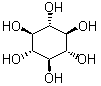 |
| Molecular Formula | C6H12O6 |
| Molecular Weight | 180.16 |
| CAS Registry Number | 488-59-5 |
| EC Number | 610-437-4 |
| SMILES | C1(C(C(C(C(C1O)O)O)O)O)O |
| Solubility | Very soluble (1000 g/L) (25 °C), Calc.* |
|---|---|
| Density | 2.038±0.06 g/cm3 (20 °C 760 Torr), Calc.* |
| Melting point | 367 °C (water )** |
| * | Calculated using Advanced Chemistry Development (ACD/Labs) Software V11.02 (©1994-2013 ACD/Labs) |
| ** | Manske, Richard H. F. |
| Hazard Symbols |  GHS07 Warning Details GHS07 Warning Details |
|---|---|
| Risk Statements | H315-H319-H335 Details |
| Safety Statements | P261-P264-P264+P265-P271-P280-P302+P352-P304+P340-P305+P351+P338-P319-P321-P332+P317-P337+P317-P362+P364-P403+P233-P405-P501 Details |
| SDS | Available |
 chemBlink Chemical Story
|
Scyllitol, also known as scyllo-inositol, is a naturally occurring polyol (sugar alcohol) with the molecular formula C6H12O6. It is a stereoisomer of inositol with six hydroxyl groups symmetrically arranged on a cyclohexane ring, giving it unique properties that are different from other inositol isomers. The compound has attracted much attention for its potential applications in medicine and biotechnology. The discovery of scyllitol dates back to the late 19th century, when it was first isolated from the kidney of the dogfish Scylliorhinus canicula, hence its name. Early research on scyllitol focused on its structural elucidation and comparison with other inositol isomers. It initially attracted attention due to its presence in various plant and animal tissues, indicating that it is widely present in nature. In recent years, scyllitol has attracted much attention for its potential therapeutic applications, especially in neurodegenerative diseases. One of the most notable areas of research involves its role in Alzheimer's disease. Studies have shown that scyllitol can inhibit the aggregation of amyloid beta peptides, which are associated with the formation of plaques in the brains of patients with Alzheimer's disease. By preventing the aggregation and toxicity of these peptides, scyllitol has the potential to be a therapeutic agent to slow the progression of Alzheimer's disease and improve cognitive function. The potential benefits of scyllitol are not limited to neurodegenerative diseases. It has been studied for its effects on diabetes management. As a sugar alcohol, scyllitol can mimic the effects of glucose without causing a significant spike in blood sugar levels. This property makes it a candidate for use in diabetes-friendly foods and drugs designed to regulate blood sugar levels. In the field of biotechnology, scyllitol can be used as a stabilizer for proteins and enzymes. Its polyol structure helps protect these biomolecules from denaturation and degradation, thereby enhancing their stability and extending their shelf life. This makes scyllitol valuable in the formulation of biopharmaceuticals and other bioactive products. In addition, scyllitol has been studied for its potential use in ophthalmology. Its compatibility with ocular tissues and ability to penetrate the blood-retinal barrier make it a candidate for the treatment of retinal diseases. Studies are currently underway to determine its efficacy in protecting retinal cells from oxidative stress and other damaging processes. Scyllitol is also being explored for its use in the food industry. As a natural sweetener with a low glycemic index, it can be used as a sugar substitute in a variety of foods. Its sweetening ability coupled with its potential health benefits make it an attractive option for the development of healthier food alternatives. In agriculture, scyllitol has shown promise as a plant growth promoter. Its ability to increase stress tolerance and promote growth under suboptimal conditions could help improve agricultural productivity. Research in this area is still in its early stages, but results to date are encouraging. Overall, the safety considerations for scyllitol are favorable. It is considered safe when consumed in moderate amounts, and studies conducted to date have not reported any major adverse effects. However, as with any compound, proper dosing and usage guidelines should be followed to ensure safety and efficacy. References 1962. Zucker und Derivate. Dünnschicht-Chromatographie. DOI: 10.1007/978-3-642-52704-3_21 |
| Market Analysis Reports |