
Online Database of Chemicals from Around the World
| Beijing Eagle Sky Pharmatech Co., Ltd. | China | |||
|---|---|---|---|---|
 | www.eagleskypharmatech.com | |||
 | +86 (10) 5979-9429 8875-5821 | |||
 | +86 (10) 5804-3698 | |||
 | sophia_818@126.com contact@eagleskypharmatech.com | |||
 | QQ Chat | |||
| Chemical manufacturer since 2009 | ||||
| chemBlink Premium supplier since 2010 | ||||
| Classification | API >> Hormone and endocrine-regulating drugs >> Pituitary hormone |
|---|---|
| Name | Oxytocin |
| Synonyms | (2S)-1-[(4R,7S,10S,13S,16S,19R)-19-amino-13-[(2S)-butan-2-yl]-10-(2-carbamoylethyl)-7-(carbamoylmethyl)-16-[(4-hydroxyphenyl)methyl]-6,9,12,15,18-pentaoxo-1,2-dithia-5,8,11,14,17-pentazacycloicosane-4-carbonyl]-N-[(1S)-1-(carbamoylmethylcarbamoyl)-3-methyl-butyl]pyrrolidine-2-carboxamide |
| Molecular Structure | 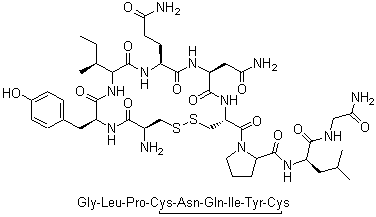 |
| Molecular Formula | C43H66N12O12S2 |
| Molecular Weight | 1007.19 |
| Protein Sequence | CYIQNCPLG |
| CAS Registry Number | 50-56-6 |
| EC Number | 200-048-4 |
| SMILES | CC[C@H](C)[C@H]1C(=O)N[C@H](C(=O)N[C@H](C(=O)N[C@@H](CSSC[C@@H](C(=O)N[C@H](C(=O)N1)CC2=CC=C(C=C2)O)N)C(=O)N3CCC[C@H]3C(=O)N[C@@H](CC(C)C)C(=O)NCC(=O)N)CC(=O)N)CCC(=O)N |
| Density | 1.3±0.1 g/cm3 Calc.* |
|---|---|
| Boiling point | 1533.3±65.0 °C 760 mmHg (Calc.)* |
| Flash point | 881.1±34.3 °C (Calc.)* |
| Solubility | Soluble water (1 mg/mL) (Expl.) |
| Index of refraction | 1.554 (Calc.)* |
| * | Calculated using Advanced Chemistry Development (ACD/Labs) Software. |
| Hazard Symbols |   GHS07;GHS08 Warning Details GHS07;GHS08 Warning Details | ||||||||||||||||||||||||||||||||||||||||||||||||||||
|---|---|---|---|---|---|---|---|---|---|---|---|---|---|---|---|---|---|---|---|---|---|---|---|---|---|---|---|---|---|---|---|---|---|---|---|---|---|---|---|---|---|---|---|---|---|---|---|---|---|---|---|---|---|
| Risk Statements | H302-H361 Details | ||||||||||||||||||||||||||||||||||||||||||||||||||||
| Safety Statements | P203-P264-P270-P280-P301+P317-P318-P330-P405-P501 Details | ||||||||||||||||||||||||||||||||||||||||||||||||||||
| Hazard Classification | |||||||||||||||||||||||||||||||||||||||||||||||||||||
| |||||||||||||||||||||||||||||||||||||||||||||||||||||
| SDS | Available | ||||||||||||||||||||||||||||||||||||||||||||||||||||
 chemBlink Chemical Story
|
Oxytocin is a naturally occurring peptide hormone produced primarily in the hypothalamus and secreted by the posterior pituitary gland. It plays a crucial role in a variety of physiological and behavioral processes, including uterine contraction during labor, milk ejection during lactation, and the modulation of social bonding and emotional behaviors. Structurally, oxytocin is a nonapeptide composed of nine amino acids, with a disulfide bridge between cysteine residues that stabilizes its cyclic structure. The discovery of oxytocin dates back to the early 20th century when scientists identified a substance from the posterior pituitary capable of inducing uterine contractions. Over the following decades, the hormone was chemically characterized and synthesized, enabling the development of pharmaceutical preparations for clinical use. Synthetic oxytocin is widely used in obstetrics to induce or augment labor, prevent postpartum hemorrhage, and facilitate milk letdown in breastfeeding. Oxytocin exerts its effects by binding to oxytocin receptors, which are members of the G protein-coupled receptor family. These receptors are widely distributed in reproductive tissues, including the uterus and mammary glands, as well as in certain regions of the brain. Binding of oxytocin to its receptor activates intracellular signaling cascades, leading to increased intracellular calcium and subsequent smooth muscle contraction. In the central nervous system, oxytocin influences neuronal circuits involved in social recognition, trust, and maternal behaviors. Clinical applications of oxytocin include the induction of labor in cases of delayed or stalled labor, the management of postpartum hemorrhage by promoting uterine contraction, and stimulation of lactation in mothers with insufficient milk production. Oxytocin is administered intravenously for labor induction or intramuscularly for postpartum hemorrhage, with dosing carefully titrated to achieve effective uterine contraction while minimizing adverse effects. Beyond reproductive and lactation functions, oxytocin has been studied for its potential roles in psychiatric and neurological conditions. Research suggests that oxytocin may modulate anxiety, social behavior, and emotional processing, and it has been investigated as a potential therapeutic agent in disorders such as autism spectrum disorder, social anxiety, and schizophrenia. The mechanisms underlying these effects involve oxytocinergic modulation of brain regions including the amygdala, hypothalamus, and prefrontal cortex. Pharmacokinetically, oxytocin has a short half-life in circulation, typically ranging from 3 to 5 minutes, necessitating continuous infusion or repeated dosing in clinical settings. Its metabolism occurs primarily in the liver and kidneys through enzymatic degradation. Due to its rapid clearance and peptide nature, oxytocin cannot be administered orally, and parenteral administration is required to achieve therapeutic concentrations. Overall, oxytocin represents a key hormone with dual roles in reproduction and social behavior. Its discovery, synthesis, and clinical application have had profound impacts on obstetrics and neonatology, while ongoing research continues to explore its broader physiological and potential therapeutic roles in human health. References Gimpl G, Fahrenholz F (2001) The oxytocin receptor system: structure, function, and regulation. Physiological Reviews 81(2) 629–683 DOI: 10.1152/physrev.2001.81.2.629 |
| Market Analysis Reports |