
Online Database of Chemicals from Around the World
| Hangzhou Verychem Science And Technology Co., Ltd. | China | |||
|---|---|---|---|---|
 | www.verychem.com | |||
 | +86 (571) 8816-2785 +86 13606544505 | |||
 | +86 (571) 8816-2787 | |||
 | lucy@verychem.com | |||
| Chemical manufacturer since 2004 | ||||
| chemBlink Massive supplier since 2021 | ||||
| Simagchem Corporation | China | |||
|---|---|---|---|---|
| www.simagchem.com | |||
| +86 13806087780 | |||
| +86 (592) 268-0237 | |||
| sale@simagchem.com | |||
| Chemical manufacturer since 2002 | ||||
| chemBlink Standard supplier since 2008 | ||||
| ShangHai PuYi Chemical Co., Ltd. | China | |||
|---|---|---|---|---|
| www.gyrochem.com | |||
| +86 (21) 5768-7505 ex 305 +86 13601674297 +86 15601977133 | |||
| +86 (21) 5768-7512 | |||
| sales@gyrochem.com annafan@gyrochem.com | |||
 | QQ Chat | |||
| Chemical manufacturer since 2008 | ||||
| chemBlink Standard supplier since 2008 | ||||
| Extrasynthese Chemical S.A.S. | France | |||
|---|---|---|---|---|
| www.extrasynthese.com | |||
| +33 (47) 898-2034 | |||
| +33 (47) 898-1945 | |||
| info@extrasynthese.com | |||
| Chemical manufacturer | ||||
| chemBlink Standard supplier since 2009 | ||||
| BOC Sciences | USA | |||
|---|---|---|---|---|
| www.bocsci.com | |||
| +1 (631) 485-4226 | |||
| +1 (631) 614-7828 | |||
| info@bocsci.com | |||
| Chemical manufacturer | ||||
| chemBlink Standard supplier since 2010 | ||||
| Xi'an Union Pharmpro Co., Ltd. | China | |||
|---|---|---|---|---|
| www.unipharmpro.com | |||
| +86 (29) 8886-5676 | |||
| +86 (29) 8886-3915 | |||
| info@unipharmpro.com | |||
| Chemical manufacturer | ||||
| chemBlink Standard supplier since 2012 | ||||
| Hangzhou Leap Chem Co., Ltd. | China | |||
|---|---|---|---|---|
| www.leapchem.com | |||
| +86 (571) 8771-1850 | |||
| market19@leapchem.com | |||
| QQ Chat | |||
| Chemical manufacturer since 2006 | ||||
| chemBlink Standard supplier since 2015 | ||||
| Wuxi Jingyao Biomedical Co., Ltd. | China | |||
|---|---|---|---|---|
| www.jingyaobiotech.cn | |||
| +86 (510) 8877-0633 | |||
| +86 (510) 8877-0633 | |||
| jingyaobiotech@126.com | |||
| Chemical distributor since 2015 | ||||
| chemBlink Standard supplier since 2016 | ||||
| Beijing Leaderherb Bio-tech. Co., Ltd. | China | |||
|---|---|---|---|---|
| www.china-api.cn | |||
| +86 (10) 5128-8246 | |||
| +86 (10) 5649-5849 | |||
| 300abc@sina.com | |||
| Chemical manufacturer since 2006 | ||||
| chemBlink Standard supplier since 2016 | ||||
| Neostar United (Changzhou) Industrial Co., Ltd. | China | |||
|---|---|---|---|---|
| www.neostarunited.com | |||
| +86 (519) 8555-7386 +86 18015025600 | |||
| +86 (519) 8555-7389 | |||
| marketing1@neostarunited.com | |||
| Chemical distributor since 2014 | ||||
| chemBlink Standard supplier since 2020 | ||||
| Dragonfarm Co., Ltd. | China | |||
|---|---|---|---|---|
| www.dragonpharm.com.cn | |||
| +86 (571) 8589-9500 8589-9501 8589-9568 | |||
| +86 (571) 8589-9589 | |||
| service@apichina.cn | |||
| Chemical distributor | ||||
| Kingchem Inc. | USA | |||
|---|---|---|---|---|
| www.kingchem.com | |||
| +1 (800) 211-4330 (201) 825-9988 | |||
| +1 (201) 825-9148 | |||
| customer-service@kingchem.com | |||
| Chemical manufacturer since 1994 | ||||
| Anvia Chemicals, LLC | USA | |||
|---|---|---|---|---|
| www.anviachem.com | |||
| +1 (414) 534-7845 | |||
| +1 (414) 762-5539 | |||
| sales@anviachem.com | |||
| Chemical manufacturer | ||||
| Classification | Chemical reagent >> Organic reagent >> Imide |
|---|---|
| Name | Tyramine |
| Synonyms | 2-(p-Hydroxyphenyl)ethylamine; 4-(2-Aminoethyl)phenol; 4-Hydroxyphenylethylamine; L-Tyramine; Tyrosamine |
| Molecular Structure | 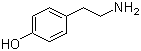 |
| Molecular Formula | C8H11NO |
| Molecular Weight | 137.18 |
| CAS Registry Number | 51-67-2 |
| EC Number | 200-115-8 |
| FEMA | 4215 |
| SMILES | C1=CC(=CC=C1CCN)O |
| Density | 1.1±0.1 g/cm3 Calc.* |
|---|---|
| Melting point | 160 - 162 °C (Expl.) |
| Boiling point | 325.2 °C 760 mmHg (Calc.)*, 363 - 371.3 °C (Expl.) |
| Flash point | 119.2±20.4 °C (Calc.)* |
| Solubility | water: 1g/95mL (15 °C) (Expl.) |
| Index of refraction | 1.577 (Calc.)* point |
| Boiling point | 175-181 °C (8 mmHg) |
| Water solubility | 1g/95mL (15 °C) |
| * | Calculated using Advanced Chemistry Development (ACD/Labs) Software. |
| Hazard Symbols |  GHS07 Warning Details GHS07 Warning Details | ||||||||||||||||||||||||
|---|---|---|---|---|---|---|---|---|---|---|---|---|---|---|---|---|---|---|---|---|---|---|---|---|---|
| Risk Statements | H315-H319-H335 Details | ||||||||||||||||||||||||
| Safety Statements | P261-P264-P264+P265-P271-P280-P302+P352-P304+P340-P305+P351+P338-P319-P321-P332+P317-P337+P317-P362+P364-P403+P233-P405-P501 Details | ||||||||||||||||||||||||
| Hazard Classification | |||||||||||||||||||||||||
| |||||||||||||||||||||||||
| SDS | Available | ||||||||||||||||||||||||
 chemBlink Chemical Story
|
Tyramine is a naturally occurring biogenic amine that has played a remarkable role in the development of neurochemistry, pharmacology, and food science. Although it is a relatively simple molecule derived from the amino acid tyrosine, its scientific importance extends far beyond its chemical structure. From its early discovery in aged cheese to its role in revealing the interaction between foods and antidepressant drugs, tyramine has repeatedly helped scientists understand how small molecules communicate with the human body. The name tyramine reflects its history. It was first isolated from cheese, and its name originates from the Greek word tyros, meaning "cheese." Researchers later found that tyramine is produced naturally when certain microorganisms decarboxylate the amino acid tyrosine during fermentation or aging. As a result, tyramine occurs not only in aged cheeses, but also in fermented soy products, cured meats, yeast extracts, and various fermented beverages. It is also synthesized in small amounts within plants, animals, and the human body. For many years tyramine was regarded simply as another naturally occurring amine. This perception changed as physiologists discovered that it could stimulate the release of norepinephrine from sympathetic nerve terminals. Rather than acting primarily as a classical neurotransmitter, tyramine functions as an indirect sympathomimetic agent, triggering the release of neurotransmitters that regulate blood pressure and cardiovascular responses. Studies of tyramine therefore contributed significantly to understanding chemical signaling in the autonomic nervous system. Its greatest historical importance emerged during the development of monoamine oxidase inhibitors (MAOIs), one of the earliest classes of antidepressant drugs introduced in the 1950s. Under normal physiological conditions, tyramine absorbed from food is rapidly metabolized by monoamine oxidase (MAO) in the intestinal wall and liver before reaching the systemic circulation in significant amounts. Patients receiving MAOI therapy, however, lose much of this protective metabolic pathway. As a result, dietary tyramine can enter the bloodstream, stimulate massive norepinephrine release, and produce sudden, sometimes life-threatening elevations in blood pressure. This unexpected interaction became widely known as the "cheese effect." It represented one of the first clear demonstrations that naturally occurring compounds in ordinary foods could interact profoundly with prescription medicines. The discovery transformed clinical practice, leading physicians to provide detailed dietary guidance for patients receiving MAOIs. It also encouraged pharmaceutical researchers to develop newer antidepressants with improved selectivity and safety profiles. Research on tyramine continued well beyond the cheese effect. During the late twentieth century, scientists discovered trace amine-associated receptors (TAARs), revealing that trace amines such as tyramine participate in previously unrecognized signaling pathways within the nervous system. Although tyramine is present at much lower concentrations than classical neurotransmitters such as dopamine or serotonin, studies of TAAR biology have suggested that trace amines may contribute to the regulation of mood, cognition, and neurological function. This discovery has renewed scientific interest in molecules once considered physiologically insignificant. Today, tyramine occupies a unique position at the intersection of chemistry, medicine, and nutrition. It serves as a reminder that naturally occurring molecules found in everyday foods can profoundly influence human physiology under specific conditions. More importantly, its history demonstrates how a simple food-derived compound helped establish modern concepts of neurochemical communication, drug-food interactions, and receptor biology. The scientific significance of tyramine therefore extends far beyond its identity as a biogenic amine. It represents one of the earliest examples showing that chemistry connects food, medicine, and the nervous system. Its story illustrates how careful observation of an unexpected clinical phenomenon can transform both biomedical research and patient care, making tyramine one of the classic small molecules in the history of neurochemistry. References 1. Blackwell, B. (1963). "Hypertensive Crisis Due to Monoamine-Oxidase Inhibitors." The Lancet, 282, 849–851. 2. Berry, M. D. (2004). "Mammalian Central Nervous System Trace Amines." Pharmacologic Reviews, 56(2), 299–320. https://doi.org/10.1124/pr.56.2.4 3. Broadley, K. J. (2010). "The Vascular Effects of Trace Amines and Amphetamines." Pharmacology & Therapeutics, 125, 363–375. https://doi.org/10.1016/j.pharmthera.2009.11.005 |
| Market Analysis Reports |