
Online Database of Chemicals from Around the World
| Simagchem Corporation | China | |||
|---|---|---|---|---|
 | www.simagchem.com | |||
 | +86 13806087780 | |||
 | +86 (592) 268-0237 | |||
 | sale@simagchem.com | |||
| Chemical manufacturer since 2002 | ||||
| chemBlink Standard supplier since 2008 | ||||
| Brook Chemical Limited | China | |||
|---|---|---|---|---|
| www.chembrook.com | |||
| +86 (21) 5276-2796 | |||
| +86 (21) 5206-2290 | |||
| info@chembrook.com ellen.cheung@chembrook.com | |||
| Chemical manufacturer | ||||
| chemBlink Standard supplier since 2009 | ||||
| BOC Sciences | USA | |||
|---|---|---|---|---|
| www.bocsci.com | |||
| +1 (631) 485-4226 | |||
| +1 (631) 614-7828 | |||
| info@bocsci.com | |||
| Chemical manufacturer | ||||
| chemBlink Standard supplier since 2010 | ||||
| Hangzhou Leap Chem Co., Ltd. | China | |||
|---|---|---|---|---|
| www.leapchem.com | |||
| +86 (571) 8771-1850 | |||
| market19@leapchem.com | |||
 | QQ Chat | |||
| Chemical manufacturer since 2006 | ||||
| chemBlink Standard supplier since 2015 | ||||
| Riverland Trading LLC. | USA | |||
|---|---|---|---|---|
| www.riverlandtrading.com | |||
| +1 (336).944-2293 | |||
| bens@riverlandtrading.com | |||
| Chemical distributor | ||||
| chemBlink Standard supplier since 2023 | ||||
| Bruc Chemicals Co., Ltd. | China | |||
|---|---|---|---|---|
| www.brucchem.com | |||
| +86 15820039489 | |||
| brucneochem@outlook.com | |||
| Chemical manufacturer since 2010 | ||||
| chemBlink Standard supplier since 2026 | ||||
| Toronto Research Chemicals Inc. | Canada | |||
|---|---|---|---|---|
| www.trc-canada.com | |||
| +1 (416) 665-9696 | |||
| +1 (416) 665-4439 | |||
| info@trc-canada.com | |||
| Chemical manufacturer since 1982 | ||||
| Classification | Organic raw materials >> Carboxylic compounds and derivatives >> Carboxylic esters and their derivatives |
|---|---|
| Name | Bis(2-propylheptyl) phthalate |
| Molecular Structure | 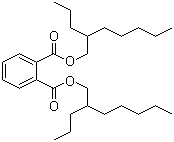 |
| Molecular Formula | C28H46O4 |
| Molecular Weight | 446.66 |
| CAS Registry Number | 53306-54-0 |
| EC Number | 258-469-4 |
| SMILES | CCCCCC(CCC)COC(=O)C1=CC=CC=C1C(=O)OCC(CCC)CCCCC |
| Density | 1.0±0.1 g/cm3 Calc.* |
|---|---|
| Boiling point | 425.8±13.0 °C 760 mmHg (Calc.)* |
| Flash point | 227.6±9.3 °C (Calc.)* |
| Index of refraction | 1.487 (Calc.)* |
| * | Calculated using Advanced Chemistry Development (ACD/Labs) Software. |
| Hazard Symbols |   GHS08;GHS09 Danger Details GHS08;GHS09 Danger Details |
|---|---|
| Risk Statements | H316-H320-H360-H351-H400 Details |
| Safety Statements | P501-P273-P202-P201-P264-P280-P391-P308+P313-P337+P313-P305+P351+P338-P332+P313-P405 Details |
| Transport Information | UN 3082 |
| SDS | Available |
 chemBlink Chemical Story
|
Bis(2-propylheptyl) phthalate, commonly abbreviated DPHP, is a high-molecular-weight phthalate ester used primarily as a plasticizer for polyvinyl chloride (PVC). Its role is deceptively simple: it helps transform naturally rigid PVC into a flexible material. Yet the molecular design of DPHP reflects decades of development in plasticizer technology, particularly the search for additives that remain in a polymer for long periods and continue performing under demanding conditions. Pure PVC is inherently hard. Its polymer chains interact strongly and cannot easily move past one another at ordinary temperatures. This is useful for rigid pipes and construction profiles, but unsuitable for products such as flexible electrical insulation, roofing membranes, hoses, flooring, and coated fabrics. Plasticizers solve this problem by positioning themselves among the polymer chains, reducing intermolecular interactions and increasing molecular mobility. The result is a material that can bend and deform without losing the basic chemical identity of PVC. DPHP belongs to the higher-molecular-weight members of the phthalate plasticizer family. Its structure consists of a phthalate core esterified with two branched C10 alcohol-derived groups. The long, branched hydrocarbon chains contribute to its low volatility and compatibility with flexible PVC. Commercial technical information describes DPHP as a primary plasticizer for PVC resins and copolymers, particularly suited to applications where long-term durability at elevated temperatures is important. This makes DPHP especially useful in electrical wire and cable compounds. Electrical insulation may remain in service for decades while experiencing heat generated by current, elevated ambient temperatures, and repeated thermal cycling. A plasticizer that evaporates or migrates too readily can gradually leave PVC harder and less flexible. DPHP's relatively high molecular weight and low volatility help reduce such losses, making it useful in formulations designed for extended service life. The same characteristics support its use in construction and automotive materials. Flexible PVC membranes, roofing products, coated fabrics, sealants, and interior or underbody automotive components may experience prolonged heat exposure and environmental aging. In these applications, the plasticizer is not merely responsible for making PVC soft on the day it is manufactured. It must help maintain the desired mechanical properties years later. DPHP therefore illustrates an important evolution in plasticizer design. Early plasticizer development focused heavily on achieving softness and processability. As applications became more demanding, additional properties became increasingly important: permanence, thermal stability, extraction resistance, low volatility, compatibility, and predictable performance over the product's lifetime. The choice of plasticizer became a sophisticated part of materials engineering rather than simply a method for softening plastic. At the same time, DPHP belongs to the broader phthalate family, whose members have received extensive toxicological and regulatory attention. It is important to distinguish among individual phthalates rather than treating them as a single substance. Differences in molecular size, metabolism, exposure, use pattern, and toxicological profile can be substantial. DPHP has therefore undergone its own toxicological evaluations, including studies of repeated exposure, reproduction, development, and metabolism. Its environmental behavior is also influenced by the same molecular properties that make it useful as a durable plasticizer. DPHP has very low water solubility and low vapor pressure, while its strong hydrophobicity favors association with organic matter and particles. Like conventional external plasticizers, it is physically incorporated into PVC rather than covalently attached to the polymer chain, so release from products remains possible during manufacturing, use, weathering, and disposal. The story of DPHP is therefore not simply about making plastic softer. It demonstrates how chemists can control the useful lifetime of a material by changing the molecular characteristics of an additive. Increasing molecular size and changing the branching of its hydrocarbon groups can influence volatility, migration, compatibility, and long-term performance. A flexible cable that remains flexible after years of heat exposure may look completely ordinary. But its durability depends on carefully balancing the properties of the polymer with molecules that are not part of the polymer chain at all. DPHP is one example of that largely invisible branch of materials science: engineering not only how a material behaves today, but how well it preserves that behavior over time. References 1. BASF. Technical Information: Palatinol DPHP. Bis(2-propylheptyl) phthalate, CAS 53306-54-0. Primary plasticizer for polyvinyl chloride resins and copolymers. BASF Palatinol DPHP Technical Information 2. U.S. Consumer Product Safety Commission. Toxicity Review of Di(2-propylheptyl) Phthalate (DPHP). CAS 53306-54-0. U.S. CPSC DPHP Toxicity Review 3. European Chemicals Agency. Bis(2-propylheptyl) phthalate, CAS 53306-54-0. Chemical and regulatory information. |
| Market Analysis Reports |