
Online Database of Chemicals from Around the World
| Beijing Kaida Technology Development Co., Ltd. | China | |||
|---|---|---|---|---|
 | www.bjkaida.cn | |||
 | +86 (10) 6299-3416 +86 13811060439 | |||
 | +86 (10) 6299-3416 | |||
 | kaida@bjkaida.cn bjkaida@163.com | |||
| Chemical manufacturer | ||||
| chemBlink Standard supplier since 2009 | ||||
| Hangzhou Leap Chem Co., Ltd. | China | |||
|---|---|---|---|---|
| www.leapchem.com | |||
| +86 (571) 8771-1850 | |||
| market19@leapchem.com | |||
 | QQ Chat | |||
| Chemical manufacturer since 2006 | ||||
| chemBlink Standard supplier since 2015 | ||||
| Shanghai Rochi Pharmaceutical Co., Ltd. | China | |||
|---|---|---|---|---|
| www.rochipharma.com | |||
| +86 (21) 3875-1876 +86 15000076078 | |||
| +86 (21) 5027-5764 | |||
| info@rochipharma.com | |||
| QQ Chat | |||
| Chemical manufacturer since 2009 | ||||
| chemBlink Standard supplier since 2015 | ||||
| Hangzhou Cherry Pharmaceutical Technology Co., Ltd. | China | |||
|---|---|---|---|---|
| www.cherrypharmatech.com | |||
| +86 (571) 8163-6070 +86 18042403330 | |||
| +86 (571) 8163-6070 | |||
| info@cherrypharmatech.com | |||
| QQ Chat | |||
 | Skype Chat | |||
| Chemical manufacturer since 2015 | ||||
| chemBlink Standard supplier since 2015 | ||||
| Amadis Chemical Co., Ltd. | China | |||
|---|---|---|---|---|
| www.amadischem.com | |||
| +86 (571) 8992-5085 | |||
| +86 (571) 8992-5065 | |||
| sales@amadischem.com | |||
| Chemical manufacturer since 2010 | ||||
| chemBlink Standard supplier since 2015 | ||||
| Nanjing Bic Biotechnology Co., Ltd. | China | |||
|---|---|---|---|---|
| www.bicbiotech.com | |||
| +86 18851183712 | |||
| sales@bicbiotech.com | |||
| QQ Chat | |||
 | WeChat: +8618851183712 | |||
 | WhatsApp:+8618851183712 | |||
| Chemical manufacturer since 2023 | ||||
| chemBlink Standard supplier since 2026 | ||||
| Chess GmbH | Germany | |||
|---|---|---|---|---|
| www.chess-chem.com | |||
| +49 (621) 318-9794 | |||
| +49 (621) 318-9691 | |||
| sales@chess-chem.com | |||
| Chemical manufacturer | ||||
| Anvia Chemicals, LLC | USA | |||
|---|---|---|---|---|
| www.anviachem.com | |||
| +1 (414) 534-7845 | |||
| +1 (414) 762-5539 | |||
| sales@anviachem.com | |||
| Chemical manufacturer | ||||
| Aaron Chemistry GmbH | Germany | |||
|---|---|---|---|---|
| www.aaron-chemistry.de | |||
| +49 (8823) 917-521 | |||
| +49 (8823) 917-523 | |||
| sales@aaron-chemistry.de | |||
| Chemical manufacturer | ||||
| Classification | Organic raw materials >> Heterocyclic compound >> Piperidines |
|---|---|
| Name | 4-(Piperidin-4-yl)morpholine |
| Molecular Structure | 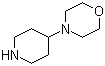 |
| Molecular Formula | C9H18N2O |
| Molecular Weight | 170.25 |
| CAS Registry Number | 53617-35-9 |
| EC Number | 627-580-3 |
| SMILES | C1CNCCC1N2CCOCC2 |
| Density | 1.0±0.1 g/cm3 Calc.* |
|---|---|
| Melting point | 40 - 43 °C (Expl.) |
| Boiling point | 256.3±35.0 °C 760 mmHg (Calc.)*, 392 - 417.7 °C (Expl.) |
| Flash point | 108.8±25.9 °C (Calc.)* |
| Index of refraction | 1.495 (Calc.)* |
| * | Calculated using Advanced Chemistry Development (ACD/Labs) Software. |
| Hazard Symbols |  GHS07 Warning Details GHS07 Warning Details | ||||||||||||||||||||||||||||||||||||||||||||
|---|---|---|---|---|---|---|---|---|---|---|---|---|---|---|---|---|---|---|---|---|---|---|---|---|---|---|---|---|---|---|---|---|---|---|---|---|---|---|---|---|---|---|---|---|---|
| Risk Statements | H315-H319-H335 Details | ||||||||||||||||||||||||||||||||||||||||||||
| Safety Statements | P261-P264-P264+P265-P271-P280-P302+P352-P304+P340-P305+P351+P338-P319-P321-P332+P317-P337+P317-P362+P364-P403+P233-P405-P501 Details | ||||||||||||||||||||||||||||||||||||||||||||
| Hazard Classification | |||||||||||||||||||||||||||||||||||||||||||||
| |||||||||||||||||||||||||||||||||||||||||||||
| SDS | Available | ||||||||||||||||||||||||||||||||||||||||||||
 chemBlink Chemical Story
|
4-(Piperidin-4-yl)morpholine is a heterocyclic compound containing a piperidine ring connected at the 4-position to a morpholine moiety. Both piperidine and morpholine are six-membered nitrogen-containing rings that are commonly found in medicinal chemistry due to their favorable pharmacokinetic properties, basicity, and ability to form hydrogen bonds with biological targets. The combination of these two rings in a single molecule creates a bifunctional scaffold that can act as a versatile building block in drug design and organic synthesis. Structurally, the compound consists of a piperidine ring in which the nitrogen atom contributes to the basicity of the molecule, and a morpholine ring attached through the 4-position of the piperidine. Morpholine contains an oxygen atom in the ring, which adds polarity and hydrogen-bonding potential. The spatial arrangement of the two rings imparts flexibility while maintaining a defined three-dimensional structure, which is beneficial for interactions with receptors, enzymes, or ion channels. The synthesis of 4-(Piperidin-4-yl)morpholine can be accomplished by nucleophilic substitution or ring-closing strategies. One common approach involves reacting 4-halo- or 4-tosylpiperidine with morpholine under conditions that favor the formation of the C–N bond, producing the target compound in high yield. Alternative methods include reductive amination or using activated intermediates to attach the morpholine moiety to the piperidine ring selectively. These strategies provide access to the compound as a stable intermediate suitable for further chemical modifications. In medicinal chemistry, 4-(Piperidin-4-yl)morpholine is used as a scaffold for designing compounds that target central nervous system receptors, transporters, and enzymes. The piperidine nitrogen can engage in ionic interactions with acidic residues in biological targets, while the morpholine oxygen can participate in hydrogen bonding or increase aqueous solubility. Substituents can be further introduced on either ring to modulate potency, selectivity, and pharmacokinetic properties, making the compound valuable for drug discovery programs focused on neuroactive agents or enzyme inhibitors. Beyond pharmacological applications, 4-(Piperidin-4-yl)morpholine is a versatile intermediate in organic synthesis. Its bifunctional nature allows it to participate in cross-coupling reactions, acylations, and alkylations. The basic nitrogen atoms can be protected, modified, or quaternized, enabling selective transformations at specific sites. This versatility allows chemists to construct complex heterocyclic molecules or incorporate the scaffold into larger molecular architectures for chemical libraries and screening campaigns. Overall, 4-(Piperidin-4-yl)morpholine exemplifies a flexible and pharmacologically relevant heterocyclic building block. Its combination of a basic piperidine ring and a polar morpholine ring enables hydrogen-bonding, ionic interactions, and solubility modulation. These properties make it valuable for medicinal chemistry, the synthesis of bioactive compounds, and the development of novel heterocyclic derivatives. References 2023. Insights of Indole: A Novel Target in Medicinal Chemistry (A Review). Russian Journal of General Chemistry. DOI: 10.1134/s1070363223070216 2016. Alectinib. Pharmaceutical Substances. 2009. Parallel Synthesis of Drug-like 5-Amino-Substituted 1,2,4-Thiadiazole Libraries Using Cyclization Reactions of a Carboxamidine Dithiocarbamate Linker. Synthesis. DOI: 10.1055/s-0028-1087970 |
| Market Analysis Reports |