
Online Database of Chemicals from Around the World
| Hefei TNJ Chemical Industry Co., Ltd. | China | |||
|---|---|---|---|---|
 | www.tnjchem.com | |||
 | +86 (551) 6541-8684 | |||
 | +86 (551) 6541-8697 | |||
 | sales@tnjchem.com | |||
| Chemical manufacturer since 2001 | ||||
| chemBlink Standard supplier since 2010 | ||||
| BOC Sciences | USA | |||
|---|---|---|---|---|
| www.bocsci.com | |||
| +1 (631) 485-4226 | |||
| +1 (631) 614-7828 | |||
| info@bocsci.com | |||
| Chemical manufacturer | ||||
| chemBlink Standard supplier since 2010 | ||||
| Intatrade Chemicals GmbH | Germany | |||
|---|---|---|---|---|
| www.intatrade.de | |||
| +49 (3493) 605-465 | |||
| +49 (3493) 605-470 | |||
| sales@intatrade.de | |||
| Chemical distributor | ||||
| chemBlink Standard supplier since 2011 | ||||
| Gihi Chemicals Co., Ltd. | China | |||
|---|---|---|---|---|
| www.gihichem.com | |||
| +86 (571) 8621-7390 +86 18072806364 | |||
| +86 (571) 8621-7391 | |||
| sales@gihichem.com | |||
| Chemical manufacturer since 2000 | ||||
| chemBlink Standard supplier since 2013 | ||||
| Suzhou Myland Pharm & Nutrition Inc. | China | |||
|---|---|---|---|---|
| www.mylandpharm.com | |||
| +86 (512) 6615-0687 | |||
| +86 (512) 6615-7101 | |||
| info@mylandpharm.com | |||
 | QQ Chat | |||
| Chemical manufacturer since 2013 | ||||
| chemBlink Standard supplier since 2014 | ||||
| Hangzhou Leap Chem Co., Ltd. | China | |||
|---|---|---|---|---|
| www.leapchem.com | |||
| +86 (571) 8771-1850 | |||
| market19@leapchem.com | |||
| QQ Chat | |||
| Chemical manufacturer since 2006 | ||||
| chemBlink Standard supplier since 2015 | ||||
| Beijing Leaderherb Bio-tech. Co., Ltd. | China | |||
|---|---|---|---|---|
| www.china-api.cn | |||
| +86 (10) 5128-8246 | |||
| +86 (10) 5649-5849 | |||
| 300abc@sina.com | |||
| Chemical manufacturer since 2006 | ||||
| chemBlink Standard supplier since 2016 | ||||
| Papchem Lifesciences | India | |||
|---|---|---|---|---|
| papchemlifesciences.com | |||
| 9061328401 | |||
| bd@papchemlifesciences.com | |||
| Chemical manufacturer since 2021 | ||||
| chemBlink Standard supplier since 2024 | ||||
| Natural Micron Pharm Tech Co., Ltd. | China | |||
|---|---|---|---|---|
| nmpharmtech.com | |||
| +86 (0538) 535-2278 | |||
| info@nmpharmtech.com | |||
| Chemical manufacturer since 2012 | ||||
| chemBlink Standard supplier since 2025 | ||||
| Santa Cruz Biotechnology, Inc. | USA | |||
|---|---|---|---|---|
| www.scbt.com | |||
| +1 (831) 457-3800 | |||
| +1 (831) 457-3801 | |||
| scbt@scbt.com | |||
| Chemical manufacturer | ||||
| AK Scientific, Inc | USA | |||
|---|---|---|---|---|
| www.aksci.com | |||
| +1 (510) 429-8835 | |||
| +1 (510) 429-8836 | |||
| sales@aksci.com | |||
| Chemical manufacturer | ||||
| Classification | Biochemical >> Inhibitor >> DNA damage >> PPAR inhibitor |
|---|---|
| Name | Palmitoylethanolamide |
| Synonyms | N-(2-Hydroxyethyl)hexadecanamide; PEA; Palmidrol |
| Molecular Structure | 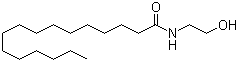 |
| Molecular Formula | C18H37NO2 |
| Molecular Weight | 299.49 |
| Protein Sequence | G |
| CAS Registry Number | 544-31-0 |
| EC Number | 208-867-9 |
| SMILES | CCCCCCCCCCCCCCCC(=O)NCCO |
| Solubility | 20 mM (DMSO), 25 mM (ethanol) |
|---|---|
| Melting point | 98-99 °C |
| Hazard Symbols |    GHS05;GHS07;GHS09 Danger Details GHS05;GHS07;GHS09 Danger Details | ||||||||||||||||
|---|---|---|---|---|---|---|---|---|---|---|---|---|---|---|---|---|---|
| Risk Statements | H315-H318-H411-H412 Details | ||||||||||||||||
| Safety Statements | P264-P264+P265-P273-P280-P302+P352-P305+P354+P338-P317-P321-P332+P317-P362+P364-P391-P501 Details | ||||||||||||||||
| Hazard Classification | |||||||||||||||||
| |||||||||||||||||
| SDS | Available | ||||||||||||||||
 chemBlink Chemical Story
|
Palmitoylethanolamide (PEA) is a naturally occurring fatty acid amide with important biological and therapeutic significance. PEA is well known for its role in the endocannabinoid system and has attracted much attention for its health benefits and applications. Palmitoylethanolamide, with the molecular formula C18H37NO2, was first discovered in the 1950s as a component of soybeans. It is a member of the N-acylethanolamine family, which also includes other compounds such as anandamide. PEA was discovered while studying biochemical pathways involved in inflammation and pain. PEA is a fatty acid amide derived from palmitic acid and ethanolamine. It is a white, odorless powder that is soluble in organic solvents but poorly soluble in water. Its chemical structure is characterized by long-chain fatty acids esterified with ethanolamine groups, which contribute to its biological activity. Palmitoylethanolamide has been widely studied for its anti-inflammatory and analgesic properties. It is believed to modulate pain and inflammation by affecting the endocannabinoid system and interacting with various receptors. Clinical studies have shown that PEA is effective in managing chronic pain conditions, including neuropathic pain and inflammatory diseases. Research suggests that PEA may have neuroprotective effects. It is believed to support neuronal health and prevent neurodegenerative diseases by reducing inflammation and oxidative stress. Its potential use in treating diseases such as multiple sclerosis and Alzheimer's disease is being investigated. PEA's anti-inflammatory properties extend to allergic diseases. It has shown promise in reducing symptoms of allergic rhinitis and asthma by modulating inflammatory responses, making it a candidate for developing new treatments for allergic diseases. In dermatology, PEA is being explored for its potential to improve skin health. Its anti-inflammatory effects are beneficial in treating conditions such as eczema and psoriasis. Topical formulations of PEA are being developed to soothe symptoms of skin diseases. Due to its wide range of potential health benefits, PEA is available as a dietary supplement. It plays an important role in supporting overall health, including pain relief, cognitive function, and immune health. As a natural compound, PEA is considered to have a good safety profile and minimal side effects compared to synthetic drugs. PEA's ability to affect a variety of biological pathways gives it the flexibility to treat a wide range of conditions, from pain and inflammation to neurological and allergic diseases. Ongoing research continues to reveal new therapeutic potential for PEA, enhancing its applicability in modern medicine and complementary health practices. References 2020. URB597 Prevents the Short-Term Excitotoxic Cell Damage in Rat Cortical Slices: Role of Cannabinoid 1 Receptors. Neurotoxicity Research, 38(4). DOI: 10.1007/s12640-020-00301-1 2018. Efficacy of ultramicronized palmitoylethanolamide in burning mouth syndrome-affected patients: a preliminary randomized double-blind controlled trial. Clinical Oral Investigations, 23(4). DOI: 10.1007/s00784-018-2720-7 2013. N-Palmitoylethanolamide protects the kidney from hypertensive injury in spontaneously hypertensive rats via inhibition of oxidative stress. Pharmacological Research, 76. DOI: 10.1016/j.phrs.2013.07.007 |
| Market Analysis Reports |