
Online Database of Chemicals from Around the World
| Watec Laboratories, Inc. | China | |||
|---|---|---|---|---|
 | www.wateclaboratories.com | |||
 | +86 (519) 8692-1516 +86 18602586511 | |||
 | +86 (519) 8526-7382 | |||
 | info@wateclaboratories.com | |||
 | QQ Chat | |||
| Chemical manufacturer since 2014 | ||||
| chemBlink Standard supplier since 2012 | ||||
| Xiamen Sunprochem Co., Ltd. | China | |||
|---|---|---|---|---|
| www.sunprochem.com | |||
| +86 (159) 8094-4750 | |||
| sale@sunprochem.com | |||
| QQ Chat | |||
 | WeChat: 15980944750 | |||
 | WhatsApp:+86 159 8094 4750 | |||
| Chemical manufacturer since 2026 | ||||
| chemBlink Standard supplier since 2026 | ||||
| Classification | Food additive >> Nutrition supplements >> Fatty acids |
|---|---|
| Name | 2-(4,4-dimethylpentan-2-yl)-5,7,7-trimethyloctanoic acid |
| Synonyms | Isostearic Acid |
| Molecular Structure | 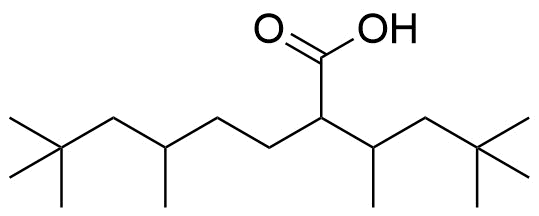 |
| Molecular Formula | C18H36O2 |
| Molecular Weight | 284.48 |
| CAS Registry Number | 54680-48-7 |
| EC Number | 679-806-5 |
| SMILES | CC(CCC(C(C)CC(C)(C)C)C(=O)O)CC(C)(C)C |
| Hazard Symbols |  GHS07 Warning Details GHS07 Warning Details | ||||||||
|---|---|---|---|---|---|---|---|---|---|
| Risk Statements | H319 Details | ||||||||
| Safety Statements | P264+P265-P280-P305+P351+P338-P337+P317 Details | ||||||||
| Hazard Classification | |||||||||
| |||||||||
| SDS | Available | ||||||||
 chemBlink Chemical Story
|
2-(4,4-Dimethylpentan-2-yl)-5,7,7-trimethyloctanoic acid is a highly branched aliphatic monocarboxylic acid with an extended hydrocarbon skeleton and a single terminal carboxyl group (–COOH). Its structure consists of an octanoic acid backbone that is extensively substituted with multiple methyl groups and a bulky alkyl substituent at the 2-position. The parent framework is octanoic acid, a straight-chain eight-carbon fatty acid. In this derivative, the carbon chain is heavily modified by branching: methyl groups are present at the 5-position and two methyl substituents at the 7-position (7,7-dimethyl substitution), and a large 4,4-dimethylpentan-2-yl group is attached at carbon 2. These substitutions create a compact, sterically hindered molecular architecture. The carboxylic acid functional group is the primary reactive site of the molecule. It can undergo typical carboxylic acid reactions such as esterification with alcohols, amidation with amines, salt formation with bases, and reduction to corresponding alcohols under strong reducing conditions. The acidity of the carboxyl group is influenced by the surrounding alkyl environment, although in this case the strong electron-donating effect of alkyl substituents slightly reduces acidity compared with less substituted carboxylic acids. The molecule is dominated by a hydrophobic hydrocarbon framework due to the extensive branching and high carbon content. This branching significantly affects its physical properties, typically lowering melting point, increasing solubility in nonpolar solvents, and reducing crystallinity compared with linear fatty acids of similar molecular weight. The steric bulk also reduces efficient packing in the solid state. The 4,4-dimethylpentan-2-yl substituent is a highly branched alkyl group containing a quaternary carbon center. This structural feature introduces significant steric hindrance near the carboxylic acid backbone, which can influence both chemical reactivity and intermolecular interactions such as hydrogen-bonded dimer formation, which is common in carboxylic acids. Like many long-chain carboxylic acids, this compound is expected to form hydrogen-bonded dimers in nonpolar environments through cyclic association of two carboxyl groups. In polar solvents or in ionized form, it may exist as carboxylate salts depending on pH conditions. From a physicochemical perspective, the compound is highly lipophilic and only weakly polar overall, despite the presence of the carboxyl group. It is expected to have low water solubility and higher solubility in organic solvents. The extensive branching also reduces van der Waals packing efficiency, which typically lowers melting point relative to linear analogues. Carboxylic acids with heavily branched structures are often encountered in industrial organic chemistry, particularly in applications involving lubricants, plasticizers, surfactant intermediates, and specialty esters. Branching is commonly introduced to tailor physical properties such as viscosity, oxidation stability, and low-temperature fluidity. Synthesis of such branched fatty acids generally involves multi-step carbon–carbon bond-forming reactions, such as alkylation of shorter acid precursors, aldol-type condensations, or controlled oligomerization of smaller building blocks followed by functional group transformations to introduce the carboxyl group. Historically, structural modification of fatty acids through branching has been an important strategy in industrial chemistry to move away from natural straight-chain fatty acids toward materials with improved thermal and oxidative stability and more desirable rheological properties. Overall, 2-(4,4-dimethylpentan-2-yl)-5,7,7-trimethyloctanoic acid is a highly branched aliphatic carboxylic acid characterized by a sterically congested hydrocarbon framework and a single terminal acid group. Its structure leads to strong hydrophobic character and physical properties typical of synthetic branched fatty acids used in specialty chemical applications. References 2025. Characterization of Branched-Chain Fatty Acids as Organic Friction-Modifier Additives for Boundary Lubrication. Tribology Letters. DOI: 10.1007/s11249-025-02067-z |
| Market Analysis Reports |