
Online Database of Chemicals from Around the World
| Guizhou Jianye Yongrong Technology Co., Ltd. (Changzhou Huadong Chemical Research Institute) | China | |||
|---|---|---|---|---|
 | www.huadongchem.com | |||
 | +86 +13851563211 | |||
 | +86 (519) 8261-6386 | |||
 | sales@huadongchem.com | |||
 | WeChat: +13851563211 | |||
| Chemical manufacturer since 1999 | ||||
| chemBlink Standard supplier since 2025 | ||||
| Classification | Surfactant >> Cationic surfactant >> Quaternary ammonium salt type |
|---|---|
| Name | Hexamethonium Bromide |
| Synonyms | trimethyl-[6-(trimethylazaniumyl)hexyl]azanium dibromide |
| Molecular Structure | 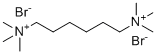 |
| Molecular Formula | C12H30Br2N2 |
| Molecular Weight | 362.19 |
| CAS Registry Number | 55-97-0 |
| EC Number | 200-249-7 |
| SMILES | C[N+](C)(C)CCCCCC[N+](C)(C)C.[Br-].[Br-] |
| Solubility | soluble 100mM (water), 50 mM (DMSO) (Expl.) |
|---|---|
| Hazard Symbols |  GHS08 Danger Details GHS08 Danger Details | ||||||||
|---|---|---|---|---|---|---|---|---|---|
| Risk Statements | H370 Details | ||||||||
| Safety Statements | P260-P264-P270-P308+P316-P321-P405-P501 Details | ||||||||
| Hazard Classification | |||||||||
| |||||||||
| SDS | Available | ||||||||
 chemBlink Chemical Story
|
Hexamethonium bromide is a chemical compound that belongs to the class of quaternary ammonium salts. It was first synthesized in the mid-20th century and gained significant attention for its pharmacological properties, particularly as a ganglionic blocker. The compound is derived from hexamethonium, which consists of a nitrogen atom bonded to six carbon atoms in a symmetrical arrangement, and bromide as the counterion. Hexamethonium bromide was initially developed for use in the treatment of hypertension (high blood pressure). Its primary mode of action is through blocking the transmission of nerve impulses in the autonomic ganglia. These ganglia are clusters of nerve cells that are part of the autonomic nervous system, which controls involuntary bodily functions such as heart rate, digestion, and blood pressure. By inhibiting the autonomic nervous system’s ability to regulate vascular tone, hexamethonium bromide effectively lowers blood pressure. This made it useful as an antihypertensive agent during the mid-20th century. However, the use of hexamethonium bromide as a therapeutic agent was eventually phased out. While it could lower blood pressure, its widespread blockade of autonomic function led to several undesirable side effects, including dry mouth, blurred vision, constipation, and a lack of ability to adjust blood pressure appropriately during physical activity. These side effects were a result of hexamethonium’s inability to selectively target specific receptors within the autonomic nervous system. Today, hexamethonium bromide is primarily used in scientific research rather than clinical settings. It continues to serve as a valuable tool in studies related to the autonomic nervous system, specifically for investigating the role of ganglionic transmission in regulating cardiovascular and other autonomic functions. Researchers use hexamethonium bromide to explore mechanisms of neurotransmission and develop a deeper understanding of the physiological processes controlled by the autonomic nervous system. Despite its decline in clinical use, hexamethonium bromide remains an important compound in the study of neuropharmacology and continues to contribute to the development of new strategies for treating cardiovascular diseases. References 2024 Acute effects of empagliflozin on open-loop baroreflex function and urine output in streptozotocin-induced type 1 diabetic rats. The Journal of Physiological Sciences, 1, 1. DOI: 10.1186/s12576-024-00938-z 2024 Effects of bilateral renal denervation on open-loop baroreflex function and urine excretion in spontaneously hypertensive rats. Hypertension Research, 1, 1. DOI: 10.1038/s41440-024-01883-5 2024 Role of GABAA receptors of the dorsomedial periaqueductal grey on blood pressure and heart rate in the anesthetized rat. Basic & Clinical Pharmacology & Toxicology, 1, 1. DOI: 10.1111/bcpt.14070 |
| Market Analysis Reports |