
Online Database of Chemicals from Around the World
| Nanjing Finetech Chemical Co., Ltd. | China | |||
|---|---|---|---|---|
 | www.fine-chemtech.com | |||
 | +86 (25) 5207-8417 +86 17714198479 | |||
 | +86 (25) 5207-8417 | |||
 | sales@fine-chemtech.com | |||
 | QQ Chat | |||
| Chemical manufacturer since 2007 | ||||
| chemBlink Standard supplier since 2007 | ||||
| BOC Sciences | USA | |||
|---|---|---|---|---|
| www.bocsci.com | |||
| +1 (631) 485-4226 | |||
| +1 (631) 614-7828 | |||
| info@bocsci.com | |||
| Chemical manufacturer | ||||
| chemBlink Standard supplier since 2010 | ||||
| Hangzhou Leap Chem Co., Ltd. | China | |||
|---|---|---|---|---|
| www.leapchem.com | |||
| +86 (571) 8771-1850 | |||
| market19@leapchem.com | |||
| QQ Chat | |||
| Chemical manufacturer since 2006 | ||||
| chemBlink Standard supplier since 2015 | ||||
| Zhejiang Rongchuang International Trade Co., Ltd. | China | |||
|---|---|---|---|---|
| www.peptideaas.com | |||
| +86 15924248838 | |||
| mihui41770@gmail.com | |||
| Chemical distributor since 2026 | ||||
| chemBlink Standard supplier since 2026 | ||||
| Ambinter | France | |||
|---|---|---|---|---|
| www.ambinter.com | |||
| +33 (1) 4524-4860 | |||
| +33 (1) 4524-6241 | |||
| contact@ambinter.com | |||
| Chemical manufacturer | ||||
| Toronto Research Chemicals Inc. | Canada | |||
|---|---|---|---|---|
| www.trc-canada.com | |||
| +1 (416) 665-9696 | |||
| +1 (416) 665-4439 | |||
| info@trc-canada.com | |||
| Chemical manufacturer since 1982 | ||||
| Classification | Pharmaceutical intermediate >> Heterocyclic compound intermediate >> Pyrimidine compound >> Amine |
|---|---|
| Name | Larocaine hydrochloride |
| Synonyms | Dimethocaine hydrochloride; 3-(Diethylamino)-2,2-dimethyl-1-propanol 4-aminobenzoate hydrochloride |
| Molecular Structure | 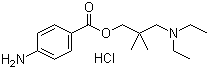 |
| Molecular Formula | C16H26N2O2.HCl |
| Molecular Weight | 314.85 |
| CAS Registry Number | 553-63-9 |
| EC Number | 687-983-5 |
| SMILES | CCN(CC)CC(C)(C)COC(=O)C1=CC=C(C=C1)N.Cl |
| Melting point | 195-196 °C |
|---|---|
| Hazard Symbols |  GHS06 Danger Details GHS06 Danger Details |
|---|---|
| Risk Statements | H301 Details |
| Safety Statements | P264-P270-P301+P316-P321-P330-P405-P501 Details |
| SDS | Available |
 chemBlink Chemical Story
|
Larocaine hydrochloride is a chemical compound that belongs to the class of local anesthetics. It is a derivative of the amino ester group, similar in structure to other local anesthetics, such as procaine and lidocaine, which are commonly used to provide temporary relief from pain during medical procedures. The primary mechanism of action of larocaine hydrochloride, like other local anesthetics, involves the blockade of sodium channels in nerve cells. By inhibiting sodium ion influx through these channels, larocaine prevents the propagation of action potentials along nerves. This blockage of nerve transmission leads to a reversible loss of sensation in the area where the anesthetic is applied, providing local anesthesia. Larocaine hydrochloride is typically used in various medical and dental procedures to prevent or alleviate pain. Its applications include minor surgical operations, dental extractions, and other interventions requiring temporary numbing of specific body areas. The compound is generally administered via injection or topical application, depending on the procedure and the required depth of anesthesia. The pharmacokinetics of larocaine hydrochloride, including its absorption, distribution, metabolism, and excretion, are similar to other local anesthetics. The onset of action is typically rapid, and the effects can last from a few minutes to several hours, depending on the concentration and the location of administration. Though larocaine hydrochloride is effective and widely used, there are potential side effects associated with its use. These may include allergic reactions, such as rashes or itching, and more serious side effects, including central nervous system toxicity, cardiovascular effects like arrhythmias, and local tissue reactions at the injection site. To minimize the risks of such side effects, the proper dosage and administration protocols must be followed. In conclusion, larocaine hydrochloride is a local anesthetic with applications in various medical and dental procedures. It works by blocking sodium channels in nerves, leading to a reversible loss of sensation. While effective, careful administration is required to avoid potential side effects associated with its use. References 2014. Dimethocaine, a synthetic cocaine derivative: Studies on its in vitro metabolism catalyzed by P450s and NAT2. Toxicology Letters, 225(1). DOI: 10.1016/j.toxlet.2013.11.033 2014. Dimethocaine, a synthetic cocaine analogue: studies on its in-vivo metabolism and its detectability in urine by means of a rat model and liquid chromatography-linear ion-trap (high-resolution) mass spectrometry. Analytical and Bioanalytical Chemistry, 406(7). DOI: 10.1007/s00216-013-7539-0 1996. Stimulant activities of dimethocaine in mice: reinforcing and anxiogenic effects. Psychopharmacology, 127(4). DOI: 10.1007/bf02806010 |
| Market Analysis Reports |