
Online Database of Chemicals from Around the World
| Shanghai Rui Yun Chemical Technology Co., Ltd. | China | |||
|---|---|---|---|---|
 | www.rychemical.com.cn | |||
 | +86 (21) 6726-7633 | |||
 | +86 (21) 6726-7655 | |||
 | sales@rychemical.com.cn | |||
 | WeChat: 13917251563 | |||
| Chemical manufacturer since 2009 | ||||
| chemBlink Premium supplier since 2009 | ||||
| Classification | Chemical reagent >> Organic reagent >> Amide |
|---|---|
| Name | p-Acetylamino benzoic acid |
| Synonyms | 4-(Acetylamino)benzoic acid; p-(Acetamino)benzoic acid; Acetylated PABA; N-(4-Carboxyphenyl)acetic acid amide; N-Acetyl-p-aminobenzoic acid |
| Molecular Structure | 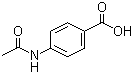 |
| Molecular Formula | C9H9NO3 |
| Molecular Weight | 179.17 |
| Protein Sequence | X |
| CAS Registry Number | 556-08-1 |
| EC Number | 209-114-7 |
| SMILES | CC(=O)NC1=CC=C(C=C1)C(=O)O |
| Melting point | 255-262 °C |
|---|---|
| Water solubility | <0.1 g/100 mL at 21 °C |
| Hazard Symbols |  GHS07 Warning Details GHS07 Warning Details | ||||||||||||||||||||
|---|---|---|---|---|---|---|---|---|---|---|---|---|---|---|---|---|---|---|---|---|---|
| Risk Statements | H315-H319-H335 Details | ||||||||||||||||||||
| Safety Statements | P261-P264-P264+P265-P271-P280-P302+P352-P304+P340-P305+P351+P338-P319-P321-P332+P317-P337+P317-P362+P364-P403+P233-P405-P501 Details | ||||||||||||||||||||
| Hazard Classification | |||||||||||||||||||||
| |||||||||||||||||||||
| SDS | Available | ||||||||||||||||||||
 chemBlink Chemical Story
|
p-Acetylamino benzoic acid, also known as acetylaminobenzoic acid, is an aromatic organic compound with a broad range of applications in chemistry and medicine. This compound is characterized by the presence of both an acetylamino group and a carboxyl group attached to a benzene ring, making it a useful intermediate in various chemical processes. The discovery of p-Acetylamino benzoic acid can be attributed to the early 20th century when researchers were investigating the synthesis of substituted benzoic acids. Its structure, featuring an acetylamino group (–NH–CO–CH3) at the para position relative to the carboxyl group (–COOH), was identified for its potential utility in synthetic chemistry. This specific arrangement of functional groups imparts unique properties to the molecule, enhancing its reactivity and applicability in multiple fields. One of the primary applications of p-Acetylamino benzoic acid is in the pharmaceutical industry. It serves as a key intermediate in the synthesis of various drugs, including analgesics and anti-inflammatory agents. For instance, it is used in the production of acetaminophen (paracetamol), a widely used over-the-counter pain reliever and fever reducer. The acetylamino group in p-Acetylamino benzoic acid is crucial for the formation of acetaminophen, making this compound an essential building block in its synthesis. In addition to its pharmaceutical applications, p-Acetylamino benzoic acid is employed in the field of dye chemistry. It can be used as a precursor in the synthesis of azo dyes, which are characterized by their vivid colors and wide range of applications in textiles and other materials. The compound's ability to form diazo intermediates allows it to participate in coupling reactions that produce these dyes, contributing to the color and stability of the final products. Furthermore, p-Acetylamino benzoic acid has applications in the synthesis of other organic compounds. Its functional groups enable it to undergo various chemical reactions, such as esterification and amidation, leading to the formation of diverse derivatives. These derivatives can be utilized in the development of new materials and chemicals, showcasing the compound's versatility in synthetic organic chemistry. In the field of materials science, p-Acetylamino benzoic acid is used as a reagent in the preparation of high-performance polymers. Its ability to form stable bonds with other molecules makes it a valuable component in the development of polymeric materials with specific properties. These materials are used in a range of applications, including coatings, adhesives, and composites. Overall, p-Acetylamino benzoic acid is a significant compound in organic synthesis with diverse applications in pharmaceuticals, dye chemistry, and materials science. Its unique structure and reactivity make it a valuable tool for chemists and researchers involved in the development of new drugs, dyes, and materials. References 2024. Studies on Secondary Metabolites and Biological Activities of Fungus Aspergillus sp. PQJ-1 from Sphagneticola trilobata. Chemistry of Natural Compounds, 60(11). DOI: 10.1007/s10600-024-04559-1 2024. Exploration of diverse secondary metabolites from Penicillium brasilianum by co-culturing with Armillaria mellea. Applied Microbiology and Biotechnology, 108(9). DOI: 10.1007/s00253-024-13282-4 2024. An Extremely Sensitive Ultra-High Throughput Growth Selection Assay for the Identification of Amidase Activity. Applied Microbiology and Biotechnology, 108(6). DOI: 10.1007/s00253-024-13233-z |
| Market Analysis Reports |