
Online Database of Chemicals from Around the World
| Nanjing Search Biotech Co., Ltd. | China | |||
|---|---|---|---|---|
 | www.searchbio.com.cn | |||
 | +86 (25) 8168-2922 8586-0978 +86 18913919581 | |||
 | +86 (25) 8586-0962 | |||
 | trade@searchbio.com.cn sales@searchbio.com.cn Linda@searchbio.com.cn | |||
 | QQ Chat | |||
| Chemical manufacturer since 2007 | ||||
| chemBlink Standard supplier since 2007 | ||||
| Simagchem Corporation | China | |||
|---|---|---|---|---|
| www.simagchem.com | |||
| +86 13806087780 | |||
| +86 (592) 268-0237 | |||
| sale@simagchem.com | |||
| Chemical manufacturer since 2002 | ||||
| chemBlink Standard supplier since 2008 | ||||
| Hefei TNJ Chemical Industry Co., Ltd. | China | |||
|---|---|---|---|---|
| www.tnjchem.com | |||
| +86 (551) 6541-8684 | |||
| +86 (551) 6541-8697 | |||
| sales@tnjchem.com | |||
| Chemical manufacturer since 2001 | ||||
| chemBlink Standard supplier since 2010 | ||||
| Intatrade Chemicals GmbH | Germany | |||
|---|---|---|---|---|
| www.intatrade.de | |||
| +49 (3493) 605-465 | |||
| +49 (3493) 605-470 | |||
| sales@intatrade.de | |||
| Chemical distributor | ||||
| chemBlink Standard supplier since 2011 | ||||
| Hangzhou Leap Chem Co., Ltd. | China | |||
|---|---|---|---|---|
| www.leapchem.com | |||
| +86 (571) 8771-1850 | |||
| market19@leapchem.com | |||
| QQ Chat | |||
| Chemical manufacturer since 2006 | ||||
| chemBlink Standard supplier since 2015 | ||||
| Hunan Yunbang Biomedical Co., Ltd. | China | |||
|---|---|---|---|---|
| www.hunanyunbang.com | |||
| +86 (731) 8552-5705 +86 13319518603 | |||
| +86 (731) 8552-5705 | |||
| ivy@hnhbsj.com | |||
| QQ Chat | |||
 | Skype Chat | |||
| Chemical manufacturer since 2014 | ||||
| chemBlink Standard supplier since 2019 | ||||
| Shandong SanYoung Industry Co., Ltd | China | |||
|---|---|---|---|---|
| www.sanyoungchem.com | |||
| +86 15564526813 | |||
| info@sanyoungchem.com | |||
| QQ Chat | |||
| Chemical manufacturer since 2008 | ||||
| chemBlink Standard supplier since 2020 | ||||
| Dalo Chem Life Sciences (Dongguan) Co., Ltd. | China | |||
|---|---|---|---|---|
| www.dalochem.com | |||
| +86 15019076757 | |||
| sales@dalochem.com | |||
 | WhatsApp:+86-15019076757 | |||
| Chemical distributor since 2023 | ||||
| chemBlink Standard supplier since 2024 | ||||
| Indofine Chemical Company, Inc. | USA | |||
|---|---|---|---|---|
| www.indofinechemical.com | |||
| +1 (888) 463-6346 | |||
| +1 (908) 359-1179 | |||
| info@indofinechemical.com | |||
| Chemical manufacturer since 1981 | ||||
| Melford Laboratories Limited | UK | |||
|---|---|---|---|---|
| www.melford.co.uk | |||
| +44 (1449) 741-178 | |||
| +44 (1449) 741-217 | |||
| pfranklin@melford.co.uk sales@melford.co.uk | |||
| Chemical manufacturer since 1985 | ||||
| Chemos GmbH & Co. KG | Germany | |||
|---|---|---|---|---|
| www.chemos.de | |||
| +49 871-966346-0 | |||
| +49 871-966346-13 | |||
| chemos@chemos.de | |||
| Chemical distributor | ||||
| Zibo Xingzhilian Chemistry Co., Ltd. | China | |||
|---|---|---|---|---|
| www.xingzhilian.com | |||
| +86 (311) 8201-6547 8201-2958 | |||
| +86 (311) 8201-7132 | |||
| zbfetdc@zb-public.sd.cninfo.net | |||
| Chemical manufacturer since 2001 | ||||
| Santa Cruz Biotechnology, Inc. | USA | |||
|---|---|---|---|---|
| www.scbt.com | |||
| +1 (831) 457-3800 | |||
| +1 (831) 457-3801 | |||
| scbt@scbt.com | |||
| Chemical manufacturer | ||||
| Kishida Chemical Co., Ltd. | Japan | |||
|---|---|---|---|---|
| www.kishida.co.jp | |||
| +81 (6) 6946-8061 | |||
| +81 (6) 6946-1607 | |||
| shiyaku@kishida.co.jp | |||
| Chemical manufacturer | ||||
| Classification | Biochemical >> Amino acids and their derivatives >> Glycine derivatives |
|---|---|
| Name | Tricine |
| Synonyms | N-(2-Hydroxy-1,1-bis(hydroxymethyl)ethyl)glycine; N-[Tris(hydroxymethyl)methyl]glycine |
| Molecular Structure | 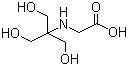 |
| Molecular Formula | C6H13NO5 |
| Molecular Weight | 179.17 |
| Protein Sequence | G |
| CAS Registry Number | 5704-04-1 |
| EC Number | 227-193-6 |
| SMILES | C(C(=O)O)NC(CO)(CO)CO |
| Solubility | 4 M (water 20 °C) |
|---|---|
| Melting point | 183 °C (decomp.) |
| Hazard Symbols |  GHS07 Warning Details GHS07 Warning Details | ||||||||||||||||
|---|---|---|---|---|---|---|---|---|---|---|---|---|---|---|---|---|---|
| Risk Statements | H315-H319-H335 Details | ||||||||||||||||
| Safety Statements | P261-P305+P351+P338 Details | ||||||||||||||||
| Hazard Classification | |||||||||||||||||
| |||||||||||||||||
| SDS | Available | ||||||||||||||||
 chemBlink Chemical Story
|
Tricine, also known as N-tris(hydroxymethyl)glycine, is a zwitterionic buffer discovered by Norman E. Good and colleagues in the 1960s. This discovery was part of their development of a series of buffers, known as Good buffers, that were specifically designed to meet the needs of biological and biochemical research. The development of N-tris(hydroxymethyl)glycine provides a stable buffering system over the pH range of 7.4 to 8.8, making it particularly useful for experiments that require precise control of pH within this range. The molecular formula of N-tris(hydroxymethyl)glycine is C6H13NO5 and its molecular weight is 179.17 g/mol. It has a central glycine moiety with three hydroxymethyl groups that enhance its buffering capacity and stability. N-tris(hydroxymethyl)glycine has a pKa of 8.1 at 25°C, making it an effective buffer that maintains pH values close to neutral to slightly alkaline. This stability across a wide range of temperatures and ionic conditions makes Tricine an essential tool in a variety of laboratory settings. Tricine is widely used in electrophoresis, especially for the separation of low molecular weight peptides and proteins. In Tricine-SDS-PAGE, Tricine replaces glycine in the running buffer, improving the resolution of small proteins and peptides. This application is essential for detailed protein analysis and characterization in molecular biology. In biochemical assays, Tricine is used to maintain stable pH conditions, which are critical for the activity and stability of enzymes and other biomolecules. Its buffering capacity ensures that assay conditions remain optimal, allowing for accurate and reliable measurements of biochemical activity. Tricine is used in protein purification protocols to maintain stable pH conditions, which are critical for preserving protein structure and function. Its compatibility with a variety of chromatographic techniques makes it a valuable buffer in protein purification and analysis. Tricine is used in cell culture media to buffer pH values within the physiological range, ensuring that cells remain healthy and viable. Its nontoxic nature makes it suitable for a variety of cell types, maintaining consistent experimental conditions for cell-based research. In molecular biology, tricine is used to prepare reagents and buffers for DNA and RNA electrophoresis, hybridization, and other techniques. Its ability to maintain a stable pH under varying conditions is essential for the accuracy and reproducibility of molecular biology experiments. The high buffering capacity makes tricine effective in maintaining a stable pH level, ensuring consistent experimental results. The low ionic strength makes tricine compatible with a variety of biological systems and techniques without interfering with the processes being studied. Tricine is generally nontoxic to cells and does not interfere with biochemical reactions, making it suitable for use in sensitive biological applications. References 2024. Virtual screening of potential orally active anti-bacterial compounds of finger millet. Vegetos, 37. DOI: 10.1007/s42535-024-01051-7 2008. Expression and purification the antimicrobial peptide CM4 in Escherichia coli. Biotechnology Letters, 31(4). DOI: 10.1007/s10529-008-9893-0 2007. Impact of Trivalent Arsenicals on Selenoprotein Synthesis. Environmental Health Perspectives, 115(3). DOI: 10.1289/ehp.9440 |
| Market Analysis Reports |