
Online Database of Chemicals from Around the World
| Medilink Pharmachem | India | |||
|---|---|---|---|---|
 | www.medilinkpharma.com | |||
 | +91 (79) 3007-0133 | |||
 | +91 (79) 4007-4175 | |||
 | exports@medilinkpharma.com | |||
| Chemical distributor since 1996 | ||||
| chemBlink Standard supplier since 2014 | ||||
| Bydone (Shanghai) Biochemical Co., Ltd. | China | |||
|---|---|---|---|---|
| www.bydone-chem.com | |||
| +86 15826115498 | |||
| sales@bydonechem.com | |||
 | QQ Chat | |||
| Chemical distributor since 2020 | ||||
| chemBlink Standard supplier since 2022 | ||||
| Zhejiang Boxiao Biopharmaceutical Co., Ltd. | China | |||
|---|---|---|---|---|
| www.bx-biopharm.com | |||
| +86 (571) 6328-0982 | |||
| helena_huang@bx-biopharm.com | |||
| QQ Chat | |||
| Chemical manufacturer since 2020 | ||||
| chemBlink Standard supplier since 2023 | ||||
| Actylis | USA | |||
|---|---|---|---|---|
| actylis.com | |||
| +1 (516) 627-6000 | |||
| +1 (516) 627-6093 | |||
| info@actylis.com | |||
| Chemical manufacturer | ||||
| Qiaoji Group Co., Ltd. | China | |||
|---|---|---|---|---|
| www.qiaoji.com | |||
| +86 (21) 6222-0928 | |||
| +86 (21) 6222-1938 | |||
| stephencao@qiaoji.com | |||
| Chemical distributor | ||||
| Tocris Bioscience Inc. | USA | |||
|---|---|---|---|---|
| www.tocris.com | |||
| +1 (636) 207-7651 | |||
| +1 (636) 207-7683 | |||
| customerservice.na@bio-techne.com | |||
| Chemical manufacturer since 1982 | ||||
| Classification | API >> Hormone and endocrine-regulating drugs >> Pituitary hormone |
|---|---|
| Name | Methylergonovine maleate salt |
| Synonyms | 9,10-Didehydro-N-[(S)-1-(hydroxymethyl)propyl]-6-methylergoline-8beta-carboxamide maleate salt |
| Molecular Structure | 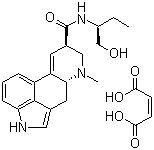 |
| Molecular Formula | C20H25N3O2.C4H4O4 |
| Molecular Weight | 455.50 |
| CAS Registry Number | 57432-61-8 |
| EC Number | 260-734-4 |
| SMILES | CC[C@@H](CO)NC(=O)[C@H]1CN([C@@H]2CC3=CNC4=CC=CC(=C34)C2=C1)C.C(=CC(=O)O)C(=O)O |
| Solubility | Soluble 25 mM (water) (Expl.) |
|---|---|
| Hazard Symbols |   GHS06;GHS08 Danger Details GHS06;GHS08 Danger Details | ||||||||||||||||||||||||||||
|---|---|---|---|---|---|---|---|---|---|---|---|---|---|---|---|---|---|---|---|---|---|---|---|---|---|---|---|---|---|
| Risk Statements | H301-H311-H331-H361-H362 Details | ||||||||||||||||||||||||||||
| Safety Statements | P203-P260-P261-P262-P263-P264-P270-P271-P280-P301+P316-P302+P352-P304+P340-P316-P318-P321-P330-P361+P364-P403+P233-P405-P501 Details | ||||||||||||||||||||||||||||
| Hazard Classification | |||||||||||||||||||||||||||||
| |||||||||||||||||||||||||||||
| Transport Information | UN 1544 | ||||||||||||||||||||||||||||
| SDS | Available | ||||||||||||||||||||||||||||
 chemBlink Chemical Story
|
Methylergonovine maleate is a semi-synthetic ergot alkaloid derivative used in obstetric medicine, primarily for the prevention and control of postpartum hemorrhage. It is the maleate salt form of methylergometrine, also known as methylergonovine, and exhibits potent uterotonic properties. As a member of the ergoline family, the compound shares a structural core with natural ergot alkaloids derived from *Claviceps purpurea*, a fungus that infects cereal grains. The discovery and isolation of ergot alkaloids date back to the early 20th century, leading to the development of more selective and safer derivatives like methylergonovine in the mid-1900s. The maleate salt form improves the solubility and stability of methylergonovine, making it suitable for both oral and parenteral administration. Chemically, methylergonovine is a hydrogenated derivative of ergonovine, differing by the presence of a methyl group on the nitrogen of the ergoline ring. The molecular structure includes a tetracyclic ergoline backbone with an amide side chain and a tertiary amine, providing it with high affinity for specific serotonergic and adrenergic receptors in smooth muscle tissue. Methylergonovine maleate acts primarily by stimulating uterine smooth muscle via direct agonism of serotonin 5-HT2 receptors and α1-adrenergic receptors. This receptor binding leads to sustained uterine contractions, which are effective in reducing postpartum bleeding by promoting uterine involution and constriction of uterine blood vessels. Its mechanism differs from oxytocin, which produces rhythmic contractions, whereas methylergonovine induces tonic, prolonged contractions. Clinically, methylergonovine maleate is indicated for the management of uterine atony following childbirth, both vaginal and cesarean. It is also used prophylactically in high-risk deliveries where uterine contraction is insufficient. The drug is typically administered orally or intramuscularly in postpartum care units. Intravenous administration is reserved for emergencies due to the risk of hypertensive episodes. Methylergonovine is not used to induce labor or for elective termination due to the risk of uterine tetany. The pharmacokinetics of methylergonovine maleate show rapid absorption after oral administration, with peak plasma concentrations usually achieved within 30 to 60 minutes. Its half-life is approximately 1 to 2 hours, and it is metabolized primarily by the liver. Excretion occurs through both urine and feces, with minimal accumulation upon repeated dosing. Caution is advised in patients with hepatic or renal impairment, and its use is contraindicated in individuals with hypertension, preeclampsia, or peripheral vascular disease due to the risk of vasoconstriction. Beyond its clinical application in obstetrics, methylergonovine maleate has been studied for its pharmacodynamic profile in vascular smooth muscle, where it exerts vasoconstrictive effects on systemic and cerebral arteries. This property is a double-edged sword; while it contributes to uterine contraction and hemostasis, it also presents a risk of vascular complications such as ischemia or hypertension if misused or administered intravenously too rapidly. From a pharmaceutical development standpoint, methylergonovine maleate is manufactured under stringent conditions to ensure consistency, stability, and purity. The maleate counterion is selected for its ability to form stable crystalline salts, facilitating the production of solid dosage forms. Storage conditions typically require protection from light and moisture to prevent degradation, as ergot alkaloids are known to be photosensitive. In summary, methylergonovine maleate salt represents an essential therapeutic agent in maternal care, specifically for the control of postpartum hemorrhage. Its development reflects the transition from crude ergot extracts to selective, semi-synthetic derivatives with defined pharmacological profiles. Despite its effectiveness, the drug must be used with caution due to its potent vasoconstrictive effects and potential for serious side effects when administered improperly. Its continued inclusion in the World Health Organization's list of essential medicines underscores its value in global maternal health strategies. References 1946. The Induction of Labor with Methergine. American Journal of Obstetrics and Gynecology, 51(6). DOI: 10.1016/s0002-9378(16)39964-1 2021. In silico drug repurposing for the treatment of heart diseases using gene expression data and molecular docking techniques. Biochemical and Biophysical Research Communications, 573. DOI: 10.1016/j.bbrc.2021.07.076 2023. A comparison of misoprostol with and without methylergometrine and oxytocin in outpatient medical abortion: a phase III randomized controlled trial. BMC Research Notes, 16(1). DOI: 10.1186/s13104-023-06509-6 |
| Market Analysis Reports |