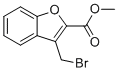
The chemical substance methyl 3-(bromomethyl)-2-benzofurancarboxylate is a functionalized benzofuran derivative bearing a bromomethyl group and a methyl ester, recognized in organic chemistry as a versatile synthetic intermediate, particularly in pharmaceutical and materials chemistry. Its discovery and applications are well-documented in the literature, rooted in the development of benzofuran chemistry and regioselective functionalization techniques.
The origins of this compound are tied to the study of benzofurans, bicyclic heterocycles consisting of a benzene ring fused to a furan ring, which have been explored since the early 20th century for their presence in natural products and pharmacological activity. Benzofurans are privileged scaffolds in medicinal chemistry due to their structural rigidity and ability to engage in π-interactions. The introduction of a bromomethyl group at the 3-position and a methyl ester at the 2-position became feasible with advances in regioselective halogenation and esterification techniques during the 1960s and 1970s. These advancements, driven by the pharmaceutical industry’s need for reactive heterocyclic intermediates, enabled the synthesis of compounds like methyl 3-(bromomethyl)-2-benzofurancarboxylate in the late 20th century to serve as building blocks for bioactive molecules.
Synthetically, methyl 3-(bromomethyl)-2-benzofurancarboxylate is typically prepared through a multi-step process. A common route starts with 2-hydroxybenzaldehyde or a related salicylaldehyde, which is cyclized with a bromoacetate derivative, such as methyl bromoacetate, under basic conditions to form the benzofuran ring with a 2-carboxylate group. The 3-position is then functionalized with a bromomethyl group, often by electrophilic bromination at the 3-position followed by radical bromination using N-bromosuccinimide (NBS) with a radical initiator like benzoyl peroxide to introduce the bromomethyl group. Alternatively, a 3-methyl-2-benzofurancarboxylate precursor can be directly brominated at the methyl group using NBS. These steps rely on well-established protocols in heterocyclic synthesis, halogenation, and esterification, ensuring regioselectivity and high yields.
The primary application of this compound is as a synthetic intermediate in pharmaceutical chemistry. The benzofuran core is a key structural motif in drugs targeting cancer, inflammation, and neurological disorders, due to its ability to bind biological targets through π-stacking and hydrogen bonding. The 3-bromomethyl group is a reactive handle for nucleophilic substitution reactions, enabling the introduction of amines, thiols, or carbon nucleophiles to form diverse derivatives. The 2-methyl ester can be hydrolyzed to a carboxylic acid or converted to amides, providing additional functionalization options. This compound is frequently used in the synthesis of kinase inhibitors, receptor modulators, and antimicrobial agents, where the benzofuran scaffold and reactive substituents optimize target affinity and pharmacokinetic properties.
In materials chemistry, the compound is employed to synthesize functionalized polymers or fluorescent probes, where the benzofuran’s aromatic system and bromomethyl group facilitate conjugation. In academic research, it serves as a model for studying benzofuran reactivity, regioselective bromination, and nucleophilic substitution mechanisms. Its synthesis has contributed to the refinement of halogenation and cyclization techniques.
The significance of methyl 3-(bromomethyl)-2-benzofurancarboxylate lies in its role as a multifunctional intermediate that combines the biological relevance of benzofurans with the synthetic versatility of bromomethyl and ester groups. Its development reflects progress in regioselective heterocyclic synthesis and halogenation chemistry. By enabling the efficient synthesis of complex, biologically active molecules, it has become a critical tool in advancing pharmaceutical, materials, and chemical research.
|





 GHS05;GHS07 Danger Details
 chemBlink Chemical Story