
Online Database of Chemicals from Around the World
| BOC Sciences | USA | |||
|---|---|---|---|---|
 | www.bocsci.com | |||
 | +1 (631) 485-4226 | |||
 | +1 (631) 614-7828 | |||
 | info@bocsci.com | |||
| Chemical manufacturer | ||||
| chemBlink Standard supplier since 2010 | ||||
| Suzhou Myland Pharm & Nutrition Inc. | China | |||
|---|---|---|---|---|
| www.mylandpharm.com | |||
| +86 (512) 6615-0687 | |||
| +86 (512) 6615-7101 | |||
| info@mylandpharm.com | |||
 | QQ Chat | |||
| Chemical manufacturer since 2013 | ||||
| chemBlink Standard supplier since 2014 | ||||
| Hangzhou Leap Chem Co., Ltd. | China | |||
|---|---|---|---|---|
| www.leapchem.com | |||
| +86 (571) 8771-1850 | |||
| market19@leapchem.com | |||
| QQ Chat | |||
| Chemical manufacturer since 2006 | ||||
| chemBlink Standard supplier since 2015 | ||||
| Xi'an Yinherb Bio-tech Co., Ltd | China | |||
|---|---|---|---|---|
| yinherb.ecer.com | |||
| +86 (29) 6333-2330 | |||
| sales@yinherb-nutraceuticals.com | |||
| QQ Chat | |||
| Chemical manufacturer since 2009 | ||||
| chemBlink Standard supplier since 2021 | ||||
| R&D Scientific Inc. | Canada | |||
|---|---|---|---|---|
| www.rdscientific.com | |||
| +1 (226) 600-0236 | |||
| sales@rdscientific.com | |||
| Chemical manufacturer since 2016 | ||||
| chemBlink Standard supplier since 2023 | ||||
| Classification | Organic raw materials >> Carboxylic compounds and derivatives >> Salt of carboxylic acid ester and its derivatives |
|---|---|
| Name | N-Acetyl-L-cysteine ethyl ester |
| Synonyms | (R)-Ethyl 2-acetamido-3-mercaptopropanoate; Ac-Cys-OEt; N-Acetyl-L-cysteine ethyl ester; N-Acetylcysteine ethyl ester |
| Molecular Structure | 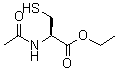 |
| Molecular Formula | C7H13NO3S |
| Molecular Weight | 191.25 |
| Protein Sequence | C |
| CAS Registry Number | 59587-09-6 |
| SMILES | CCOC(=O)[C@H](CS)NC(=O)C |
| Solubility | Sparingly soluble (12 g/L) (25 °C), Calc.* |
|---|---|
| Density | 1.138±0.06 g/cm3 (20 °C 760 Torr), Calc.* |
| Melting point | 44.1-44.5 °C** |
| Boiling point | 337.6±32.0 °C 760 mmHg (Calc.)* |
| Flash point | 158.0±25.1 °C (Calc.)* |
| Index of refraction | 1.48 (Calc.)* |
| * | Calculated using Advanced Chemistry Development (ACD/Labs) Software V11.02 (©1994-2020 ACD/Labs) |
| ** | Tsikas, Dimitrios |
| Hazard Symbols |    GHS07;GHS08;GHS09 Danger Details GHS07;GHS08;GHS09 Danger Details |
|---|---|
| Risk Statements | H302-H319-H332-H372-H400 Details |
| Safety Statements | P260-P264-P270-P273-P280-P301+P312+P330-P304+P312-P305+P351+P338-P314-P337+P313-P391-P501 Details |
| SDS | Available |
 chemBlink Chemical Story
|
N-Acetyl-L-cysteine ethyl ester is a synthetic derivative of the amino acid L-cysteine in which both the amino and carboxyl functional groups are chemically modified. Specifically, the amino group is acetylated to form an amide (N-acetyl), and the carboxylic acid group is converted into an ethyl ester. The molecule retains the characteristic thiol (–SH) side chain of cysteine, which is a defining structural and chemical feature. The parent amino acid, L-cysteine, contains three key functional groups: a primary amine, a carboxylic acid, and a thiol-containing side chain. In N-acetyl-L-cysteine ethyl ester, the amine is no longer free but is converted into a stable amide through acetylation. This modification reduces basicity and eliminates the zwitterionic nature typical of amino acids. In addition, esterification of the carboxyl group removes its acidity and increases the overall lipophilicity of the molecule. The thiol group remains intact and is the most chemically reactive site in the molecule. Thiols are nucleophilic sulfur-containing functional groups capable of undergoing oxidation to form disulfides, participating in redox reactions, and binding to electrophilic centers. The presence of the thiol group largely governs the compound’s chemical reactivity in biological and chemical systems. The N-acetyl group introduces a carbonyl functionality adjacent to nitrogen, forming an amide bond stabilized by resonance between the carbonyl oxygen and nitrogen lone pair. This resonance reduces the nucleophilicity of the nitrogen atom and increases overall structural stability. Amide bonds are generally resistant to hydrolysis under neutral conditions but can be cleaved under strongly acidic or basic environments. The ethyl ester group at the carboxyl terminus is also a stabilized functional group. Esters are less polar than carboxylic acids and reduce hydrogen-bond donation capability. This modification significantly increases hydrophobicity relative to unmodified cysteine and alters solubility and membrane interaction properties. From a structural perspective, N-acetyl-L-cysteine ethyl ester is a small, flexible molecule without aromatic rings or rigid cyclic systems. Its conformational behavior is governed primarily by rotation around single bonds in the carbon backbone and the orientation of the amide and ester groups. The thiol side chain introduces localized polarity and reactivity within an otherwise moderately lipophilic framework. The molecule contains both hydrogen-bond donors and acceptors, although fewer than the parent amino acid due to derivatization. The amide carbonyl and sulfur atom can act as hydrogen-bond acceptors, while the thiol group can act as a weak hydrogen-bond donor. Overall polarity is reduced compared with cysteine due to masking of ionic functional groups. Chemically, thiol-containing esters such as this are susceptible to oxidation, often forming disulfide-linked dimers under oxidative conditions. This redox behavior is a key feature of sulfur amino acid derivatives and contributes to their chemical and biochemical reactivity. Without verified literature specific to this exact compound, no statements can be made regarding biological function or pharmacological use. Based on established structural chemistry, N-acetyl-L-cysteine ethyl ester can be described as a lipophilic, non-zwitterionic cysteine derivative featuring a protected amine, an esterified carboxyl group, and a reactive thiol side chain that dominates its chemical behavior. References 2026. A gel-forming antioxidant eye drop for photoreceptor protection in retinitis pigmentosa. Drug Delivery and Translational Research. DOI: 10.1007/s13346-026-02070-4 2024. NRF2 activation by cysteine as a survival mechanism for triple-negative breast cancer cells. Oncogene. DOI: 10.1038/s41388-024-03025-0 2023. Non-small cell lung cancers (NSCLCs) oncolysis using coxsackievirus B5 and synergistic DNA-damage response inhibitors. Signal Transduction and Targeted Therapy. DOI: https://www.ncbi.nlm.nih.gov/pmc/articles/PMC10518312 |
| Market Analysis Reports |