
Online Database of Chemicals from Around the World
| CAS: 59708-52-0 Product: Carfentanil No suppliers available. |
| Classification | API >> Other chemicals |
|---|---|
| Name | Carfentanil |
| Synonyms | Carfentanyl; R 31833; 4-[(1-Oxopropyl)phenylamino]-1-(2-phenylethyl)-4-piperidinecarboxylic acid methyl ester |
| Molecular Structure | 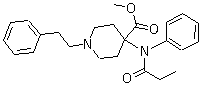 |
| Molecular Formula | C24H30N2O3 |
| Molecular Weight | 394.51 |
| CAS Registry Number | 59708-52-0 |
| EC Number | 878-302-4 |
| SMILES | CCC(=O)N(C1=CC=CC=C1)C2(CCN(CC2)CCC3=CC=CC=C3)C(=O)OC |
| Density | 1.1±0.1 g/cm3 Calc.* |
|---|---|
| Boiling point | 508.1±50.0 °C 760 mmHg (Calc.)* |
| Flash point | 261.1±30.1 °C (Calc.)* |
| Index of refraction | 1.577 (Calc.)* |
| * | Calculated using Advanced Chemistry Development (ACD/Labs) Software. |
| Hazard Symbols |    GHS06;GHS07;GHS08 Danger Details GHS06;GHS07;GHS08 Danger Details | ||||||||||||||||
|---|---|---|---|---|---|---|---|---|---|---|---|---|---|---|---|---|---|
| Risk Statements | H300-H310-H317-H330-H336-H361 Details | ||||||||||||||||
| Safety Statements | P203-P260-P261-P262-P264-P270-P271-P272-P280-P284-P301+P316-P302+P352-P304+P340-P316-P318-P319-P320-P321-P330-P333+P317-P361+P364-P362+P364-P403+P233-P405-P501 Details | ||||||||||||||||
| Hazard Classification | |||||||||||||||||
| |||||||||||||||||
| Controlled Substance | DEA Drug Code Number: 9743 Details | ||||||||||||||||
| CSA Schedule: II | |||||||||||||||||
| Narcotics? Yes | |||||||||||||||||
 chemBlink Chemical Story
|
Carfentanil is a synthetic opioid analgesic that is structurally related to fentanyl and classified as an extremely potent μ-opioid receptor agonist. It was first synthesized in the 1970s for veterinary use, particularly for the immobilization of large animals such as elephants and other megafauna. The compound was never intended for human medical use due to its extraordinary potency, which is estimated to be approximately 10,000 times greater than that of morphine and 100 times greater than that of fentanyl. The discovery of carfentanil stemmed from efforts to develop high-efficacy opioid compounds that could achieve immobilization with minimal volume and rapid onset in large mammals. Its molecular modifications include a methyl ester group and a carbomethoxy moiety, enhancing its lipophilicity and binding affinity to the μ-opioid receptor. These structural features result in rapid blood-brain barrier penetration and intense receptor activation. Carfentanil is typically formulated as a citrate salt for use in veterinary tranquilizer darts. It induces deep sedation, analgesia, and immobilization within minutes of administration. The compound’s duration of action is relatively short, which is beneficial in controlled veterinary scenarios where rapid recovery may be desired following reversal with opioid antagonists such as naltrexone. Despite its specialized veterinary application, carfentanil has been implicated in numerous accidental human overdoses, primarily through illicit drug markets where it is often found as an adulterant in heroin or counterfeit opioid tablets. Its presence in recreational drug supplies poses a severe public health risk because even trace amounts can cause fatal respiratory depression. Unlike pharmaceutical opioids used in human medicine, the therapeutic window of carfentanil is exceedingly narrow, and its toxic dose closely approximates its effective dose. Pharmacodynamically, carfentanil binds with high affinity to μ-opioid receptors in the central nervous system, leading to profound suppression of respiratory drive, analgesia, sedation, and euphoria. Due to its strong receptor interaction and long duration of binding, reversal with naloxone may require significantly higher or repeated doses compared to other opioids. This characteristic complicates emergency medical response in overdose scenarios and has necessitated increased training and preparedness among first responders. Carfentanil is metabolized primarily in the liver through oxidative processes involving cytochrome P450 enzymes. Metabolites are excreted in the urine. Detection of the parent compound and its metabolites in biological specimens is challenging due to the low concentrations typically present in overdose cases, requiring highly sensitive analytical techniques such as liquid chromatography-tandem mass spectrometry. Regulatory agencies in many countries have classified carfentanil as a controlled substance with no accepted medical use in humans, reflecting its high potential for abuse and risk of fatal toxicity. In the United States, carfentanil is listed as a Schedule II substance under the Controlled Substances Act but is tightly restricted and monitored, with use largely confined to specialized veterinary applications. The emergence of carfentanil in illicit drug markets has prompted public health advisories and law enforcement interventions due to the compound’s role in increasing the lethality of opioid-related deaths. Efforts to control its distribution include international cooperation to limit its manufacture and export, particularly in the context of synthetic opioid trafficking. While carfentanil serves a legitimate role in veterinary medicine, its extreme potency and misuse in human contexts underscore the broader challenges posed by synthetic opioids in modern pharmacology and public health. References 1982. Potent, New Analgesics, Tailor‐Made for Different Purposes. Acta Anaesthesiologica Scandinavica, 26(3). DOI: 10.1111/j.1399-6576.1982.tb01765.x 1985. CARFENTANIL AND XYLAZINE FOR IMMOBILIZATION OF MOOSE (ALCES ALCES) ON ISLE ROYALE. Journal of Wildlife Diseases, 21(1). DOI: 10.7589/0090-3558-21.1.48 2024. Total-body imaging of mu-opioid receptors with [11C]carfentanil in non-human primates. European Journal of Nuclear Medicine and Molecular Imaging, 51(10). DOI: 10.1007/s00259-024-06746-2 |
| Market Analysis Reports |