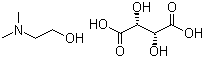
Dimethylaminoethanol bitartrate is a useful example of why a chemical salt should be separated from the claims made for the molecule it contains. Dimethylaminoethanol, or DMAE, is a small amino alcohol structurally related to choline. Converting the basic amine to a salt with tartaric acid produces a crystalline, water-soluble material that is easier to formulate and handle than the free base. The bitartrate form, CAS 5988-51-2, has consequently appeared in supplements and research studies.
Because choline is a precursor in phospholipid metabolism and acetylcholine biology, DMAE has long attracted claims that it might enhance cognition by increasing acetylcholine. That biochemical resemblance is scientifically interesting, but structural analogy is not proof of a clinical effect. The National Toxicology Program notes that DMAE bitartrate has been marketed for memory and cognitive function while also emphasizing that available information on the bitartrate salt is limited. Claims about supplementation therefore need to be distinguished from established nutrient function.
The NTP prenatal developmental study provides a good example of how such uncertainty is handled experimentally. Researchers administered defined doses of DMAE bitartrate to pregnant rats and evaluated maternal and developmental endpoints. The report, published as NTP DART-04, did not treat the material as harmless merely because it is sold commercially. Instead, it characterized a specific chemical form, dose range, and biological context. That is how toxicology converts vague exposure into testable questions.
The salt form also matters chemically. Free DMAE is a volatile basic liquid, whereas the bitartrate is an ionic solid made from DMAE and tartaric acid. The change improves physical handling but does not create a new vitamin. In solution, acid-base equilibria determine protonation, and the biological fate depends on the DMAE component, the counterion, dose, absorption, and metabolism. Product labels can make a salt look like a unique nutritional substance when much of its chemistry is simply acid-base formulation.
The tartaric-acid counterion also has stereochemistry. The product name specifies the (+)-bitartrate form, so identity includes not only which acid is present but which stereochemical form of tartaric acid is used. In many salts the counterion is treated as secondary information, yet it can influence crystal packing, hygroscopicity, melting behavior, and manufacturing consistency. For supplement and toxicology work, reporting the exact salt therefore matters. "DMAE" and "DMAE (+)-bitartrate" are related chemical descriptions, but they are not interchangeable analytical identities.
What makes DMAE bitartrate memorable is therefore the gap between plausible biochemical stories and demonstrated outcomes. Its relationship to choline makes good hypotheses possible; its salt form makes commercial formulations practical; neither fact alone proves cognitive benefit. The compound is a reminder that chemical similarity, formulation convenience, and marketing history must be kept separate from evidence about efficacy and safety.
References:
1. National Toxicology Program. NTP DART Report 04. 2020. DOI: 10.22427/NTP-DART-04.
2. National Toxicology Program chemical information for dimethylaminoethanol bitartrate, CAS 5988-51-2.
3. PubChem and toxicological database records for dimethylaminoethanol and its salts.
4. General biochemical literature on choline, acetylcholine and amino alcohol metabolism.
|




 GHS07 Warning Details
 chemBlink Chemical Story