
Online Database of Chemicals from Around the World
| Jinan Chenghui-Shuangda Chemical Co., Ltd. | China | |||
|---|---|---|---|---|
 | www.jnchsd.com | |||
 | +86 (531) 5889-7051 +86 15053146086 | |||
 | +86 (531) 5889-7093 | |||
 | jnchsd@qq.com | |||
 | QQ Chat | |||
| Chemical manufacturer since 2002 | ||||
| chemBlink Standard supplier since 2007 | ||||
| BOC Sciences | USA | |||
|---|---|---|---|---|
| www.bocsci.com | |||
| +1 (631) 485-4226 | |||
| +1 (631) 614-7828 | |||
| info@bocsci.com | |||
| Chemical manufacturer | ||||
| chemBlink Standard supplier since 2010 | ||||
| Jinan An-dm Chemical Co., Ltd. | China | |||
|---|---|---|---|---|
| www.an-dm.com | |||
| +86 15550736712 | |||
| andmchem@hotmail.com | |||
| Chemical manufacturer | ||||
| chemBlink Standard supplier since 2014 | ||||
| Chongqing Land Tower Pharmaceutical Co., Ltd. | China | |||
|---|---|---|---|---|
| www.cqlandtower.com | |||
| +86 (23) 6898-0308 | |||
| +86 (23) 6238-5716 | |||
| business@cqlandtower.com | |||
| Chemical manufacturer since 2010 | ||||
| chemBlink Standard supplier since 2014 | ||||
| Hangzhou Leap Chem Co., Ltd. | China | |||
|---|---|---|---|---|
| www.leapchem.com | |||
| +86 (571) 8771-1850 | |||
| market19@leapchem.com | |||
| QQ Chat | |||
| Chemical manufacturer since 2006 | ||||
| chemBlink Standard supplier since 2015 | ||||
| Typu Group | China | |||
|---|---|---|---|---|
| www.typugroup.com | |||
| +86 85220966 | |||
| order@typugroup.com | |||
| Chemical distributor since 2008 | ||||
| chemBlink Standard supplier since 2021 | ||||
| Shandong Chenghui Shuangda Pharmaceutical Co., Ltd. | China | |||
|---|---|---|---|---|
| www.chsdpharma.com | |||
| +86-531-58897029 | |||
| ericqiao@jnchsd.com | |||
| QQ Chat | |||
 | WeChat: 15550412551 | |||
 | WhatsApp:15550412551 | |||
| Chemical manufacturer since 2014 | ||||
| chemBlink Standard supplier since 2025 | ||||
| Toronto Research Chemicals Inc. | Canada | |||
|---|---|---|---|---|
| www.trc-canada.com | |||
| +1 (416) 665-9696 | |||
| +1 (416) 665-4439 | |||
| info@trc-canada.com | |||
| Chemical manufacturer since 1982 | ||||
| Wako Pure Chemical Industries, Ltd. | Japan | |||
|---|---|---|---|---|
| www.wako-chem.co.jp | |||
| +81 (6) 6203-3741 | |||
| +81 (6) 6201-5964 | |||
| wkhk.info@fujifilm.com | |||
| Chemical manufacturer since 1922 | ||||
| Classification | API >> Anesthetic agents >> Local anesthetics |
|---|---|
| Name | Dibucaine hydrochloride |
| Synonyms | 2-Butoxy-N-[2-(diethylamino)ethyl]-4-quinolinecarboxamide monohydrochloride; 2-Butoxy-N-(2-diethylaminoethyl)cinchoninamide hydrochloride |
| Molecular Structure | 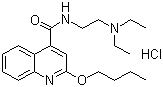 |
| Molecular Formula | C20H29N3O2.HCl |
| Molecular Weight | 379.93 |
| CAS Registry Number | 61-12-1 |
| EC Number | 200-498-1 |
| SMILES | CCCCOC1=NC2=CC=CC=C2C(=C1)C(=O)NCCN(CC)CC.Cl |
| Melting point | 99 - 101 °C (Expl.) |
|---|---|
| Solubility | DMSO 76 mg/mL, Water 76 mg/mL (Expl.) |
| Hazard Symbols |    GHS05;GHS07;GHS09 Danger Details GHS05;GHS07;GHS09 Danger Details | ||||||||||||||||||||||||||||||||||||||||||||||||
|---|---|---|---|---|---|---|---|---|---|---|---|---|---|---|---|---|---|---|---|---|---|---|---|---|---|---|---|---|---|---|---|---|---|---|---|---|---|---|---|---|---|---|---|---|---|---|---|---|---|
| Risk Statements | H302-H317-H318-H411 Details | ||||||||||||||||||||||||||||||||||||||||||||||||
| Safety Statements | P261-P264-P264+P265-P270-P272-P273-P280-P301+P317-P302+P352-P305+P354+P338-P317-P321-P330-P333+P317-P362+P364-P391-P501 Details | ||||||||||||||||||||||||||||||||||||||||||||||||
| Hazard Classification | |||||||||||||||||||||||||||||||||||||||||||||||||
| |||||||||||||||||||||||||||||||||||||||||||||||||
| SDS | Available | ||||||||||||||||||||||||||||||||||||||||||||||||
 chemBlink Chemical Story
|
Dibucaine hydrochloride is a potent local anesthetic belonging to the amide class of anesthetics. It is primarily used for topical anesthesia of the skin and mucous membranes and occasionally in small doses for spinal anesthesia. Dibucaine hydrochloride exerts its anesthetic effect by blocking voltage-gated sodium channels in nerve cell membranes, thereby inhibiting the initiation and propagation of nerve impulses and causing a reversible loss of sensation in the area of application. The compound was developed and introduced into clinical use in the mid-20th century, with its chemical structure designed to provide strong and long-lasting local anesthesia. Dibucaine hydrochloride is noted for its high potency compared to other local anesthetics, which makes it effective in very small amounts. It is commonly supplied as a hydrochloride salt to enhance its solubility and stability in aqueous formulations. Clinically, dibucaine hydrochloride is often used in topical creams, ointments, or solutions for the relief of pain, itching, and discomfort associated with conditions such as hemorrhoids, minor burns, insect bites, and anal fissures. Its use in spinal anesthesia is limited due to concerns about neurotoxicity when used in higher concentrations or volumes. Pharmacodynamically, dibucaine blocks the conduction of nerve impulses by selectively binding to and stabilizing the inactive state of sodium channels on neuronal membranes. This action prevents the influx of sodium ions necessary for depolarization, effectively blocking nerve signal transmission. Pharmacokinetically, dibucaine hydrochloride is absorbed slowly from topical sites, which contributes to its prolonged duration of action. When absorbed systemically, it is metabolized primarily in the liver by enzymatic hydrolysis and N-dealkylation pathways. The metabolites and unchanged drug are excreted mainly via the kidneys. The elimination half-life varies depending on the route of administration but is generally several hours. Adverse effects are primarily related to local irritation or allergic reactions at the site of application. Systemic toxicity is rare but can occur if excessive amounts are absorbed or injected, potentially causing symptoms such as dizziness, tinnitus, nervousness, seizures, or cardiac disturbances. Due to its potency, careful dosing and application are important to avoid toxicity. Dibucaine hydrochloride is also known for its use in the dibucaine number test, a diagnostic assay to measure atypical plasma cholinesterase activity, which helps identify individuals with genetic variants that affect the metabolism of certain anesthetics. In summary, dibucaine hydrochloride is a highly potent local anesthetic used primarily for topical pain relief. Its mechanism of action involves sodium channel blockade leading to nerve impulse inhibition. The compound’s strong anesthetic effect, coupled with a relatively slow systemic absorption and metabolism, allows for prolonged local anesthesia with a generally favorable safety profile when used appropriately. References 1974. Kinetic characteristics of monoamine oxidase and serum cholinesterase in several related rat strains. Biochemical Genetics, 11(4). DOI: 10.1007/bf00485998 2018. Greenness assessment as per Eco-scale and AMVI metrics for the chromatographic assay of selected drugs in a semisolid dosage form and in tissues. Chemical Papers, 73(3). DOI: 10.1007/s11696-018-0619-z 2022. A quantitative high-throughput screen identifies compounds that lower expression of the SCA2-and ALS-associated gene ATXN2. The Journal of Biological Chemistry, 298(8). DOI: 10.1016/j.jbc.2022.102228 |
| Market Analysis Reports |