
Online Database of Chemicals from Around the World
| Hefei TNJ Chemical Industry Co., Ltd. | China | |||
|---|---|---|---|---|
 | www.tnjchem.com | |||
 | +86 (551) 6541-8684 | |||
 | +86 (551) 6541-8697 | |||
 | sales@tnjchem.com | |||
| Chemical manufacturer since 2001 | ||||
| chemBlink Standard supplier since 2010 | ||||
| Wilshire Technologies, Inc. | USA | |||
|---|---|---|---|---|
| www.wilshiretechnologies.com | |||
| +1 (609) 683-1117 | |||
| +1 (732) 274-0049 | |||
| Wilshire-info@evonik.com | |||
| Chemical manufacturer since 1997 | ||||
| chemBlink Standard supplier since 2010 | ||||
| BOC Sciences | USA | |||
|---|---|---|---|---|
| www.bocsci.com | |||
| +1 (631) 485-4226 | |||
| +1 (631) 614-7828 | |||
| info@bocsci.com | |||
| Chemical manufacturer | ||||
| chemBlink Standard supplier since 2010 | ||||
| Alkaloids Corporation | India | |||
|---|---|---|---|---|
| www.alkaloidscorp.com | |||
| +91 (33) 2475-2952 | |||
| alkacorp@alkaloids.in | |||
| Chemical manufacturer since 1967 | ||||
| chemBlink Standard supplier since 2010 | ||||
| Hangzhou Leap Chem Co., Ltd. | China | |||
|---|---|---|---|---|
| www.leapchem.com | |||
| +86 (571) 8771-1850 | |||
| market19@leapchem.com | |||
 | QQ Chat | |||
| Chemical manufacturer since 2006 | ||||
| chemBlink Standard supplier since 2015 | ||||
| Chengdu Biopurify Phytochemicals Ltd. | China | |||
|---|---|---|---|---|
| www.phytopurify.com | |||
| +86 (28) 8263-3860 8263-3987 | |||
| +86 (28) 8263-3165 | |||
| sales@biopurify.com biopurify@gmail.com | |||
| QQ Chat | |||
 | Skype Chat | |||
| Chemical manufacturer | ||||
| chemBlink Standard supplier since 2017 | ||||
| Zhejiang Boxiao Biopharmaceutical Co., Ltd. | China | |||
|---|---|---|---|---|
| www.bx-biopharm.com | |||
| +86 (571) 6328-0982 | |||
| helena_huang@bx-biopharm.com | |||
| QQ Chat | |||
| Chemical manufacturer since 2020 | ||||
| chemBlink Standard supplier since 2023 | ||||
| Sinova Corporation | USA | |||
|---|---|---|---|---|
| www.sinovainc.com | |||
| +1 (301) 961-1525 | |||
| +1 (240) 235-4288 | |||
| sales@sinovainc.com | |||
| Chemical manufacturer | ||||
| Avonchem/Chromos Express Ltd. | UK | |||
|---|---|---|---|---|
| www.avonchem.co.uk | |||
| +44 (1625) 434-300 | |||
| +44 (1625) 869-777 | |||
| info@avonchem.co.uk | |||
| Chemical manufacturer | ||||
| Santa Cruz Biotechnology, Inc. | USA | |||
|---|---|---|---|---|
| www.scbt.com | |||
| +1 (831) 457-3800 | |||
| +1 (831) 457-3801 | |||
| scbt@scbt.com | |||
| Chemical manufacturer | ||||
| Classification | API >> Circulatory system medication >> Peripheral vasodilator |
|---|---|
| Name | Papaverine hydrochloride |
| Synonyms | 6,7-Dimethoxy-1-(3,4-dimethoxybenzyl)-isoquinoline hydrochloride; 1-(3,4-dimethoxybenzyl)-6,7-dimethoxyisoquinoline hydrochloride |
| Molecular Structure | 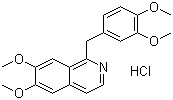 |
| Molecular Formula | C20H21NO4.HCl |
| Molecular Weight | 375.85 |
| CAS Registry Number | 61-25-6 |
| EC Number | 200-502-1 |
| SMILES | COC1=C(C=C(C=C1)CC2=NC=CC3=CC(=C(C=C32)OC)OC)OC.Cl |
| Melting point | 220 °C (Decomposes) (Expl.) |
|---|---|
| Solubility | DMSO: 10 mM, water: 10 mM (Expl.) point |
| Water solubility | freely soluble |
| Hazard Symbols |   GHS06;GHS07 Danger Details GHS06;GHS07 Danger Details | ||||||||||||||||
|---|---|---|---|---|---|---|---|---|---|---|---|---|---|---|---|---|---|
| Risk Statements | H301-H302 Details | ||||||||||||||||
| Safety Statements | P264-P270-P301+P316-P301+P317-P321-P330-P405-P501 Details | ||||||||||||||||
| Hazard Classification | |||||||||||||||||
| |||||||||||||||||
| SDS | Available | ||||||||||||||||
 chemBlink Chemical Story
|
Papaverine hydrochloride is the hydrochloride salt of papaverine, a benzylisoquinoline alkaloid historically isolated from opium but pharmacologically unlike morphine and classical opioid alkaloids. NCI describes it as a direct-acting smooth-muscle relaxant that can also be produced synthetically. Its action is not mediated by opioid receptors; nonselective phosphodiesterase inhibition and direct effects on calcium handling have been implicated. These effects relax vascular and other smooth muscle. The hydrochloride supplies a defined pharmaceutical form of the basic alkaloid. Papaverine has been used as a vasodilator and smooth-muscle relaxant and in intracavernosal therapy for erectile dysfunction. The exact registry identity matters because free forms, salts, hydrates, stereoisomers, metabolites, intermediates and finished medicines can have separate CAS numbers even when their names are closely related. This distinction affects molecular weight, analytical standards, formulation, manufacturing specifications and interpretation of published data. A reliable database story therefore follows the exact substance rather than silently borrowing every property of a related compound. Structure also shows how chemists use functional groups as deliberate tools. Aromatic and heterocyclic frameworks establish molecular shape and electronics, while amines, hydroxyl groups, carbonyls, carboxyl functions or ionic centers determine reactivity and intermolecular interactions. In multistep synthesis, a compound may be valuable precisely because one position can be transformed selectively while the rest of a complex framework survives. Modern development is also an analytical-control problem. Researchers must establish identity and purity, distinguish relevant stereoisomers or salt forms, monitor process-related species and define reproducible specifications. These requirements explain why an intermediate, metabolite or reagent can be scientifically important even when it is never administered as an independent medicine. A Chemical Story must distinguish documented use from structural possibility. A familiar scaffold may suggest an activity, but resemblance is not evidence that the exact CAS substance has been tested or approved for that purpose. Verified history and demonstrated applications therefore take priority over attractive but unsupported extrapolation. Seen broadly, practical performance emerges from the entire molecular system rather than one recognizable group. Structure, stereochemistry, physical form, synthetic route, metabolism and reaction environment can all determine what a substance actually does. Connecting those molecular details to its documented role is what turns a registry entry into a meaningful chemical story. The exact registry identity matters because free forms, salts, hydrates, stereoisomers, metabolites, intermediates and finished medicines can have separate CAS numbers even when their names are closely related. This distinction affects molecular weight, analytical standards, formulation, manufacturing specifications and interpretation of published data. A reliable database story therefore follows the exact substance rather than silently borrowing every property of a related compound. Structure also shows how chemists use functional groups as deliberate tools. Aromatic and heterocyclic frameworks establish molecular shape and electronics, while amines, hydroxyl groups, carbonyls, carboxyl functions or ionic centers determine reactivity and intermolecular interactions. In multistep synthesis, a compound may be valuable precisely because one position can be transformed selectively while the rest of a complex framework survives. Modern development is also an analytical-control problem. Researchers must establish identity and purity, distinguish relevant stereoisomers or salt forms, monitor process-related species and define reproducible specifications. These requirements explain why an intermediate, metabolite or reagent can be scientifically important even when it is never administered as an independent medicine. A Chemical Story must distinguish documented use from structural possibility. A familiar scaffold may suggest an activity, but resemblance is not evidence that the exact CAS substance has been tested or approved for that purpose. Verified history and demonstrated applications therefore take priority over attractive but unsupported extrapolation. References: 1. National Cancer Institute Drug Dictionary. Papaverine Hydrochloride. 2. NLM MeSH. Papaverine. 3. Sneader W. Drug Discovery: A History. Wiley. |
| Market Analysis Reports |