
Online Database of Chemicals from Around the World
| Simagchem Corporation | China | |||
|---|---|---|---|---|
 | www.simagchem.com | |||
 | +86 13806087780 | |||
 | +86 (592) 268-0237 | |||
 | sale@simagchem.com | |||
| Chemical manufacturer since 2002 | ||||
| chemBlink Standard supplier since 2008 | ||||
| Tianjin Zhongxin Chem-tech Co., Ltd. | China | |||
|---|---|---|---|---|
| www.tjzxchem.com | |||
| +86 (22) 6688-0623 | |||
| +86 (22) 8988-0739 ex 8030 | |||
| sales@tjzxchem.com | |||
| Chemical manufacturer since 2007 | ||||
| chemBlink Standard supplier since 2009 | ||||
| BOC Sciences | USA | |||
|---|---|---|---|---|
| www.bocsci.com | |||
| +1 (631) 485-4226 | |||
| +1 (631) 614-7828 | |||
| info@bocsci.com | |||
| Chemical manufacturer | ||||
| chemBlink Standard supplier since 2010 | ||||
| Anhui Royal Chemical Co., Ltd. | China | |||
|---|---|---|---|---|
| www.royal-chem.com | |||
| +86 (25) 8663-9253 | |||
| +86 (25) 5227-9193 | |||
| zoey.zhao@royal-chem.com | |||
| Chemical manufacturer since 2008 | ||||
| chemBlink Standard supplier since 2019 | ||||
| Spectrum Info Ltd. | Ukraine | |||
|---|---|---|---|---|
| www.spec-info.com | |||
| +38 (044) 573-5462 | |||
| +38 (044) 573-2397 | |||
| spec-info@spec-info.com | |||
| Chemical manufacturer | ||||
| Classification | Organic raw materials >> Amino compound >> Cycloalkylamines, aromatic monoamines, aromatic polyamines and derivatives and salts |
|---|---|
| Name | N,N-Dibutylaniline |
| Molecular Structure | 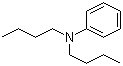 |
| Molecular Formula | C14H23N |
| Molecular Weight | 205.34 |
| CAS Registry Number | 613-29-6 |
| EC Number | 210-335-6 |
| SMILES | CCCCN(CCCC)C1=CC=CC=C1 |
| Density | 0.906 |
|---|---|
| Boiling point | 269-270 °C |
| Refractive index | 1.517-1.519 |
| Flash point | 113 °C |
| Hazard Symbols |  GHS07 Warning Details GHS07 Warning Details | ||||||||||||||||||||||||||||
|---|---|---|---|---|---|---|---|---|---|---|---|---|---|---|---|---|---|---|---|---|---|---|---|---|---|---|---|---|---|
| Risk Statements | H302-H312-H315-H319-H332-H335 Details | ||||||||||||||||||||||||||||
| Safety Statements | P261-P264-P264+P265-P270-P271-P280-P301+P317-P302+P352-P304+P340-P305+P351+P338-P317-P319-P321-P330-P332+P317-P337+P317-P362+P364-P403+P233-P405-P501 Details | ||||||||||||||||||||||||||||
| Hazard Classification | |||||||||||||||||||||||||||||
| |||||||||||||||||||||||||||||
| SDS | Available | ||||||||||||||||||||||||||||
 chemBlink Chemical Story
|
N,N-Dibutylaniline is an organic compound belonging to the class of substituted anilines, with the molecular formula C14H23N. It consists of an aniline group (C6H5NH2) with two butyl groups (-C4H9) attached to the nitrogen atom, making it a dialkyl-substituted aniline derivative. Its chemical structure imparts it with distinct properties that have made it an important substance in various industrial and chemical processes. The discovery and development of N,N-dibutylaniline are closely linked to the expansion of organic chemistry in the early 20th century when chemists began synthesizing and exploring the applications of substituted aniline derivatives. These compounds were of interest due to their potential applications in dyes, rubber chemicals, and later, as intermediates in organic synthesis. N,N-Dibutylaniline was particularly valued for its stability and solubility in organic solvents, making it a useful reagent in a variety of chemical reactions. One of the primary applications of N,N-dibutylaniline is its use as an intermediate in the production of dyes and pigments. Its structure allows it to participate in complex chemical transformations that yield various colorants used in textiles, plastics, and coatings. The presence of the butyl groups on the nitrogen atom enhances the solubility of the final dye products, making them more suitable for use in non-polar solvents. Additionally, its chemical stability allows for more controlled and predictable reactions, which is crucial for producing high-quality, consistent colorants. N,N-Dibutylaniline also plays an important role in the rubber industry, where it is used as a vulcanization accelerator. Vulcanization is a chemical process used to harden rubber, improving its durability, elasticity, and resistance to environmental factors such as heat and aging. N,N-Dibutylaniline serves as a key component in accelerator systems that speed up the vulcanization process. By promoting cross-linking in the rubber molecules, it helps to produce stronger and more durable rubber materials. This application is critical in the production of tires, industrial rubber products, and consumer goods that require long-lasting performance. Beyond its role in dye and rubber industries, N,N-dibutylaniline has applications in organic synthesis as a precursor to more complex chemical compounds. Its ability to undergo alkylation, acylation, and oxidation reactions makes it a versatile intermediate for creating more specialized compounds. It has been explored as a starting material for the synthesis of pharmaceuticals and other fine chemicals, where the butyl groups can be further modified to introduce additional functionality into target molecules. In terms of safety and handling, N,N-dibutylaniline is a potentially hazardous substance, particularly if inhaled, ingested, or absorbed through the skin. It is important to handle the chemical in well-ventilated areas while using appropriate protective equipment, such as gloves and goggles, to minimize exposure risks. Its environmental impact is also a concern, as it can pose risks to aquatic life if improperly disposed of. Therefore, proper waste management and environmental safety protocols are essential when working with this compound. In summary, N,N-dibutylaniline has found important applications in the dye, rubber, and chemical industries due to its versatility as an intermediate and its ability to facilitate key chemical processes. Its discovery and development have contributed significantly to advancements in these fields, while also requiring careful attention to safety and environmental considerations during its use. References 2020. Advances in Carbon-Element Bond Construction under Chan-Lam Cross-Coupling Conditions: A Second Decade. *Synthesis*, 53(04). DOI: 10.1055/s-0040-1705971 2007. Photoinduced Intramolecular Charge Transfer in Push−Pull Polyenes: Effects of Solvation, Electron-Donor Group, and Polyenic Chain Length. *The journal of physical chemistry. B*, 111(45). DOI: 10.1021/jp075418z 2018. An Effective Heterogeneous Copper Catalyst System for C-N Coupling and Its Application in the Preparation of 2-Methyl-4-methoxydiphenylamine (MMDPA). *Synthesis*, 50(20). DOI: 10.1055/s-0037-1609578 |
| Market Analysis Reports |