
Online Database of Chemicals from Around the World
| Hangzhou Verychem Science And Technology Co., Ltd. | China | |||
|---|---|---|---|---|
 | www.verychem.com | |||
 | +86 (571) 8816-2785 +86 13606544505 | |||
 | +86 (571) 8816-2787 | |||
 | lucy@verychem.com | |||
| Chemical manufacturer since 2004 | ||||
| chemBlink Massive supplier since 2021 | ||||
| XinChem Corporation | China | |||
|---|---|---|---|---|
| www.xinchem.com | |||
| +86 (21) 3412-3252 | |||
| +86 (21) 5415-3973 | |||
| xinchem@126.com | |||
| Chemical manufacturer | ||||
| chemBlink Standard supplier since 2007 | ||||
| Zhejiang Liaoyuan Pharmaceutical Co., Ltd. | China | |||
|---|---|---|---|---|
| www.liaoyuan.com.cn | |||
| +86 (576) 8511-3128 | |||
| +86 (576) 8530-2808 | |||
| billior@liaoyuan.com.cn | |||
| Chemical manufacturer | ||||
| chemBlink Standard supplier since 2008 | ||||
| BOC Sciences | USA | |||
|---|---|---|---|---|
| www.bocsci.com | |||
| +1 (631) 485-4226 | |||
| +1 (631) 614-7828 | |||
| info@bocsci.com | |||
| Chemical manufacturer | ||||
| chemBlink Standard supplier since 2010 | ||||
| PharmAgra Labs, Inc. | USA | |||
|---|---|---|---|---|
| www.pharmagra.com | |||
| +1 (828) 884-8656 | |||
| +1 (828) 884-9469 | |||
| sales@pharmagra.com | |||
| Chemical manufacturer since 1999 | ||||
| chemBlink Standard supplier since 2014 | ||||
| Xin Yao (Shen Zhen) Biotech Co., Ltd. | China | |||
|---|---|---|---|---|
| www.xinyaosz.com | |||
| +86 (755) 8988-0280 | |||
| +86 (755) 8930-3680 | |||
| 3004662104@qq.com | |||
| Chemical manufacturer since 2012 | ||||
| chemBlink Standard supplier since 2018 | ||||
| Nanjing Hicin Pharmaceutical Co., Ltd. | China | |||
|---|---|---|---|---|
| www.hicinchem.com | |||
| +86 (25) 8360-8920 8324-1000 | |||
| +86 (25) 8320-3820 / 8322-2891 | |||
| hxwang@hicinchem.com | |||
| Chemical manufacturer since 1998 | ||||
| Classification | Pharmaceutical intermediate >> Heterocyclic compound intermediate >> Pyridine compound |
|---|---|
| Name | 1-(3-Hydroxymethylpyridin-2-yl)-4-methyl-2-phenylpiperazine |
| Synonyms | Acyclomirtazapine alcohol |
| Molecular Structure | 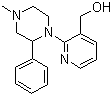 |
| Molecular Formula | C17H21N3O |
| Molecular Weight | 283.37 |
| CAS Registry Number | 61337-89-1 |
| EC Number | 700-296-8 |
| SMILES | CN1CCN(C(C1)C2=CC=CC=C2)C3=C(C=CC=N3)CO |
| Density | 1.2±0.1 g/cm3, Calc.* |
|---|---|
| Index of Refraction | 1.602, Calc.* |
| Boiling Point | 478.8±45.0 °C (760 mmHg), Calc.* |
| Flash Point | 243.3±28.7 °C, Calc.* |
| * | Calculated using Advanced Chemistry Development (ACD/Labs) Software. |
| Hazard Symbols |   GHS05;GHS07 Danger Details GHS05;GHS07 Danger Details | ||||||||||||
|---|---|---|---|---|---|---|---|---|---|---|---|---|---|
| Risk Statements | H302-H318-H412 Details | ||||||||||||
| Safety Statements | P264-P264+P265-P270-P273-P280-P301+P317-P305+P354+P338-P317-P330-P501 Details | ||||||||||||
| Hazard Classification | |||||||||||||
| |||||||||||||
| SDS | Available | ||||||||||||
 chemBlink Chemical Story
|
1-(3-Hydroxymethylpyridin-2-yl)-4-methyl-2-phenylpiperazine is a chemical compound that is recognized for its applications in medicinal chemistry, particularly in the development of potential pharmacological agents. This compound contains a piperazine ring, a common feature in many bioactive molecules, and incorporates both a pyridine moiety and a phenyl group, which contribute to its chemical reactivity and biological activity. The compound was first synthesized as part of efforts to explore the structure-activity relationships (SAR) of piperazine derivatives, particularly those that exhibit interactions with various biological targets. Piperazine derivatives are of significant interest due to their diverse biological activities, including their ability to act as receptor modulators and enzyme inhibitors. The incorporation of a hydroxymethyl group at the 3-position of the pyridine ring is known to influence the compound's ability to interact with biological receptors and enzymes, enhancing its potential use in drug development. One of the key applications of 1-(3-hydroxymethylpyridin-2-yl)-4-methyl-2-phenylpiperazine is in the design of compounds targeting the central nervous system (CNS). Many piperazine derivatives are known to modulate neurotransmitter systems, such as serotonin, dopamine, and norepinephrine, and are thus studied for their potential use in treating psychiatric disorders, including anxiety, depression, and schizophrenia. The hydroxymethylpyridine component of this compound may enhance interactions with neurotransmitter receptors, contributing to its activity as a potential CNS-active agent. The compound's phenyl group is another feature that may influence its pharmacological activity. Phenyl groups are commonly incorporated into drug candidates to improve binding affinity to specific targets, and they can also enhance lipophilicity, which influences the compound's ability to cross the blood-brain barrier. This makes 1-(3-hydroxymethylpyridin-2-yl)-4-methyl-2-phenylpiperazine a promising structure for the development of CNS-active drugs. In addition to its CNS-related applications, 1-(3-hydroxymethylpyridin-2-yl)-4-methyl-2-phenylpiperazine has been explored for its potential as a ligand in medicinal chemistry. Its ability to interact with various receptors, including those involved in neurotransmitter signaling, positions it as a useful building block in the design of more selective and potent pharmacological agents. This compound has been studied for its ability to modulate receptor activity in ways that could lead to the development of novel therapeutic agents for a range of neurological and psychiatric disorders. Furthermore, piperazine derivatives like this compound are also investigated for their antimicrobial properties. The versatility of the piperazine ring allows it to interact with a variety of biological targets, and some derivatives have shown activity against bacterial and fungal pathogens. However, the primary focus of research on 1-(3-hydroxymethylpyridin-2-yl)-4-methyl-2-phenylpiperazine has been on its potential use in neuropharmacology. In conclusion, 1-(3-hydroxymethylpyridin-2-yl)-4-methyl-2-phenylpiperazine is a compound of interest in medicinal chemistry, particularly for its potential applications in the treatment of central nervous system disorders. Its structural features, including the piperazine ring, pyridine group, and phenyl substitution, contribute to its biological activity and make it a valuable scaffold in the design of bioactive molecules. Although further research is needed to fully understand its pharmacological profile, the compound's versatility in interacting with biological targets positions it as a potential lead compound for drug development. References (2003). Mirtazapine. Pharmaceutical Substances [Online]. Thieme: Stuttgart. (2020). A kind of preparation method of mirtazapine and intermediate product thereof. CN-111187264-A, 2020-05-22. Priority Date: 2018-11-14. (2017). Manufacturing method of mirtazapine. JP-2017222608-A, 2017-12-21. Priority Date: 2016-06-15. |
| Market Analysis Reports |