
Online Database of Chemicals from Around the World
| Guarson Chem | China | |||
|---|---|---|---|---|
 | www.guarson.com | |||
 | +86 (523) 8805-9600 8805-9602 +86 13805268803 | |||
 | +86 (523) 8822-3118 ex 802 | |||
 | info@guarson.com xuyi@guarson.com | |||
 | QQ Chat | |||
| Chemical manufacturer | ||||
| chemBlink Standard supplier since 2011 | ||||
| Jiangsu Nengyue New Material Technology Co., Ltd. | China | |||
|---|---|---|---|---|
| www.jiangsunengyue.com | |||
| +86 13376001577 | |||
| robin@jiangsunengyue.com | |||
 | WhatsApp:+8613376001577 | |||
| Chemical manufacturer since 2022 | ||||
| chemBlink Standard supplier since 2024 | ||||
| Achemica | Switzerland | |||
|---|---|---|---|---|
| www.achemica.com | |||
| +41 (24) 466-2929 | |||
| +41 (24) 466-2800 | |||
| contact@achemica.com | |||
| Chemical manufacturer since 2010 | ||||
| Classification | Organic raw materials >> Organometallic compound >> Organic scandium, tantalum, thallium, tungsten, antimony, lanthanum, lead, vanadium, molybdenum, chromium, ytterbium, etc. |
|---|---|
| Name | Bis(4-tert-butylphenyl)iodonium hexafluoroantimonate |
| Synonyms | 4,4'-Di-tert-butyldiphenyliodonium hexafluoroantimonate; BBI 103 |
| Molecular Structure | 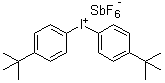 |
| Molecular Formula | C20H26I.SbF6 |
| Molecular Weight | 629.08 |
| CAS Registry Number | 61358-23-4 |
| EC Number | 638-799-9 |
| SMILES | CC(C)(C)C1=CC=C(C=C1)[I+]C2=CC=C(C=C2)C(C)(C)C.F[Sb-](F)(F)(F)(F)F |
| Hazard Symbols |   GHS07;GHS09 Warning Details GHS07;GHS09 Warning Details | ||||||||||||||||
|---|---|---|---|---|---|---|---|---|---|---|---|---|---|---|---|---|---|
| Risk Statements | H302-H332-H411 Details | ||||||||||||||||
| Safety Statements | P261-P264-P270-P271-P273-P301+P317-P304+P340-P317-P330-P391-P501 Details | ||||||||||||||||
| Hazard Classification | |||||||||||||||||
| |||||||||||||||||
| SDS | Available | ||||||||||||||||
 chemBlink Chemical Story
|
Bis(4-tert-butylphenyl)iodonium hexafluoroantimonate is an organoiodine compound widely used in photoinitiator systems, particularly in the production of advanced polymer materials and coatings. This iodonium salt plays a key role in cationic polymerization processes, where it generates reactive cations upon exposure to UV light, initiating polymerization reactions in various industrial applications. The discovery of bis(4-tert-butylphenyl)iodonium hexafluoroantimonate is tied to the broader development of iodonium salts as photoinitiators, which began in the mid-20th century. Early research into photoinitiation focused on exploring ways to harness UV light to drive chemical reactions, leading to the identification of iodonium salts as effective agents for initiating cationic polymerization. The introduction of the hexafluoroantimonate anion further enhanced the reactivity and stability of these salts, making them highly efficient in polymerization systems. Bis(4-tert-butylphenyl)iodonium hexafluoroantimonate has a structure characterized by two tert-butyl-substituted phenyl groups attached to an iodine atom, with the hexafluoroantimonate acting as a counterion. This combination of substituents provides the compound with excellent solubility in various organic solvents and resins, making it a versatile photoinitiator in a wide range of applications. One of the primary uses of bis(4-tert-butylphenyl)iodonium hexafluoroantimonate is in the formulation of UV-curable coatings and adhesives. In these applications, the compound is incorporated into a mixture of monomers and oligomers that, when exposed to UV light, undergo rapid polymerization to form solid materials. This process is highly valued in industries requiring fast curing times, such as electronics, automotive, and packaging. The compound’s ability to initiate cationic polymerization allows for the curing of epoxies, vinyl ethers, and other monomers, producing durable and stable coatings with excellent adhesion, chemical resistance, and mechanical properties. In the realm of 3D printing, bis(4-tert-butylphenyl)iodonium hexafluoroantimonate plays a crucial role in stereolithography (SLA) processes. These processes rely on photopolymerization to create precise, high-resolution structures layer by layer. The compound’s efficient photoinitiating properties ensure that the polymerization occurs accurately and consistently, leading to the production of intricate 3D structures used in prototyping, medical devices, and high-tech manufacturing. Research has also explored the use of bis(4-tert-butylphenyl)iodonium hexafluoroantimonate in the development of advanced photoresist materials. Photoresists are essential in the semiconductor industry for lithography, where precise patterns are transferred onto silicon wafers. The compound’s ability to initiate cationic polymerization under UV light exposure makes it an ideal component for creating fine patterns required in microelectronics. As with many photoinitiators, the efficiency and performance of bis(4-tert-butylphenyl)iodonium hexafluoroantimonate depend on the specific formulation and the application conditions. Factors such as light intensity, wavelength, and the nature of the monomers or oligomers being polymerized all influence the effectiveness of the compound in initiating polymerization. Therefore, ongoing research focuses on optimizing formulations to enhance the performance of this iodonium salt across various industries. Despite its many advantages, bis(4-tert-butylphenyl)iodonium hexafluoroantimonate presents challenges related to safety and environmental impact. Iodonium salts can be sensitive to heat, light, and moisture, necessitating careful handling and storage. Additionally, the environmental concerns surrounding the use of antimony-based compounds have prompted efforts to explore alternative anions and more sustainable photoinitiator systems. Researchers are investigating greener alternatives to minimize the ecological footprint of these compounds without compromising their effectiveness. References 1998. Radiation Curing and Unsaturated Polyesters Finishes Curing Through Unsaturation. *Introduction to Paint Chemistry and Principles of Paint Technology*. DOI: 10.1007/978-1-4899-3180-1_16 |
| Market Analysis Reports |