
Online Database of Chemicals from Around the World
| Simagchem Corporation | China | |||
|---|---|---|---|---|
 | www.simagchem.com | |||
 | +86 13806087780 | |||
 | +86 (592) 268-0237 | |||
 | sale@simagchem.com | |||
| Chemical manufacturer since 2002 | ||||
| chemBlink Standard supplier since 2008 | ||||
| Tianjin Zhongxin Chem-tech Co., Ltd. | China | |||
|---|---|---|---|---|
| www.tjzxchem.com | |||
| +86 (22) 6688-0623 | |||
| +86 (22) 8988-0739 ex 8030 | |||
| sales@tjzxchem.com | |||
| Chemical manufacturer since 2007 | ||||
| chemBlink Standard supplier since 2009 | ||||
| Anhui Royal Chemical Co., Ltd. | China | |||
|---|---|---|---|---|
| www.royal-chem.com | |||
| +86 (25) 8663-9253 | |||
| +86 (25) 5227-9193 | |||
| zoey.zhao@royal-chem.com | |||
| Chemical manufacturer since 2008 | ||||
| chemBlink Standard supplier since 2019 | ||||
| Classification | Organic raw materials >> Aryl compounds >> Anilines |
|---|---|
| Name | N-Benzyl-N-methylaniline |
| Molecular Structure | 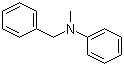 |
| Molecular Formula | C14H15N |
| Molecular Weight | 197.28 |
| CAS Registry Number | 614-30-2 |
| EC Number | 210-375-4 |
| SMILES | CN(CC1=CC=CC=C1)C2=CC=CC=C2 |
| Solubility | 11.25 mg/L (25 °C water) |
|---|---|
| Density | 1.0±0.1 g/cm3, Calc.* |
| Index of Refraction | 1.608, Calc.* |
| Melting point | 60.53 °C |
| Boiling Point | 316.2±21.0 °C (760 mmHg), Calc.*, 299.77 °C |
| Flash Point | 128.8±15.0 °C, Calc.* |
| * | Calculated using Advanced Chemistry Development (ACD/Labs) Software. |
| Hazard Symbols |  GHS07 Warning Details GHS07 Warning Details |
|---|---|
| Risk Statements | H315-H319-H335 Details |
| Safety Statements | P261-P305+P351+P338 Details |
| SDS | Available |
 chemBlink Chemical Story
|
N-Benzyl-N-methylaniline is an organic compound with the chemical formula C14H15N. It belongs to the class of substituted anilines, where a benzyl group (C6H5CH2) and a methyl group (CH3) are attached to the nitrogen atom of an aniline structure. This modification provides the compound with unique chemical properties that have been utilized in various industries, especially in organic synthesis. The discovery of N-Benzyl-N-methylaniline dates back to the early 20th century when organic chemists were exploring the synthesis and properties of aniline derivatives. Researchers found that introducing different substituents to the aniline nitrogen resulted in compounds with diverse reactivities and applications. N-Benzyl-N-methylaniline was synthesized as part of this exploration, and its potential as a versatile reagent in organic chemistry soon became apparent. One of the primary applications of N-Benzyl-N-methylaniline is in the field of organic synthesis, where it is used as a precursor for more complex molecules. The benzyl and methyl groups attached to the nitrogen provide the compound with enhanced stability and reactivity, allowing it to participate in various chemical reactions such as alkylation and condensation processes. This makes it a valuable intermediate in the synthesis of pharmaceuticals, agrochemicals, and fine chemicals. Its role as a building block in creating more specialized molecules underscores its importance in the chemical industry. In addition to its role in synthesis, N-Benzyl-N-methylaniline has found applications in the production of dyes and pigments. The presence of the benzyl group allows for the introduction of chromophores and other functional groups, making it a useful starting material for creating colorants used in textiles, plastics, and other materials. The chemical stability of N-Benzyl-N-methylaniline helps ensure that the resulting dyes are durable and long-lasting, which is crucial for industrial applications. N-Benzyl-N-methylaniline has also been explored for use in the development of novel materials, particularly in the creation of polymers. It can be incorporated into polymer backbones, contributing to the modification of polymer properties such as flexibility, solubility, and resistance to environmental factors. This versatility in material design highlights the compound’s potential in advanced materials science, where tailored chemical structures are needed to meet specific application requirements. In terms of safety and handling, N-Benzyl-N-methylaniline is a potentially hazardous substance, particularly if inhaled, ingested, or absorbed through the skin. It should be handled with appropriate protective equipment, including gloves and goggles, in well-ventilated areas. Proper storage and disposal procedures are also essential to minimize environmental and health risks. Overall, N-Benzyl-N-methylaniline is a significant compound in the realm of organic chemistry, with valuable applications in synthesis, materials science, and the dye industry. Its discovery and development have paved the way for innovations in several fields, demonstrating the ongoing importance of aniline derivatives in modern chemical research and industry. References 2021. C-H Bond Functionalization of Amines: A Graphical Overview of Diverse Methods. *SynOpen*, 5(3). DOI: 10.1055/s-0040-1706051 2015. N-Methylation of Aromatic Amines and N-Heterocycles under Acidic Conditions with the TTT (1,3,5-Trioxane-Triethylsilane-Trifluoroacetic Acid) System. *Synthesis*, 47(16). DOI: 10.1055/s-0034-1381049 2016. Efficient and Selective N-Alkylation of Amines with Alcohols Catalysed by Manganese Pincer Complexes. *Nature Communications*, 7. DOI: 10.1038/ncomms12641 |
| Market Analysis Reports |