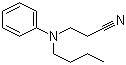
3-(Butylphenylamino)propiononitrile is an organic compound that belongs to the class of substituted anilines, characterized by a phenyl group attached to a butylamine chain. Its chemical structure consists of a propiononitrile group linked to a butyl-substituted phenylamine moiety. This compound is primarily used as an intermediate in organic synthesis, playing a critical role in the production of other complex molecules, particularly in the fields of pharmaceuticals and agrochemicals.
The discovery of compounds like 3-(butylphenylamino)propiononitrile is rooted in the development of aromatic amines and nitriles as key building blocks for organic chemistry. Aniline derivatives, in particular, have been studied since the 19th century due to their broad reactivity and utility in synthetic processes. Advances in nitrile chemistry, which enabled the coupling of nitrile groups with various organic fragments, allowed the formation of compounds like 3-(butylphenylamino)propiononitrile. This synthesis was facilitated by progress in catalysis and the availability of specialized reagents.
In terms of applications, 3-(butylphenylamino)propiononitrile is primarily used as an intermediate in the synthesis of more complex organic compounds. In the pharmaceutical industry, it is employed to develop biologically active molecules, particularly in the preparation of candidate drugs that exhibit activity related to cancer treatment, inflammation, or neurological disorders. The presence of both the aniline and nitrile functionalities in the structure allows for versatility in reaction mechanisms, making the compound useful in creating a variety of molecular frameworks.
In agrochemical research, 3-(butylphenylamino)propiononitrile can be used as a precursor to synthesize compounds with herbicidal or insecticidal properties. The reactivity of the nitrile group allows for further functionalization, enabling the creation of molecules that interact with biological systems to control pest populations or enhance plant growth.
Moreover, the compound has found use in the field of materials science. It is sometimes employed in the creation of specialty polymers or as a monomer in polymerization reactions where specific mechanical or thermal properties are required. By integrating 3-(butylphenylamino)propiononitrile into a polymer matrix, researchers can design materials with tailored characteristics for specific industrial applications, such as coatings, adhesives, or electronic materials.
Safety considerations are important when handling 3-(butylphenylamino)propiononitrile, as with many aromatic amines and nitrile-containing compounds. Proper protective equipment, including gloves and eyewear, should be used to avoid exposure, which can lead to skin irritation or other adverse health effects. Proper ventilation in workspaces is also essential to minimize the risk of inhalation or accidental exposure.
In conclusion, 3-(butylphenylamino)propiononitrile serves as a valuable intermediate in organic synthesis, with its applications spanning pharmaceuticals, agrochemicals, and materials science. Its unique chemical structure offers versatility in synthetic processes, enabling the development of a wide range of products.
|




 GHS07 Warning Details
 chemBlink Chemical Story