
Online Database of Chemicals from Around the World
| Hangzhou Leap Chem Co., Ltd. | China | |||
|---|---|---|---|---|
 | www.leapchem.com | |||
 | +86 (571) 8771-1850 | |||
 | market19@leapchem.com | |||
 | QQ Chat | |||
| Chemical manufacturer since 2006 | ||||
| chemBlink Standard supplier since 2015 | ||||
| Matrix Scientific Inc. | USA | |||
|---|---|---|---|---|
| www.matrixscientific.com | |||
| +1 (803) 788-9494 | |||
 | +1 (803) 788-9419 | |||
| sales@matrixscientific.com | |||
| Chemical manufacturer | ||||
| Classification | Chemical reagent >> Organic reagent >> Amine salt (ammonium salt) |
|---|---|
| Name | Dibutylamine monohydrochloride |
| Synonyms | Dibutylammonium chloride; N-Butyl-1-butanamine hydrochloride |
| Molecular Structure | 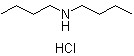 |
| Molecular Formula | C8H19N.HCl |
| Molecular Weight | 165.70 |
| CAS Registry Number | 6287-40-7 |
| EC Number | 228-521-0 |
| SMILES | CCCCNCCCC.Cl |
| Melting point | 284-286 °C* |
|---|---|
| * | Kundiger, Donald G. |
| Hazard Symbols |  GHS07 Warning Details GHS07 Warning Details | ||||||||||||||||||||||||||||||||||||
|---|---|---|---|---|---|---|---|---|---|---|---|---|---|---|---|---|---|---|---|---|---|---|---|---|---|---|---|---|---|---|---|---|---|---|---|---|---|
| Risk Statements | H302+H312+H332-H302-H312-H315-H319-H332 Details | ||||||||||||||||||||||||||||||||||||
| Safety Statements | P261-P264-P264+P265-P270-P271-P280-P301+P317-P302+P352-P304+P340-P305+P351+P338-P317-P319-P321-P330-P332+P317-P337+P317-P362+P364-P403+P233-P405-P501 Details | ||||||||||||||||||||||||||||||||||||
| Hazard Classification | |||||||||||||||||||||||||||||||||||||
| |||||||||||||||||||||||||||||||||||||
| SDS | Available | ||||||||||||||||||||||||||||||||||||
 chemBlink Chemical Story
|
Dibutylamine monohydrochloride is a chemical compound with the molecular formula C8H18ClN. It is the hydrochloride salt of dibutylamine, a tertiary amine characterized by the presence of two butyl groups attached to a nitrogen atom. This compound is typically encountered as a colorless to pale yellow liquid or crystalline solid and is soluble in water and alcohol. The discovery of dibutylamine monohydrochloride can be traced back to the late 19th century when chemists began exploring the synthesis and properties of various amines. Dibutylamine itself was first synthesized in the early 20th century through the reaction of butylamine with butyl halides. The formation of dibutylamine monohydrochloride involves the protonation of dibutylamine with hydrochloric acid, resulting in the formation of the stable salt. This process highlights the significance of amine chemistry in producing a variety of functional compounds used across multiple applications. Dibutylamine monohydrochloride is primarily used in organic synthesis as a reagent and catalyst. Its structure allows it to participate in various chemical reactions, including nucleophilic substitutions and acylations. In particular, dibutylamine derivatives are often employed in the synthesis of active pharmaceutical ingredients (APIs), where they serve as intermediates or building blocks for more complex molecules. The ability of dibutylamine monohydrochloride to function as a nucleophile and a base makes it a valuable component in medicinal chemistry. In addition to its pharmaceutical applications, dibutylamine monohydrochloride has been utilized in the production of surfactants and other industrial chemicals. Its surfactant properties enable it to act as an emulsifying agent, which is essential in formulations for personal care products, detergents, and coatings. By improving the stability and solubility of these formulations, dibutylamine monohydrochloride plays a crucial role in enhancing product performance. Research into the biological activities of dibutylamine derivatives has also revealed potential applications in the field of agrochemicals. Some studies suggest that certain dibutylamine derivatives exhibit herbicidal and pesticidal properties, making them of interest for developing environmentally friendly agricultural solutions. While specific research on dibutylamine monohydrochloride's biological effects is limited, its structural characteristics indicate that it may possess similar bioactive properties, warranting further investigation. Despite its utility, safety precautions are essential when handling dibutylamine monohydrochloride. As with many amines, it can pose health risks, including skin irritation and respiratory issues. Therefore, proper laboratory practices, including the use of personal protective equipment and adherence to safety protocols, are crucial to minimize exposure and ensure safe handling. In summary, dibutylamine monohydrochloride is an important chemical compound with a notable history of discovery and diverse applications in organic synthesis, pharmaceuticals, and industrial formulations. Its versatility as a reagent and its role in various chemical processes continue to make it a subject of interest in contemporary chemistry, highlighting its relevance across multiple fields. References 1987. Effect of butylated hydroxyanisole on in vitro and in vivo nitrosation of dibutylamine. Toxicology, 45(2). DOI: 10.1016/0300-483x(87)90011-4 2005. Solvent-free sampling with di-n-butylamine for monitoring of isocyanates in air. Journal of environmental monitoring : JEM, 7(2). DOI: 10.1039/b414761h 2015. Osage Orange (Maclura pomifera L.) Seed Oil Poly(alpha-hydroxydibutylamine) Triglycerides: Synthesis and Characterization. Journal of Agricultural and Food Chemistry, 63(35). DOI: 10.1021/acs.jafc.5b01625 |
| Market Analysis Reports |