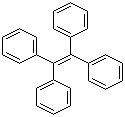
Tetraphenylethylene (TPE) is an organic compound with the molecular formula C26H20. It features a central ethylene (ethylene) core bonded to four phenyl rings. The compound, notable for its symmetrical structure and high degree of conjugation, has been extensively studied due to its unique physical and chemical properties, making it valuable in materials science and organic electronics.
The discovery of Tetraphenylethylene can be traced back to the exploration of polyphenyl ethylenes, which are derivatives of ethylene where phenyl groups replace hydrogen atoms. Researchers have investigated these compounds to understand their electronic properties and potential applications in various fields. TPE was synthesized to explore its role in photophysical processes and its potential for use in advanced materials.
One of the key applications of Tetraphenylethylene is in the field of organic light-emitting diodes (OLEDs). The compound’s high degree of conjugation enables efficient electronic transitions, making it suitable for use as a luminescent material in OLEDs. TPE can emit bright light when an electric current is passed through it, making it a valuable component in display technologies and lighting applications. Its high photoluminescence efficiency and stability under operational conditions contribute to the performance and longevity of OLED devices.
Tetraphenylethylene is also important in the development of organic semiconductors. Due to its extended π-conjugated system, TPE exhibits good charge transport properties. This makes it useful in the fabrication of organic thin-film transistors (OTFTs) and other electronic devices where efficient charge carrier mobility is essential. By incorporating TPE into these devices, researchers and engineers can enhance their performance and reliability.
In addition to its use in electronics, TPE has applications in materials science, particularly in the development of luminescent materials. The compound’s ability to form aggregates and exhibit aggregation-induced emission (AIE) is a notable feature. In solution, TPE typically exhibits weak fluorescence due to non-radiative decay. However, in the solid state or in certain environments, the compound shows strong fluorescence, which is useful for designing sensors and imaging agents. This property of AIE has led to the development of new types of fluorescent probes for biological and chemical sensing.
Furthermore, Tetraphenylethylene is employed in the synthesis of more complex organic compounds. Its reactive phenyl groups allow for various chemical modifications and coupling reactions, making it a versatile building block in organic synthesis. These modified derivatives can be used to create functionalized materials with specific electronic, optical, or chemical properties, expanding the range of applications in research and industry.
In summary, Tetraphenylethylene is a significant compound with diverse applications in organic electronics, materials science, and synthetic chemistry. Its discovery and subsequent utilization have paved the way for advancements in OLED technology, organic semiconductors, and luminescent materials. The unique properties of TPE, including its high conjugation and aggregation-induced emission, highlight its importance in both scientific research and practical applications.
|




 GHS07 Warning Details
 chemBlink Chemical Story